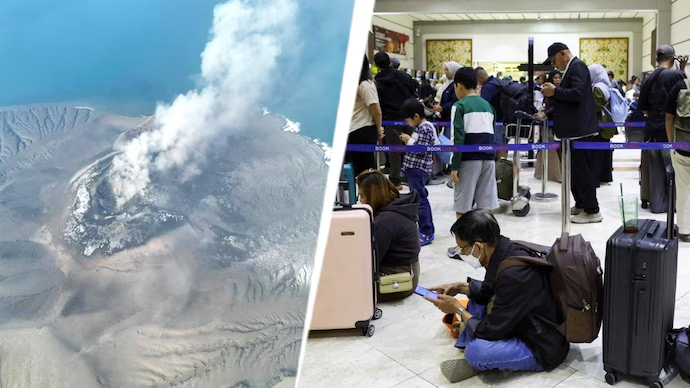
Operations at Indonesia’s primary gateway, Soekarno-Hatta International Airport, were halted on Sunday, September 6, 2026, after a plume of volcanic ash from Mount Anak Krakatoa drifted into the airspace surrounding the capital.
The shutdown has stranded over 22,000 passengers and affected hundreds of domestic and international flights across the region. The eruption began late Friday evening in the Sunda Strait, located more than 150 kilometers (93 miles) west of Jakarta.
By Saturday night and early Sunday morning, the volcano intensified, sending fountains of lava into the air, generating loud explosive blasts, and launching giant columns of ash up to 50,000 feet (15,000 meters) into the atmosphere. Diagnostic runway sweeps and airspace evaluations conducted near midnight confirmed dangerous levels of airborne particulate glass drifting over Java and Sumatra, prompting immediate safety interventions.
Airport authorities initially suspended operations at 1:30 AM local time on Sunday (18:30 GMT Saturday). Although initially planned as a brief operational pause, aviation authorities extended the closure several times throughout the day, stretching to 9:30 AM, 1:30 PM, and eventually 5:30 PM local time, as volcanic activity continued to surge.
“Safety remains the top priority in every operational decision, including flight schedule adjustments made by airlines,” said Lukman F. Laisa, Director General of Civil Aviation at Indonesia’s Ministry of Transportation. Laisa noted that microscopic volcanic ash presents catastrophic risks to jet engines and severely impairs cockpit visibility.
Transportation Minister Dudy Purwagandhi confirmed that the operational halt extended beyond Soekarno-Hatta, impacting multiple regional facilities. Closures were enacted at the Soekarno-Hatta International Airport (Tangerang, Banten / Greater Jakarta), the Halim Perdanakusuma Airport (Jakarta), Husein Sastranegara Airport (Bandung), Radin Inten II Airport and Budiarto Airport.
To manage diverted traffic, Minister Purwagandhi stated that regional hubs, including airports in Surabaya and Semarang, have been designated as alternative landing venues for inbound aircraft. More than 300 flights have been canceled, delayed, or rerouted. Regional carriers, including Garuda Indonesia, AirAsia, Singapore Airlines, and Malaysia Airlines, restructured schedules or grounded services along high-density corridors like Singapore-Jakarta, Kuala Lumpur, Sydney, Doha, and Seoul.
Despite the travel chaos, civil defense officials offered reassurance regarding coastal safety. Indonesia’s Disaster Mitigation Agency (BNPB) confirmed that while ashfall poses respiratory and eye hazards for local communities, the current eruption poses no immediate risk of a tsunami.