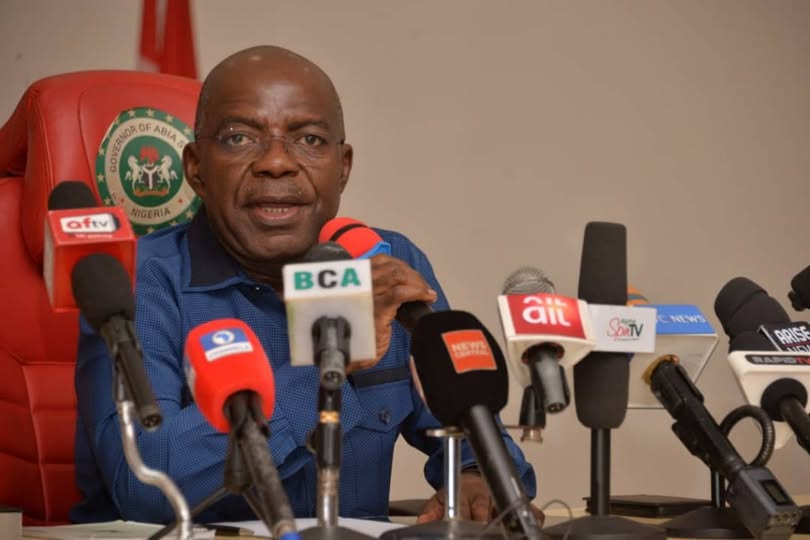
Abia State Governor, Alex Otti, has expressed strong confidence that he will complete a full eight-year tenure in office, insisting that the people of the state are discerning enough to sustain what he described as a growing wave of transformation.
The governor made the remarks on Tuesday at his office in Umuahia while hosting members of the Old Students Association of the Federal School of Arts and Science, Aba. The visiting alumni group had commended his administration’s efforts so far and voiced optimism that he would secure re-election in 2027 to consolidate ongoing projects across the state.
Responding to their show of support, Otti struck a measured but assured tone, making it clear that while politics remains inevitable, governance remains his priority.
“About 2027, we don’t let it distract us, but you have a point,” he said. “Primaries will happen within the month and then elections will be next year. But we know that Abia people are not stupid.”
The comment, delivered with a mix of candour and confidence, underscored his belief that voters in the state are increasingly focused on performance rather than political rhetoric. According to him, the electorate understands what is at stake and is unlikely to abandon policies and projects that are already yielding tangible results.
“They know what is good for them,” Otti added. “Because of that, we also know that it’s all about politics. And I’m not too sure that there is someone that would want to throw away what is good.”
Since assuming office, Otti has consistently framed his administration as one driven by reform and results, particularly in areas such as infrastructure renewal, public sector accountability, and economic revitalisation. His government has embarked on road rehabilitation projects in Aba and Umuahia, while also pursuing fiscal discipline measures aimed at improving the state’s financial health.
Supporters argue that these efforts have begun to reshape public perception of governance in Abia, a state that has long grappled with infrastructural decay and economic stagnation. Critics, however, caution that challenges remain, particularly in job creation and rural development, where expectations continue to rise.
The visit by the alumni association carried symbolic weight, reflecting a growing trend of civic groups and professional bodies engaging more directly with political leadership. Members of the delegation praised the governor’s leadership style and urged him to remain focused despite the mounting political activities ahead of the next election cycle.
Observers note that Otti’s remarks come at a time when political alignments and calculations are gradually intensifying ahead of 2027. While he did not directly address potential challengers, his comments suggest a strategy anchored on performance legitimacy rather than political maneuvering.
Political analysts say such confidence is not unusual for incumbents, but its sustainability will depend largely on the administration’s ability to maintain momentum and deliver visible improvements across key sectors.
For many residents, the conversation is less about political timelines and more about everyday realities, roads, jobs, security, and economic opportunities. In that sense, the governor’s assertion that governance will not be overshadowed by politics may resonate with a population eager for continuity in development.
As the political calendar inches forward, the coming months are expected to test both the strength of Otti’s reforms and the depth of public trust in his leadership. For now, however, the governor appears firmly focused on his agenda, confident that the people of Abia will ultimately decide in favour of continuity.