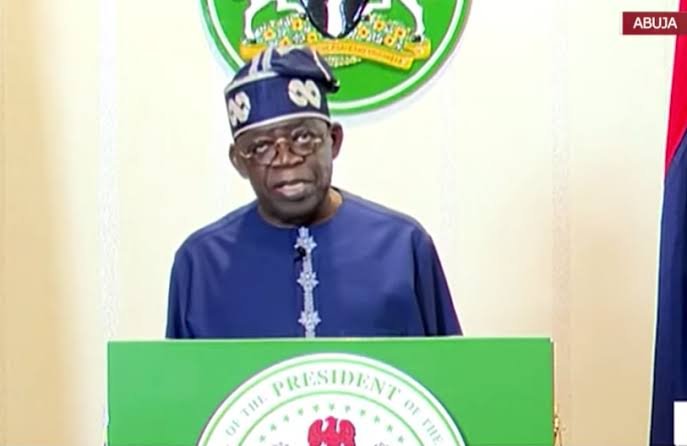
President Bola Tinubu did the unexpected last Wednesday. He attended the Nigerian Guild of Editors (NGE) Conference 2025. It was the very first for any Nigerian president. Quite absurdly, the watchdog, the Nigerian press, willingly moved into the tiger’s buba – the lair – for deliberation on its welfare. Ayinla Ade-Gaitor, the Iganna, Ìwájòwà LGA of Oyo State-born Apala musician of the 1970s/80s fame, equally wondered at this quixotic equation. My compatriots, can a tiger and a dog co-habit in the same lair? – “K’ájá ó dúró, k’ékùn ó dúró, ńjé yíó seé se, èyin alárá wa?” Ade-Gaitor asked in his melodious Iganna-flavoured voice.
But at the 21st NGE Annual Conference (ANEC) 2025 held in its lair – the Aso Rock State House Conference Centre in Abuja – the tiger and the dog became so giddy after clinking wine glasses, so much that they both shared titivating embraces. They had both been soused to their eyeballs. When it was time for the tiger to speak, clanking its incisors menacingly and magisterially, with recent blood dripping from its lips and caked blood stuck round its nose, this strange incest reminded me of Sir Kitoye Ajasa.
Ajasa (1866 – 1937) was a Nigerian lawyer from the Saro family migrants of Dahomey, present day Benin Republic, which had existed from 1600 to 1904. He studied at the Inner Temple Inn of Court and was called to the bar in 1893. Ajasa was similarly a legislator during the colonial period. He was however conservative, pacifist and a lackey of the colonial authorities. While the likes of Herbert Macaulay fell out with the British rulers over their insistence that British rule was self-serving and a little in the interest of the natives, Ajasa thought otherwise. He believed that national progress could only be made if Africans were subservient to and cloned European ideas and institutions. In pursuit of his grovelling to colonial authorities, Ajasa and others of his persuasion like J.K. Randle, Christopher Sapara Williams and Henry Carr, became apologists of the British government, believing that criticising it was counter-productive. Their reasoning was that, grovelling before white-haired, long-nosed, pink-skinned men who called themselves salvationists, was the guarantee for development.
To achieve this persuasion, Ajasa became a newspaper founder. Of course, his Nigerian Pioneer newspaper, founded in 1914, the year of Nigeria’s birth, invited so much reproach. He deliberately founded it as counterpoise to the radical Lagos Weekly Record newspaper of John Payne Jackson that was a thorn in the flesh of the colonialists. Ajasa’s brand of journalism frowned at anti-government polemics as other papers of the time did. In return, the people of Lagos extremely distrusted it. In 1923, Ajasa wrote that his newspaper “existed in order to interpret thoroughly and accurately the Government to the people and the people to the Government”. In fact, he was a known confidant of Sir Frederick Lugard, the colonial Governor-General, and the general belief was that the Lugard government funded his Nigerian Pioneer newspaper. In its stories and editorial comments, the newspaper provided staunch support for the colonial government’s measures and cynically attacked people and organisations that were thorns in the flesh of government.
The Weekly Record, unlike Ajasa’s, was uncompromising in its journalism crusade. It was so fierce that Governor-General Lugard was extremely irked by it, intensely sensitive to it and was irritated by Jackson’s journalism. The newspaper however stirred racial consciousness in the hearts of the colonised natives and in its leader of February 26, 1910, it wrote: “One cannot refrain from speculating upon the bankruptcy of the New Imperialism and the apparent decay of British Imperial genius, so long as Great Britain continues to transcend the limits of political righteousness; to harbour the colour prejudice (the logical outcome of the Americanization of England…) …; to legislate away the rights of her coloured subjects (as witness the South African Union Act); and to remain indifferent to the wishes of her subject dependencies.”
The Weekly Record newspaper however had a remarkably long existence, spanning forty years, that is, 1891–1930. After Jackson’s death in 1918, his son, Thomas Horatius Jackson, took over the running of the newspaper.
To demonstrate their opprobrium for Ajasa’s leaflet, the Nigerian Pioneer newspaper, the people scoffed at it on the newsstand. To Ajasa’s contemporaries, his lickspittling was bothersome. They could not fathom his boot-licking attitude and openly disdained his Nigerian Pioneer as “the guardian angel of an oligarchy of reactionaries”. Ajasa himself was subject of disdain as the people wondered how “any man in Lagos, African by birth, race and descent … should be so wholly devoid of race consciousness, and utterly oblivious of appreciation of the duties, obligations and responsibilities devolving on him.”
Ajasa’s newspaper itself became more or less the unofficial bulletin of the colonial government. It publicly mocked nationalists who fought for development and in a particular case, in the 1916 Lagos water rate protest against the colonial government, Ajasa labeled agitators like Macaulay ‘radicals.’ In 1921, with the help of Alimotu Pelewura, leader of Lagos Women’s Association, the powerful market women’s group, who at her death in 1951, was succeeded by Abibatu Mogaji, Macaulay again led a major protest on this agitation. It was part of a broader struggle against colonial policies which revolved round issues like taxation, land ownership and water rates. To Ajasa, the colonised natives must fully adopt European ideas and institutions as expressway to national progress.
Ajasa, in 1906, became an unofficial member of the Legislative Council. In 1914, he was made a member of Lugard’s Nigerian Council. He was later became a Judge of the High Court of Lagos, Officer of the Order of the British Empire and knighted as ‘Knight Bachelor’, becoming the first Nigerian to be so honoured by the British. He was in the Nigerian parliament till 1933 and shortly after 1937 when he died, the Nigerian Pioneer died.
So, when on Wednesday, President Tinubu urged the Nigerian media to “report boldly, but do so truthfully; critique government policy but do so with knowledge and fairness. Your aim must never be to tear down, but to help build a better society,” my mind told me that that fluid and racy speech was for the klieg. In actual fact, the president wanted Kitoye Ajasa-reincarnates for journalists, an Ajitóoba – phlegm-eater – media conscripts who would blind their eyes to government’s wobbly feet at national parade. Just as Kitoye Ajasa did for Frederick Lugard and the British colonial lords.
Since Lugard, the Kitoye Adisa-kind press had always been the preference of governments thereafter. Ever since the establishment of the Nigerian Daily Times on June 1, 1926 and even prior, the Nigeria press and Nigerians themselves had always been thirsty for adversarial journalism as a weapon of combating the colonial government. By 1937 when Nnamdi Azikiwe came with his West African Pilot and 1949 when the Nigerian Tribune came on board, ordinary Nigerians had begun to salivate for a press that would stand up to their self-serving colonial governments and native inheritors of their seats who jointly treated Nigerian people with disdain. Nigerian media’s treatment of news became binary: it was either they were for the people against government, or against the people, but in romance with government, like Kitoye Ajasa’s.
Since the Muhammadu Buhari government, the Nigerian media has operated under a very precarious situation. Its first blow was economic. As Eze Anaba, the editors’ president said, the Nigerian democracy, resilient through the ages, is currently under the bayonet of “insecurity, economic hardship, misinformation, and declining public trust in institutions, (as well as) government officials’ intolerance, sometimes, to freedom of the press.” The gravamen of Anaba’s speech can be found in his quip that “editors must therefore defend the sanctity of truth, insist on transparency, and hold power to account — not as adversaries of government, but as constructive partners in the pursuit of national progress.”
In what would look like a systematic but gradual decimation of the Nigerian press, governments have since 1999 corroded its powers. The ostensible aim is to ensure that the Nigerian press barks but bites seldom. For those who can recall, the battle to wean Nigeria of military rule was largely fought on the pages of its newspapers. The press literally yielded its space for democracy activists to make use of it for their campaign for democracy. In the process, many journalists were sacrificed. Many were jailed and maimed. Bagauda Kaltho of The News signposted the clan of journalists who paid the ultimate price, in anticipation of liberty for Nigerians today. The newspaper press was so formidable that both Generals Ibrahim Babangida and Sani Abacha had to roll out tanks to extinguish its irritating flame. At the end of the day, the Nigerian press was largely responsible for the rout of military rule in Nigeria and its replacement with civil rule.
In what would look like a systematic but gradual decimation of the Nigerian press, governments have since 1999 corroded its powers. The ostensible aim is to ensure that the Nigerian press barks but bites seldom. For those who can recall, the battle to wean Nigeria of military rule was largely fought on the pages of its newspapers. The press literally yielded its space for democracy activists to make use of it for their campaign for democracy. In the process, many journalists were sacrificed.
By 1999 when Nigeria returned power to civilians, the Nigerian newspaper press was still blistering. Its armaments were still potent and practitioners retained their energy which seemed to be bursting at its seams. Not long after the commencement of the Fourth Republic, the newspaper press made public examples of the carried-over rots of Nigeria’s governmental dysfunctionality. One after the other, even at a time when its tools were analogue, the press made mincemeat of public officers who, as it was later revealed, were evil doppelgängers of what they claimed to be in public. Salisu Buhari, the young Kano State legislator, who became Speaker of the House of Representatives, had his bubble burst. So also did Evan Enwerem. But for his street craftiness, the man who is the Nigerian president today would have been drowned by that hyper-ventilating press energy of the early 4th Republic.
The press of this period’s investigative acumen was top-notch and it could compete with any newspaper press anywhere in the world. My haunch is that, alarmed by the enormous power at its disposal and the system-purifying but dirty people-destroying powers within its grips, governments since 1999, either deliberately or otherwise, perfected plans to castrate the deadly watchdog of the Nigerian press. Today, they have made a huge success of this engagement. The success is such that, the wily politicians in agbada, babariga and Ishiagu can thump their individual chests that the battle to rid the Nigerian governance space of the irritancy of the Nigerian press, which the military, with their tanks and artillery, couldn’t achieve in decades, were effortlessly executed by them.