By Charles Obiajulu Ugwu – PhD
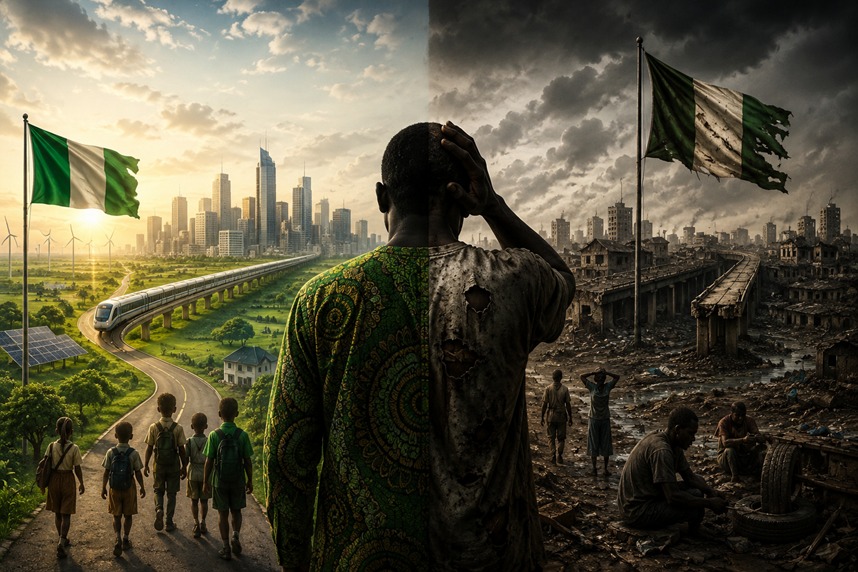
Nigeria does not have a government problem. It has a mirror problem, and the country keeps smashing the mirror instead of looking into it.
For decades, the national conversation has run on a single circuit: point at the government, indict the leadership, exhaust the outrage, repeat. It is the most comfortable ritual in Nigerian public life, because it costs the citizen nothing. It requires no guardrail left unstolen, no tax honestly paid, no truth told without inducement. It simply requires a finger, pointed outward, forever.
But strip the ritual away and look at what actually happens between elections. There is a particular kind of silence that follows a Nigerian bridge reopening. For a season, the railings gleam. The expansion joints sit flush. The streetlights hold their glass. Then, sometime before the second rainy season arrives, the railings are gone, sold by weight to a scrap dealer a few streets away.
When the Third Mainland Bridge in Lagos reopened after extensive government refurbishment, it took only weeks before vandals were caught stripping its newly installed road light indicators. The Second Niger Bridge, a national monument to long-delayed ambition, has not been spared either. Across the country, from the Lagos–Ibadan rail corridor to the Abuja–Kaduna line, from Kaduna to Kwara to Enugu, the pattern repeats with the fidelity of ritual: build, strip, repeat. And in every one of these moments, the actor is not the state. The actor is us.
It would be convenient to file this under insecurity, or poverty, or the failure of policing. Each explanation is partly true and none is sufficient. Poverty explains hunger. It does not explain why a man will dismantle the very guardrail that might one day save his own child from falling into a gutter, or pry the cover off a manhole that will, within days, swallow someone’s leg on a dark street he himself walks. What is being described here is not desperation behaving as desperation must. It is something closer to a civic reflex: the instinct to treat anything held in common as unclaimed, as belonging to no one and therefore available to anyone strong enough or quick enough to take it first.
This essay makes a case that is not comfortable: a far larger share of Nigeria’s stalled development is citizen-manufactured and citizen-sustained than the national conversation has ever been willing to admit. Not caused by poverty alone, not excused by weak institutions alone, but actively reproduced, day after day, by a culture that has learned to treat the commons as unclaimed and consequence as optional. Nigeria’s governance failures are real, well documented, and deserve every ounce of scrutiny they receive.
But that scrutiny has become the perfect alibi, a permission slip that lets an entire citizenry outsource its own character to the people it loves to blame. There is a second fracture running beneath the first, one that rarely gets named with the same rigor, and it deserves its moment in the light. It is the fracture of citizenship itself: the slow, almost invisible erosion of the everyday disciplines, honesties, and restraints without which no state, however well led, can build anything that lasts.
The Two Halves of a Broken Contract
Development is never delivered. It is co-produced. A government can build a road, but it cannot walk beside every citizen forever, forcing honesty at the checkpoint, insisting on truth in the marketplace, holding a hand back from the drain cover at midnight. At some point, the state must be able to trust that its citizens will do the ordinary right thing without a policeman standing over them. This is not a moral flourish. It is the actual mechanical basis on which any complex society scales.
Every nation now cited as a development miracle discovered this the hard way. South Korea in 1960 was among the poorest countries on earth, with a GDP per capita roughly comparable to Ghana’s at the time, its cities in rubble, its state apparatus thin and underfunded. What changed in the following two decades was not simply that the government in Seoul became wiser. It was that ordinary villagers, through a nationwide program known as Saemaul Undong, or the New Village Movement, were drawn into rebuilding their own roads, roofs, and irrigation channels as active participants rather than passive recipients of state largesse.
Scholars who have studied the movement closely have pushed back against the popular story that credits everything to a strong, directive state, showing instead that local leaders and communities became genuine co-authors of the transformation, taking ownership of shared infrastructure in a way that outlasted any single government program. The state supplied cement and coordination. The people supplied the discipline that made the cement mean something.
Neither half of that equation would have worked alone, and it is worth being honest that the movement had real costs too, including its uncomfortable entanglement with an authoritarian government that used it, in part, to entrench political control. But the civic mechanism it activated, the willingness of ordinary citizens to treat shared infrastructure as their own responsibility rather than the state’s problem, is the part worth studying, independent of the politics that surrounded it.
The Evidence in Plain Sight
The signs of the citizen-side fracture are not subtle. They do not require a research grant to observe; they require only open eyes.
Tax compliance in Nigeria remains a matter of extraction rather than covenant. Voluntary, honest disclosure is treated less as civic duty than as a trap for the unwary, something to be minimized, delayed, or evaded wherever the opportunity presents itself. Basic truth-telling, whether under oath, in a job reference, or in the account one gives a neighbor of what actually happened, is negotiable in ways that would astonish a visitor unfamiliar with how routine the negotiation has become. Civic participation, from voting to reporting a crime to showing up for jury-adjacent duties, tends to move only when it has been priced, whether through outright inducement or through some quieter form of coercion.
And then there is the infrastructure itself, patient and mute, absorbing the damage. Investigative reporting on Nigerian cities has documented, year after year, the same grim inventory: manhole covers vanishing by the hundreds annually in Lagos neighborhoods like Ikeja, Surulere, and Mushin; streetlights and bridge railings stripped along the Third Mainland and Eko Bridges; rail sleepers and armoured cables pulled from tracks stretching from Warri-Itakpe to the Eastern and Western rail districts; transformers stripped for copper; expansion joints on major bridges pried loose and sold as scrap.
In the Federal Capital Territory, the destruction became so brazen by January 2025 that the territorial administration declared what it called an all-out war on vandals, following the theft of manhole covers, solar lights, and flyover components across most of the city’s highways, often in open partnership with scrap markets known locally as panteka. Officials have publicly urged residents to take ownership of public infrastructure, an appeal that is itself a quiet admission of how far the sense of shared custodianship has eroded.
None of this is the work of a shadowy, external enemy. It is the work of Nigerians, harming Nigeria, for the price of scrap metal.
Why the Loop Closes on Both Sides
It would be a mistake to read any of this as exonerating the country’s leadership class. The two fractures are not competitors for blame; they feed each other in a closed loop that has proven remarkably durable. A citizenry that watches public funds disappear without consequence at the highest levels absorbs a lesson, whether consciously or not: that theft is simply the ordinary texture of public life, differing only in scale from level to level.
A state that habitually betrays the trust placed in it teaches its citizens, by example, that trust is a currency for the credulous. In this sense, the vandal at the manhole cover and the official who diverts a road-construction budget are not unrelated phenomena. They are expressions of the same underlying orientation toward the public good, operating at different altitudes.
But a loop only closes if both of its halves are acknowledged. It has become almost a reflex of contemporary Nigerian commentary to spend all available analytical energy indicting the political class while treating citizen conduct as an embarrassing footnote, mentioned briefly if at all before the conversation returns to its familiar and more comfortable target. This selective gaze is not analysis. It is a ritual that lets everyone leave the room without having to look too closely at their own hands.
What a Reset Actually Requires
None of this is unique to Nigeria in kind, only perhaps in the particular intensity and visibility of its expression. Every developing society wrestles with some version of the gap between what its people demand of the state and what they are willing to give back to the collective in return. But few countries display the gap as openly, or absorb its costs as repeatedly, as Nigeria currently does.
If there is a genuine reset available to the country, it will not be found solely in a new leader, a new party, or a new development plan, however well designed. Plans of that kind have arrived before, with fanfare, and departed largely unrealized, not only because implementation faltered at the top, but because the social soil they were planted in remained inhospitable. Pouring resources into infrastructure that will be stripped within two seasons, staffing institutions with citizens who will not pay what they owe or tell the truth they are asked for, is not reform. It is water poured into a field already governed by weeds, in the hope that something edible will somehow survive the competition.
The renegotiation Nigeria needs runs through its citizens as much as through its government. It asks something uncomfortable of ordinary people: that the commons be treated as an extension of the self rather than an unclaimed carcass; that honesty be practiced as an ordinary discipline rather than reserved for moments when a consequence is likely; that civic participation be offered rather than sold. None of this absolves the state of its own, larger obligations. But it insists that the state’s obligations are only half the equation, and that a country cannot indefinitely outsource its own character to the people meant to govern it.
The guardrail that vanishes two seasons after installation is not simply an engineering failure or a policing failure. It is the same mirror this essay opened with, small enough to hold in one hand, honest enough to show exactly what stands in front of it. No country has ever developed on the discipline of its government alone. Nigeria will not be the first. What the mirror reflects back is a question every Nigerian, not only every Nigerian leader, will eventually have to answer: what kind of custodianship are we actually prepared to practice, once no one is watching?
Charles is a contrarian thinker writing from Lagos