By Charles Obiajulu Ugwu- PhD
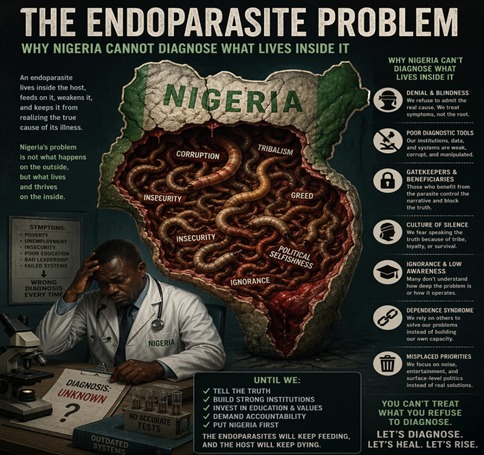
There is a proverb, encountered in various forms across West African oral tradition, that the creature consuming a plant from within is the hardest of all to find. It does not arrive visibly from outside. It does not announce itself against the foliage. It is of the plant, sustained by the plant, and over time, with the patience of long residence, it learns to wear the plant’s own colours. The camouflage is not incidental. It is the condition of survival.
Nigeria has had more than six decades to locate what is eating it from within. It has not done so. The more pressing question is no longer whether the parasite exists. It is why every successive attempt at diagnosis arrives after the damage, reads symptoms rather than causes, and delivers its findings as a postmortem on a government already spent and a population already exhausted.
Nigeria does not lack a diagnosis. It lacks a political settlement that would find the cure tolerable.
This is not a failure of intelligence, and it would be condescending to suggest otherwise. Nigeria has produced formidable analysts, rigorous commissions, and credible reform blueprints. The Pius Okigbo Panel of 1994 documented the Central Bank’s off-budget expenditure of nearly $12 billion under the Babangida administration with forensic precision. The Obasanjo-era anti-corruption institutions were designed by individuals who understood institutional theory. The reports exist. The diagnoses are not wrong. What fails, consistently, is not the capacity to see but the structural and political conditions that would make acting on what is seen rational for those with the power to act.
The failure is systemic and, in a specific sense, civilisational. The parasite has outlasted every reform effort not because it is stronger than the state but because the diagnostic apparatus itself is contaminated by the same conditions that produced the pathology. Three structural features account for this, and they deserve examination with some rigour.
The Institutionalisation of Deferred Accountability
Nigerian governance has evolved, across its civilian and military iterations, a shared syntax of reckoning after the fact. Transition committees, probe panels, and fact-finding tribunals have become ritualised instruments, not of correction, but of managed outrage. They are the political equivalent of a physician who writes detailed notes about a patient’s deterioration but never administers treatment, and who hands the notes to the next physician, who does the same.
When General Sani Abacha died in 1998, the transition to Obasanjo’s civilian administration produced investigations, confessions, and the eventual recovery of a portion of the billions looted from public coffers. Some of that money was returned by Swiss banks under international pressure; some was recovered through negotiated forfeitures by the Abacha family. What was not produced was a structural reform of the mechanisms that had made the looting possible. The Central Bank remained susceptible to executive discretion. The procurement architecture remained opaque. The judiciary remained accessible to the highest bidder. The investigation was genuine. The transformation was absent.
The same pattern reasserted itself under Jonathan, under Buhari, and with depressing consistency under Tinubu. Each incoming administration announces its seriousness about the sins of its predecessor. The Economic and Financial Crimes Commission, established in 2003 with genuine ambitions, has secured thousands of convictions over two decades while presiding over a public sector that the Transparency International Corruption Perceptions Index consistently ranks among the world’s most compromised. Activity is not the same as progress. Prosecutorial energy directed at mostly political opponents is not the same as systemic repair.
The pattern has a structural logic. In a system where political transition is the primary vehicle for wealth redistribution, the incoming administration has every incentive to prosecute its predecessors and every incentive to preserve the mechanisms of extraction for its own use. Accountability becomes a weapon rather than a principle. The postmortem industry flourishes precisely because it is useful to those who commission it, and threatening to no one who matters.
The Social Mechanics of Proximity and Complicity
The second structural feature is more intimate and, for that reason, more resistant to external pressure. The parasite mimics the foliage because, in Nigeria’s political ecology, it largely is the foliage. The individuals who administer state resources and those who extract them illegitimately are not distinct populations. They are, frequently, the same individuals operating in alternating registers, or they are bound by ties of kinship, community obligation, and patronage network to those who are.
Consider the logic as it operates at its most elementary level. A senior civil servant in the Ministry of Petroleum Resources belongs to a community that includes cousins who are contractors, uncles who are traditional title holders with expectations of patronage, a wife whose business interests intersect with the ministry’s procurement decisions, and a state governor from his home state who facilitated his appointment and will require reciprocation. None of these relationships are hidden. They are the texture of social life. They constitute, in Igbo terms, the very network of obligation that marks a man as a person of standing rather than a person of isolation.
This is the profoundest form of camouflage. The parasite does not need to hide because its host considers it family. The reform agenda, in this context, is not experienced as liberation from a burden. It is experienced as a demand to amputate oneself from one’s social body. Senior Nigerian executives who have spent time in international organisations frequently describe the cognitive dissonance of returning home: the pressure to demonstrate loyalty to kin and community through the selective application of institutional resources is not experienced as corruption. It is experienced as the minimum requirement of being a decent human being in a society where the state provides nothing and the family provides everything.
The Enron collapse in 2001 offered the world a glimpse of how institutional culture can be corrupted from within by a community of mutual enablement. Arthur Andersen, Enron’s auditor, was not simply negligent. It was structurally incapable of independence because the social and financial bonds between the two organisations had eroded the separation that audit requires. Nigeria’s challenge is analogous but an order of magnitude more pervasive. The entanglement is not between two organisations. It is between every institution of state and the social networks that predate, surround, and outlast any formal appointment.
The reform proposals that would genuinely relocate power, break patronage chains, and enforce institutional boundaries are identified, instinctively and correctly, as existential threats by precisely those with the authority to implement them. The parasite’s deepest camouflage is not ideological. It is relational.
The Epistemology of Performance
The third feature operates at the level of culture and cognition. Nigerian public life has produced a robust and highly sophisticated capacity to appear to address problems as a functional substitute for addressing them. This is not simple hypocrisy, though hypocrisy is part of it. It is something closer to a shared consensual fiction, maintained with remarkable discipline by all relevant parties.
Policy pronouncements, anti-corruption agencies, fiscal frameworks, national development plans, the National Economic Council, the Fiscal Responsibility Act, the Public Procurement Act of 2007, the Economic Recovery and Growth Plan, the Renewed Hope Agenda. These instruments are produced with genuine technical competence. The individuals who design them often have first-rate credentials from the world’s best institutions. The documents themselves would not embarrass a competent development economist at the World Bank. What they rarely survive is the implementation environment, which is governed by entirely different incentive structures from those the documents presuppose.
Rwanda offers an instructive contrast, not because it is a democracy but because it demonstrates what implementation discipline produces when a political leadership genuinely bears the cost of failure. Paul Kagame’s administration established the Imihigo performance contracts in 2006, binding district governors to measurable targets and publishing the results. The mechanism is not transferable wholesale to Nigeria’s federal structure. But the underlying logic, that leaders must personally absorb the reputational and professional consequences of institutional failure, is precisely what Nigerian governance arrangements are designed to prevent. The performance of accountability substitutes for accountability itself because no senior actor is genuinely exposed to the downside of failure.
The Dangote Cement operation offers a private-sector variation on the same insight. Aliko Dangote built an organisation that functions with a discipline rare in Nigerian institutional life not because he is immune to Nigeria’s ambient pressures but because he structured his organisation around personal accountability, clear performance measurement, and the genuine consequence of underperformance. The gap between the Dangote Group’s operational discipline and the operational reality of the Nigerian National Petroleum Company is not a gap in talent. Nigeria produces talented people in abundance. It is a gap in the architecture of consequence.
The epistemology of performance is self-reinforcing. When citizens observe repeatedly that announcements produce nothing, cynicism becomes rational. When civil society organisations observe that their reports are received ceremonially and ignored operationally, learned helplessness follows. When international partners observe that institutional reform produces new letterheads rather than new behaviour, aid conditionality becomes symbolic. The entire system learns to produce the signal of seriousness without the substance, and the gap between signal and substance ceases to be experienced as a failure. It becomes the normal operating condition.
The Shape of a Genuine Prognosis
The question that follows from this analysis is uncomfortable but necessary. If three structural features conspire to make diagnosis perpetually retrospective and remedy perpetually deferred, what would it take to break the cycle?
The answer is not a better report. Nigeria has enough reports. It is not a more committed anti-corruption czar. Nigeria has had several, and the institution invariably outlasts the commitment. It is not foreign pressure, though international frameworks such as the FATF grey-listing, which Nigeria has experienced, and the reputational cost of being classified a high-risk jurisdiction, create marginal incentives for compliance at the margins. None of these interventions address the structural features identified above.
What is required is, at minimum, the convergence of two conditions that Nigeria has not yet managed simultaneously. The first is a sufficient disruption of the patronage networks that make the status quo self-perpetuating, not by moral persuasion but by altering the cost-benefit calculus of those who maintain them. This means, concretely, the automation of state processes that currently require human discretion, the publication of beneficial ownership registries that make the concealment of extraction expensive, and the integration of Nigerian financial flows into international transparency frameworks with genuine enforcement teeth.
The second condition is the construction of institutional arrangements robust enough to survive the withdrawal of individual political will. Nigeria has seen genuine reformers. Ngozi Okonjo-Iweala’s tenure as Finance Minister produced measurable improvements in fiscal transparency. Those improvements were partially reversed after her departure, because they resided in her personal authority rather than in institutional architecture that would outlast any individual.
The first condition without the second produces interludes of reform that collapse when the reformer exits. The second without the first produces technically sophisticated institutions that are colonised and redirected within a single political cycle. Both conditions must be advanced together, and both require that a critical mass of Nigerian elites calculate that the existing arrangement costs them more than the alternative. That calculation has not yet been made at the necessary scale, and until it is, the postmortems will continue, each more sophisticated than the last, none of them followed by recovery.
The parasite survives not because it is strong but because the plant has not yet decided, at the level of its deepest political architecture, that expelling it is worth the convulsion.
There is, finally, a question of will that no structural analysis can entirely dissolve. Structures are made and unmade by human choice, including collective choice. Singapore in the 1960s was, by most objective measures, a less promising candidate for institutional transformation than Nigeria. It had no natural resources, a small population, ethnic tensions, and a colonial inheritance as compromised as Nigeria’s. What it had was a political leadership that internalised the cost of failure and a citizenry that, over time, came to hold that leadership to account. The contrast is not offered as a simple lesson. It is offered as evidence that the endoparasite problem is not fate.
What Nigeria requires is not a new administration with a better slogan, nor another transition committee with a sharper mandate. It requires the kind of structural self-examination that is, by definition, uncomfortable, because it locates the source of the damage not in the last government, not in colonial history, not in the machinations of foreign powers, but in the arrangements that Nigerians, and specifically Nigerian elites, have constructed, maintained, and protected because those arrangements have served them. The parasite, in the end, survives because it is not universally unwelcome. That is the diagnosis that no postmortem, so far, has been willing to write in full.
About the Author.
Charles is a contrarian thinker writing from Lagos