By Charles Obiajulu Ugwu
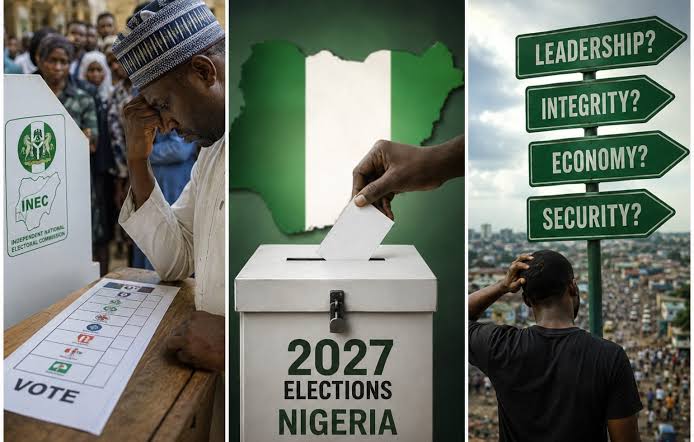
Never in the Fourth Republic has a sitting president looked so safe on paper, and never has an election felt so hard to read. Most of the governors are in his party. The federal purse is in his hands. His opponents spent the year quarrelling in public. And still the country walks towards 16 January with a restlessness that no tally of defections can explain. My argument is that the restlessness is sound. What Nigerians cannot read this time is not the result. It is the ground the contest is standing on.
The Old Suspense and the New
Nigerians know electoral suspense the way farmers know the rains: as something to be endured, argued over and, in the end, survived. In 1999 the question was whether the soldiers would really go back to the barracks. In 2015 it was whether a sitting president would accept defeat, and Goodluck Jonathan’s telephone call to Muhammadu Buhari settled it in a way the country still recalls with something close to pride. In 2023 it was whether a third force could break a two-party habit, and Peter Obi’s showing proved that the habit could be shaken, if not yet broken. Each time, the doubt was about the result. Everyone knew the rules, the referee and the players. Only the score was hidden.
This time the doubt has moved. Think of a wrestling festival in a village square. In a normal year the elders mark out the ring, the wrestlers are called by name, the drummers settle in, and the crowd argues happily about who will throw whom. Now picture a year in which the ring is redrawn after the wrestlers have already stepped inside it. The list of contenders changes from one market day to the next. Two or three of them are still standing before the elders, arguing about whether they are allowed to wrestle at all. And a party of visitors from a faraway country has taken up position at the edge of the square, announcing loudly that they are watching. The crowd that year is excited, but its excitement has an edge. People are no longer sure what kind of event they have come to see.
That edge is what the noise of this season is really about. Beneath the rallies, the defections and the daily brawl on social media sits a quieter unease, an uncertainty about conditions rather than outcomes. What follows tries to name its sources one at a time, then to look at the dangers we have grown too used to seeing, and finally to ask what all of it is actually for.
Rules Rewritten in Mid-Race
The first source of unease is the rulebook. On 13 February 2026, INEC published its notice of election under the 2022 Electoral Act and fixed the presidential poll for 20 February 2027. Five days later the President signed a new law, the Electoral Act 2026. Within two weeks the commission had pulled the presidential and National Assembly elections forward to 16 January, with governorship and state assembly polls on 6 February. There were sensible reasons, not least that the earlier dates fell inside Ramadan. The consequence is still striking. For the first time since 1999, Nigerians will choose a president in January, after a campaign that runs through Christmas, the year-end exodus to hometowns and the dust of the harmattan.
The calendar is the smaller part of the story. When the timetable changes after the race has begun, every runner learns that the rules are also up for grabs. Opposition leaders were calling the new Act anti-democratic within days of its signing. Their sharpest complaint concerned Section 60(3) and the electronic transmission of results. The Senate first threw out a clause making transmission mandatory, then reversed itself under public pressure. What survived is the arrangement the Speaker of the House has defended as a hybrid of electronic and manual transmission, on the grounds that patchy network coverage could otherwise shut out voters in places without signal.
There is a fair case for that. A country with dead zones the size of small European states cannot pretend that every polling unit has a reliable connection. But a sound design is not the same thing as public trust. Anyone who watched the results portal stall on the night of the 2023 presidential election hears the word hybrid and imagines a side door. INEC’s chairman, Professor Joash Amupitan, has promised a mock presidential election to test the system and insists the 2023 failures will not recur. He may be proved right. Trust, though, is rebuilt by experience rather than assurance, and the only experience that counts will arrive on the night itself. Until then the rules enter the contest as one more thing to fight over.
A Full House Is Not the Same as a Strong One
The second source of unease runs through the ruling party’s very strength. When the 2023 cycle closed, the APC held 21 states. In roughly a year, ten sitting governors crossed into it, and party officials now speak of about 31. The governors of Enugu, Bayelsa and Taraba have walked in with their structures. Osun’s governor, Ademola Adeleke, moved to the Accord Party and still endorsed the President, as has Anambra’s APGA government. Asked in May 2025 about the drift towards a one-party state, the President offered an image that stuck: nobody, he said, should blame people for jumping off a sinking ship when they have no life jackets.
Like most good political lines, it revealed more than it meant to. Some governors sincerely believe that a close partnership with Abuja will bring roads, money and projects home; Nasarawa’s Abdullahi Sule has credited the President’s reforms in exactly those terms. Still, defection in Nigeria is rarely a change of conviction. It is a reading of the weather: where the federal goodwill lies, where the investigators are not looking, whose name is likely to appear on the next list of appointments. One columnist pushed the point further, arguing that Nigeria is not drifting towards a one-party state at all, because it has already become a one-man state in which the formal institutions barely restrain the will at the centre.
The paradox is that each new arrival tells us a little less. A governor’s endorsement brings machinery: ward chairmen, vehicles, local favours, people who know how to turn out a crowd. It does not bring the vote of a household that has watched the price of a bag of rice outrun its income since the fuel subsidy went and the naira was set loose. Investors and many economists have praised those reforms. The families who paid for them have been less generous. January will be the first presidential test of whether an elite consensus can outvote a mass discomfort, and nobody honestly knows the answer. A crowded tent can mean the host is strong. It can also mean that everyone has run in from the same storm.
An Opposition Still Looking for Its Name
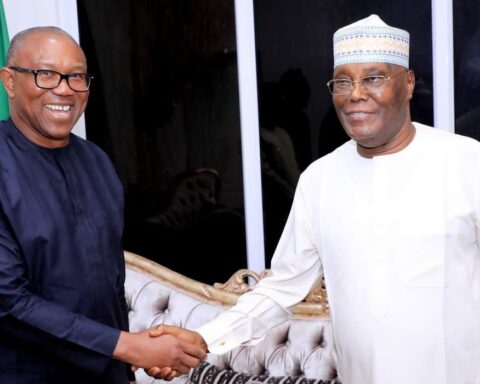
If the ruling party’s difficulty is a fullness that conceals, the opposition’s is a fragmentation that confuses. In July 2025, Atiku Abubakar, Peter Obi, Nasir El-Rufai and others adopted the African Democratic Congress as their coalition platform. On paper the sums were irresistible: in 2023, Atiku and Obi together drew more than thirteen million votes, against the winner’s 8.8 million. Arithmetic, however, has never been the opposition’s problem. Ego and sequence have. Within a year, Obi and Rabiu Kwankwaso had walked out to the Nigeria Democratic Congress, reportedly because Atiku would not stand aside. Later a faction of the ADC itself told Atiku to stop presenting himself as its candidate.
The field that has emerged is crowded and strange. Atiku runs on the ADC with Rotimi Amaechi as his running mate, after a primary whose outcome Amaechi had at first rejected. Obi runs on the NDC with Kwankwaso beside him. Oyo’s governor, Seyi Makinde, carries the flag of the Allied Peoples Movement. A faction of the PDP named Goodluck Jonathan its candidate in absentia, without a public word of acceptance from him at the time. INEC has listed eighteen presidential candidates. As this essay goes to press, opposition parties are preparing to sign a Covenant for Democratic Renewal on 23 November, still searching for a single challenger less than two months before polling day.
So the real question is not who leads the opposition. It is whether an opposition, in the singular, exists. The January ballot may carry several names that each claim to be the alternative, each rooted in a different region, each nursing a different grievance. A voter who wants change will find not one exit but several, all clearly marked, and no sign telling her which of them actually opens onto the street.
Rotation, Now in Writing
The fourth source is quieter, and it may prove the most consequential. Nigeria’s presidency has long moved between North and South by convention, an unwritten understanding enforced by party zoning and elite memory. In this cycle the convention has been put on paper. Kwankwaso has confirmed that he and Obi signed an agreement under which Obi would serve a single term, from 2027 to 2031, after which power would return to the North.
Supporters say a written pact is more honest than the whispered deals of the past, and they have a point. But a contract changes the meaning of a vote. A Northern voter weighing the NDC ticket is not only choosing a president for 2027; she is buying an option on 2031. A Southern voter is being asked to accept a presidency with an expiry date stamped on it before it begins. Atiku, who has signalled that this is probably his last attempt, offers the North something different: take the presidency now rather than wait four years for a promise to mature. The incumbent, for his part, seeks the second term that much Southern opinion regards as his due under rotation.
The effect is that 2027 is two elections folded into one. Every serious candidacy carries an implied answer to the succession question of 2031, and voters in every region are calculating not just for the next four years but for the eight after. Uncertainty compounds when a single ballot has to settle two horizons at once.
The North in Play
For most of the Fourth Republic, the North behaved in presidential contests like a bloc that could be won wholesale by the right alliance. It supplied nearly two-thirds of President Tinubu’s votes in 2023 and holds more than 54 million registered voters across nineteen states. In 2027 it has become something else: a region every serious candidate must split rather than sweep.
Insecurity is what loosened it. Banditry in the North-West, insurgency in the North-East and the land wars of the North-Central have turned rural life into a daily exercise in risk management. One report widely carried this year put kidnappings at 2.2 million in a single year, with ransoms of about N2.2 trillion. Not every figure in such reports survives scrutiny, but the lived experience behind them is not seriously disputed. Picture a farmer in Zamfara who sold his cattle last dry season to buy back his son. He is unlikely to vote on the strength of his governor’s endorsement.
The ruling party knows this. Its national chairman has predicted that the North will give the President more than seventy per cent of its votes, yet Vice President Kashim Shettima, opening a northern campaign office, cautioned that the region’s support was not a blank cheque. The President has reportedly weighed taking his campaign to all thirty-six states. The opposition has built its tickets for the same terrain: Kwankwaso’s Kano base for Obi, Atiku’s own Northern pedigree for the ADC. In January every arithmetic will be tested in the North, and its voters have learned the value of being undecided.
When Faith Finds a Foreign Audience
The sixth source has no real precedent. In October 2025 the United States designated Nigeria a Country of Particular Concern for religious freedom. On 1 November 2025, President Donald Trump posted that he would send American forces into Nigeria “all guns blazing” unless the government did more to protect Christians. American lawmakers have since come on fact-finding visits, and the State Department has said it will watch the January vote closely and has warned of the risk of violence.
Religious balance has always been an electoral variable in Nigeria, but a domestic one, managed through ticket composition and regional bargaining. The Muslim-Muslim ticket of 2023 was a calculated risk in a home market. In 2027 the same ticket is being read in Washington. For much of the first half of 2026 there was open talk that the President might replace Shettima with a Northern Christian to soften that reading. In July the APC kept Shettima, which ended the speculation but not the argument.
The argument cuts both ways. The government rejects the genocide label, and many serious researchers describe violence that falls on Christians and Muslims alike, driven by land, climate, crime and thin rural policing. Some Nigerians nonetheless welcome American pressure as a check on a government they distrust. Others, of both faiths, resent it as interference that flattens a complicated tragedy into a story of one faith hunting another. A Vanguard columnist put the sovereign anxiety plainly: Nigeria’s choice of leader should be made in Abuja, not in Mar-a-Lago. Once a foreign capital becomes an imagined participant, the election’s uncertainty spills past the borders and into the country’s sense of who is really deciding.
The Last Stand of a Generation
The seventh source is generational. The President is seventy-four. Atiku, who first sought the presidency in 1993 and turns eighty this month, has suggested this is his final attempt. Jonathan’s name returned to the conversation more than a decade after he left office. Even Obi’s candidacy is framed as a single term. The cast, in large part, is the cast of 1999 taking its final bow.
What makes this unsettling rather than merely poignant is that no successor generation is visible inside the parties. Young Nigerians are the largest and most digitally restless part of the electorate, yet the main tickets are led by men who entered national politics before many of those voters were born. Nobody knows whether the energy that drove the youth vote of 2023 will return, transfer to someone new, or sink into cynicism. A generation that leaves the stage without having prepared its replacement leaves behind not a vacuum but a fog.
Ballots Decided in Courtrooms
The last source is legal. Nigerian elections have long ended in court; this one may begin there. In May a Federal High Court held that Jonathan was eligible to run, dismissing a suit which argued that his return would amount to a third presidential oath, and the dispute has since gone to the Court of Appeal. The PDP is split between rival leaderships issuing rival nominations. An ADC faction disputes Atiku’s standing. Any of these cases could mean that a name on the ballot today is not on it in January, or that a January victory is argued over for months on grounds of nomination rather than votes.
When the judiciary becomes an early participant instead of a late referee, uncertainty takes on a different texture. Voters must ask not only whom they prefer, but whose candidacy will still be standing when they reach the booth.
The Uncertainty of Conditions
Put these together and a pattern appears. Rules rewritten after the start. A ruling party whose fullness hides an untested premise. An opposition unable to settle on a name. A rotation pact that turns one vote into two. A North that now swings. A foreign audience for a domestic balance of faiths. A generation leaving without heirs. A ballot whose final shape rests partly with judges. None of these is a slogan, and none appears on a campaign poster. Together they explain why the season feels feverish even to those who fully expect the incumbent to win.
The usual language of electoral analysis is about who is ahead and by how much. That language does not reach far enough in 2027, because the deeper uncertainty concerns the conditions under which any outcome will be accepted. A disputed winner can be litigated; Nigeria has done it before and survived. A result reached under conditions that large parts of the country regard as illegitimate in advance is much harder to absorb. Victory can be announced by a returning officer. Legitimacy cannot.
The Volatilities We Prefer Not to See
Every election plan in Nigeria comes with a list of foreseeable risks, and most of them are dutifully recited at workshops. The real danger lies in risks we have either grown too used to or quietly decided not to look at. Several of them could, under the wrong pressure, swallow the whole process and everyone in it.
The first is time. Because the election has moved to January while the inauguration stays fixed at 29 May, the country will live through more than four months between the declaration of a winner and the oath of office. The gap has never been this wide. If the incumbent wins, petitions will run through that season while the losers’ supporters stew. If he loses, Nigeria will learn for the first time what a defeated president does with four months of full constitutional authority, command of the security services and a new budget year just beginning. In 2015 the gap between Jonathan’s defeat and Buhari’s swearing-in was two months, and it was managed by an unusually gracious loser. Grace is not a national institution, and no one should plan as though it were.
The second is violence that has already begun. The African Centre for Security, Governance and Development counted seventy physical election-related attacks across nineteen states and the FCT between January and late October, with twenty-seven deaths, and that was before formal campaigning had properly warmed up. On 13 November the President himself condemned the rise in political violence. A national peace pact has been signed, but Atiku and Makinde were absent from the signing. A peace accord that two of the principal contenders did not attend is a promise with gaps in it.
The third is hunger at the polling unit. Yiaga Africa has warned that economic hardship could drive vote buying, especially the trading of food for votes. When a family’s first question on a Saturday morning is whether there will be dinner, a bag of rice offered near the ballot box does not feel like an insult. It feels like a meal. Vote buying in a lean season is less a story about the cunning of the buyer than about the desperation of the seller, and it works best exactly where reform has hurt most.
The fourth is manufactured truth. INEC’s own chairman now lists AI-driven disinformation and foreign information manipulation among the gravest threats to the vote. Imagine a fabricated recording of a leading candidate conceding, or of a returning officer confessing to fraud, released at two in the morning while collation is still under way. It would travel across family WhatsApp groups faster than any correction INEC could issue, and in a country primed to suspect the worst, the correction might not be believed when it arrived.
The fifth is scale in an awkward season. INEC plans to deploy about 1.4 million ad hoc staff to more than 176,000 polling units, many of them young corps members posted far from home, moving sensitive materials through the harmattan and the year-end rush. Every logistical delay in Nigeria tends to be read as a political act. A late start in one zone and an early start in another can become a conspiracy theory before lunchtime.
The sixth is the regions the vote may not fully reach. Parts of the North-West and North-East remain places where voting is itself dangerous, and the question of which communities can and cannot vote quietly shapes the totals. In the South-East, Nnamdi Kanu was sentenced to life imprisonment in November 2025 on terrorism charges, years of sit-at-home enforcement have left their scars, and a son of the region is again on the ballot. Many in the South-East have condemned the violence done in separatism’s name. Even so, if Obi loses through a process his supporters believe was crooked, the old story of exclusion will not lack new tellers.
The seventh is the fragility of the principals themselves. The leading contenders are in their seventies and, in Atiku’s case, at eighty. Nobody wishes misfortune on anyone. But Nigeria has seen what follows when a candidate dies mid-process: in Kogi in 2015, Abubakar Audu died before the governorship result was declared, and the legal confusion that followed took a Supreme Court judgment to settle. Our succession rules have never been tested in a presidential contest. A system one sudden event away from improvising ought at least to admit it.
None of these risks is exotic. That is precisely the problem. Each is familiar enough to have stopped frightening us, and familiar dangers are the ones that arrive to find nobody prepared.
The Real Stakes No One Dares to Call by Name
Strip away the posters and ask a plain question: beyond the offices themselves, what is actually being contested? Look for an ideological line between the main formations and you will look in vain. Every manifesto promises security, jobs, electricity, a steadier naira and an end to corruption. No serious contender is running on a theory of the state that the others reject. The differences that matter are of region, faith, generation and temperament, and of who will be in the room when the money is shared.
The candidates’ own histories confirm it. Between them, Atiku, Obi, Kwankwaso and Amaechi have worn the colours of most of the parties that have mattered in the Fourth Republic. Nyesom Wike, a former PDP governor, now runs the federal capital for an APC president while still contesting the remains of his old party. Nasir El-Rufai, once among the ruling party’s fiercest defenders, is now among its fiercest critics. In such a system, parties are less like churches than like motor parks. You board the bus going your way and change vehicles when the route changes.
Alliances are temporary, and so are judgements. It has become ordinary to see a politician who once described a rival as unfit for office sitting beside him at a coalition summit, calling him a brother, or a governor who spent one season denouncing Abuja spending the next introducing its occupant as a visionary. Voters notice. What they learn is not that politicians lie, which they knew already, but that public judgement in Nigeria has a shelf life roughly as long as the next appointment cycle. That lesson does more lasting damage than any single scandal, because it teaches citizens to discount every word.
The herding towards the leading parties is not irrational. In a federation where the centre controls most of the money and all of the armed forces, and where losing can mean years of exclusion and sometimes an invitation from an anti-graft agency, standing outside the winning camp is expensive. Herds form when the plain is open and the predators are near. The trouble is that a political class which herds by instinct produces governments without opposition and oppositions without patience. And because the governorship elections fall only three weeks after the presidential vote, the herd will be watching January closely. Expect a second and faster stampede between 16 January and 6 February, as candidates and voters alike rush to stand beside whoever has just won.
What, then, is really at stake? Three things, I think, and almost nobody says them aloud. The first is the meaning of the vote. If enough of the political class has gathered in one place before polling day, the election risks becoming the ratification of a settlement rather than a choice between paths. The second is protection. In the private arithmetic of many politicians, being in or near federal power is the surest shield against investigation and the surest road to contracts, while losing is a kind of exposure. Elections fought on those terms carry a desperation that no manifesto explains. The third is the shape of 2031 and beyond: which region, which generation and which coalition will own the next settlement of the federation, and whether that settlement will be negotiated in public or only in the rooms where tickets are agreed.
There is a best case, and it deserves to be described plainly, because hope that is never described is easily dismissed. In the best case, the hybrid transmission system works well enough that losers can watch their defeat polling unit by polling unit and recognise it as real. The North’s new restlessness makes its votes count again and forces every candidate to court the region rather than assume it. The opposition, beaten or victorious, learns that fragmentation is fatal and begins to rebuild around ideas rather than men. Young voters return in numbers that remind the old guard its successors are watching. And whoever loses goes to court rather than to the streets, and accepts the verdict when it comes. None of this is fanciful. Each part of it has happened somewhere in Nigeria’s recent past.
The worst case is quieter than the headlines suggest. It need not be a dramatic collapse. It is a victory won on a low turnout, delivered more by machinery than by persuasion, amid a transmission dispute that leaves half the country convinced it was cheated; then a long interregnum in which grievances harden, a region telling itself once again that it has been shut out, foreign commentators pouring their own meanings into the result, and a political class closing ranks around the winner and calling it national unity. In that version everyone with a seat at the table survives. The only loser is the citizen who believed the vote decided anything.
That is the stake no one dares to name: whether the ballot in Nigeria remains an instrument of choice, or settles into a ritual that blesses arrangements already made. The wrestlers will step into the ring on 16 January whatever happens, and the elders will declare a winner. The question that matters belongs to the crowd as it walks home through the dust: did it watch a contest, or a performance staged for its benefit? A country can survive a disputed winner. It is far harder to survive a crowd that has stopped believing in the square.
About the Author
Charles is a contrarian thinker writing from Lagos