By Agbeze Ireke Kalu Onuma, AI-KO
Growing up, I saw the world through maps. Like other kids I had interest in football and music, but also spent hours staring at maps.
I would sit for hours, staring at the delicate veins of rivers, the jagged edges of mountains, the thin, trembling lines that divided one country from another. To me, a map was never just paper – it was a portal. It whispered of faraway places, of winds that smelled different, of cities that pulsed with stories I could only imagine.
From our small room – sometimes in Abiriba, sometimes in Aba, sometimes in Enugu – I traveled the world without moving an inch. My finger would glide across borders as if they were invitations, not barriers. I believed that maps were promises – that every line led somewhere, that every name meant something. I thought the world, like a map, was drawn with purpose.
But adulthood has a way of redrawing everything. The maps I once loved now fill me with unease. The lines that once thrilled me now look like scars – deep, uneven, and painful. I no longer see adventure; I see affliction. The borders no longer separate countries; they separate fates. What once looked like design now looks like…
When I look at a map of Nigeria today, I no longer see a country – I see a patient on life support. The rivers look like veins struggling to carry blood to dying organs. The cities are pressure points of pain. The borders are sutures holding together a body that refuses to heal. I study the map not as a dreamer anymore, but as a reluctant pathologist, tracing the contours of a nation’s slow decay.
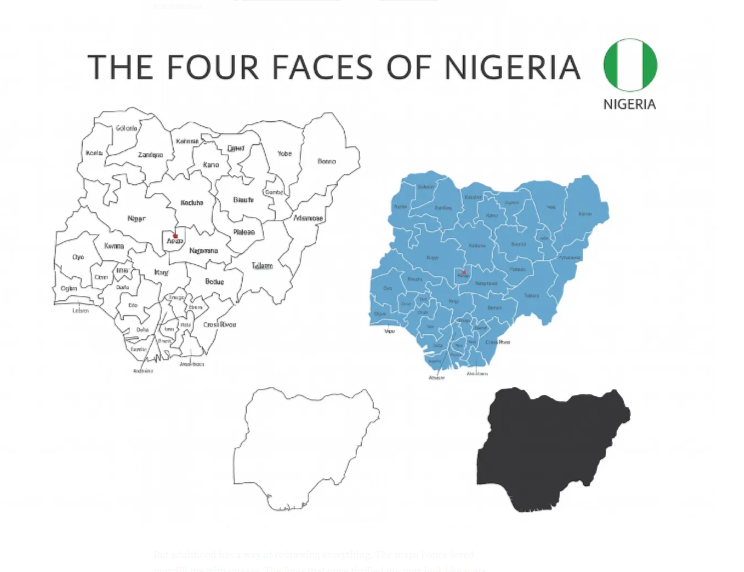
The four maps before me this morning – the Illusion, the Structure, the Void, and the Abyss – are not just cartographic variations. They are psychological states, political diagnoses, moral x-rays. Together, they tell the story of a country that has lost its compass, a people suspended between memory and madness.
So, let us not merely look at them. Let us interrogate them – line by line, truth by truth. Let us peel back the geography to expose the anatomy beneath. Because within those lines lie the stories we have buried, the lies we have rehearsed, and the dangerous trajectory we continue to ignore.
For in the end, every map is a confession – a record not just of where we are, but of what we have become.
MAP 1: THE NIGERIA OF “STRUCTURE” – The Labyrinth of Illusion
QUICK FACTS
Nigeria is officially divided into 36 states and the Federal Capital Territory (FCT). This structure was not the product of a single plan but of successive military decrees and political maneuvers. At independence in 1960, Nigeria had three regions (later four). In 1967, General Yakubu Gowon created 12 states to weaken secessionist movements during the civil war. Subsequent military governments expanded the number: 19 states in 1976, 21 in 1987, 30 in 1991, and finally 36 in 1996 under General Sani Abacha. Each round of state creation was driven less by neutral planning and more by political calculations – balancing ethnic demands, consolidating control, and fragmenting opposition.
The map we all know – that familiar outline of Nigeria divided neatly into 36 states and a federal capital – looks like a carefully built puzzle. On paper, it suggests order, deliberation, and governance. It appears to be the product of rational planning, a federation designed to balance diversity and deliver representation.
But beneath that neat geometry lies a story of control and illusion. Nigeria’s state boundaries are not neutral lines; they are political inscriptions, drawn and redrawn by military rulers responding to crises, demands, and ambitions.
At independence in 1960, Nigeria was divided into three regions – Northern, Eastern, and Western – later joined by a Mid-Western Region in 1963. This arrangement quickly proved inadequate for a country of hundreds of ethnic groups and competing political interests. In 1967, on the eve of civil war, General Yakubu Gowon dismantled the regional system and created 12 states, a move designed to weaken secessionist Biafra and assert federal control.
The puzzle expanded again in 1976 under General Murtala Muhammed, who raised the number to 19 states, claiming to bring governance closer to the people. In 1987, General Ibrahim Babangida added two more states, then 11 more in 1991, bringing the total to 30. Finally, in 1996, General Sani Abacha carved out six additional states, fixing the number at 36 plus the Federal Capital Territory of Abuja.
Each act of state creation was framed as reform, but in practice it was often a tool of political engineering – a way to fragment opposition, appease ethnic constituencies, and consolidate central power. The neat divisions on the map conceal messy realities: overlapping identities, contested boundaries, and communities split across artificial lines.
Thus, the map is not just geography; it is politics drawn in ink. It is a labyrinth of illusion, where the appearance of structure masks the deeper story of manipulation. The lines promise representation, but they also perpetuate division. They suggest stability, but they were born of crisis. They look deliberate, but they are the residue of improvisation.
Nigeria’s map, then, is both symbol and symptom: a carefully curated image of federal order, and a reminder that what looks like structure can also be the architecture of illusion.
THE OFFICIAL STORY
QUICK FACTS
Nigeria’s political “structure” refers to its 36 states and the Federal Capital Territory, each with constitutionally guaranteed allocations and representation.
• The Federation Account Allocation Committee (FAAC) meets monthly to distribute revenue from oil, VAT, customs duties, and other sources among the federal, state, and local governments. In 2025, FAAC disbursements average ₦1.5 – ₦2 trillion monthly, with states heavily dependent on these transfers.
• Resource sharing is often criticized as unfair: oil-producing states demand more derivation funds, while non-oil states rely almost entirely on FAAC.
• Governors are frequently accused of treating allocations as personal estates, with weak accountability and limited transparency. Civil society groups note that citizens are most visible during elections, but less considered in governance afterward.
This is the Nigeria that politicians invoke when they speak of “the structure.” To them, it is sacred – the foundation that justifies everything: the way oil wealth is shared, the way power rotates, the way every debate about who rules next is framed.
On paper, the structure looks neat: 36 states and a federal capital, each entitled to its slice of the national pie. In practice, it is a system sustained by ritual. Every month, the Federation Account Allocation Committee (FAAC) gathers in Abuja to divide revenue – oil proceeds, VAT, customs duties – into federal, state, and local shares. In 2025, these disbursements average ₦1.5 – ₦2 trillion monthly, lifelines without which most states could not survive.
The Federation Account, the lifeblood of the system, is funded overwhelmingly by oil wealth and taxes collected from the South. Lagos, Port Harcourt, and the Niger Delta provide the bulk of VAT, customs duties, and petroleum revenues. Yet these funds are pooled and shared monthly at the Federation Account Allocation Committee (FAAC), where every state – regardless of contribution – receives its slice.
Here lies the contradiction. In much of the North, governments enforce sharia law, banning alcohol and punishing those who trade in it. Yet VAT from alcohol sales in Lagos or Port Harcourt flows into the federation account, and northern states gladly collect their share. The moral posturing of prohibition is subsidized by the very revenues it condemns.
Minerals tell another story. Nigeria is rich in gold, lead, zinc, and other solid minerals, much of it concentrated in the North. But according to government audits, over 80% of mining is informal or illegal, controlled by cabals and armed groups. Only a fraction – sometimes estimated at less than 1% of proceeds – reaches the federation account. The rest fuels smuggling networks, insecurity, and private fortunes. The map shows boundaries, but in reality, it is riddled with shadow economies.
So what is this structure? A federation, or a loose and conflicted union held together by convenience? The South provides the bulk of funds; the North depends on them while restricting or criminalizing the very goods that generate them. The minerals that could diversify the economy are siphoned off into private hands.
The map tells a deeper, darker story – one of lies and deception. It is not a puzzle of unity but a ledger of dependence. The North needs the South for revenue; the South is bound to the North by obligation. What we owe each other is not solidarity but a bondage of convenience, a federation in name but a contradiction in practice.
But the ritual conceals imbalance. Oil-producing states argue for greater derivation, while non-oil states cling to FAAC as their only oxygen. Governors, entrusted with stewardship, often behave more like landlords than leaders, treating allocations as rents to be dispensed rather than investments to be managed. Transparency is thin, accountability thinner.
For ordinary Nigerians, the structure is less a foundation than a cage. Citizens are reduced to numbers – counted during elections, when their votes are needed, then forgotten in the long stretches between. The spreadsheets of FAAC record figures, not faces; percentages, not people.
Thus, the “structure” is both symbol and system: a map of divisions that sustains political bargaining, a monthly ritual that keeps the machinery alive, and a narrative that politicians defend as untouchable. It is Nigeria as arithmetic, where governance is measured in allocations, and the people themselves are too often lost in the sum.
THE REALITY BEHIND THE LINES
QUICK FACTS
Nigeria’s official map shows 36 states and the Federal Capital Territory, but boundaries often fail to reflect lived realities.
• In Illela, Sokoto State, the armed group known as the Lakurawa operates across Nigeria – Niger borders. They are linked to the Islamic State Sahel Province, enforcing their own rules, taxing communities, and clashing with vigilantes.
• In the Lake Chad Basin, borders between Nigeria, Niger, Chad, and Cameroon are porous. Armed groups like ISWAP and Boko Haram dominate fishing and trade routes, taxing locals and fighting for control. In November 2025, clashes killed nearly 200 fighters, showing how militants, not governments, dictate order.
• The Federation Account Allocation Committee (FAAC) disburses trillions monthly to states, but most states remain dependent on Abuja. In March 2024, FAAC shared ₦2.33 trillion, with states receiving ₦366.95 billion.
The lines on Nigeria’s map are not truths; they are illusions. They exist in government offices, in budget spreadsheets, in the ritual of FAAC meetings where billions are divided. But in the daily lives of people, those lines dissolve.
In Illela, Sokoto State, near the Niger Republic border, the Lakurawa hold sway. They are not a government but an armed group, part vigilante, part tax collector, linked to the Islamic State Sahel Province. They impose their own rules, levy charges on communities, and clash with vigilantes and security forces. For residents, the border is not protection – it is commerce. As one local put it, “The border is just a suggestion for the poor and a business for the powerful.”
The illusion stretches to the Lake Chad Basin, where the map claims neat boundaries between Borno and Yobe, Nigeria and its neighbors. But for fishermen, the lake is no longer theirs. It belongs to armed groups like ISWAP, who tax catches, control smuggling routes, and enforce their own order. In November 2025, Boko Haram ambushed ISWAP on Lake Chad’s islands, killing nearly 200 fighters in a turf war over waterways and trade. The government’s map was irrelevant; the militants’ map was the one that mattered.
And what of the 36 states? On paper, they are centers of power. In reality, they are 36 bank accounts, fed monthly by Abuja. In March 2024, FAAC disbursed ₦2.33 trillion, with states receiving ₦366.95 billion. Governors depend on these transfers, often treating them as rents to be dispensed rather than investments to be managed. Citizens, meanwhile, remain invisible except during elections, when their numbers are tallied for votes.
The truth is stark: the boundaries do not protect anyone. They divide collective pain into smaller, more convenient pieces, making suffering easier to ignore. Nigeria’s map is a labyrinth of illusion – lines that promise governance but conceal fragility, allocations that sustain elites but abandon communities, borders that exist in ink but vanish in reality.
MAP 2: THE NIGERIA OF “OPTICS” – The BlueFacade
The map is a single, unbroken shade of blue – smooth, polished, and corporate. It looks less like a country and more like a logo: clean, confident, and ready for business. There are no jagged borders or messy divisions, just a calm surface that suggests unity, depth, and promise. On first glance, it feels reassuring – the kind of image you’d expect to see on the cover of an investment brochure or a diplomatic presentation slide.
The Official Story
This is the Nigeria of international conferences and glossy reports – the Nigeria that arrives polished and rehearsed at the G20, the World Economic Forum in Davos, and the African Union summits. It is the Nigeria that President Bola Ahmed Tinubu presents to investors and foreign dignitaries: “The Giant of Africa,” “Africa’s Largest Economy,” a nation “Open for Business.”
In this narrative, the blue stands for progress, reform, and opportunity. It is the color of PowerPoint slides and investor prospectuses, of carefully choreographed speeches and branded pavilions. It represents a vast, integrated market of over 220 million people, the largest population on the continent, and a GDP that still ranks Nigeria as Africa’s biggest economy despite its volatility. It is Nigeria as a brand, curated for global consumption, designed to reassure capital and seduce optimism.
The official story leans on numbers that dazzle:
A GDP of over $470 billion (2024 IMF estimate), larger than South Africa’s.
• A tech ecosystem valued at $5 billion, with Lagos hailed as “Africa’s Silicon Valley.”
• A startup scene that has produced unicorns like Flutterwave, Andela, and Interswitch, drawing venture capital from Silicon Valley and London.
• A market size that promises scale: 40% of West Africa’s population, a youthful median age of 18, and a diaspora remitting nearly $20 billion annually.
It is the Nigeria of reforms announced with fanfare: the removal of fuel subsidies in 2023, the floating of the naira, the push for digital transformation, and the rhetoric of “renewed hope.” It is the Nigeria that signs MOUs worth billions at international summits, promising railways, refineries, and renewable energy projects.
But beneath the sheen, the layers begin to show. The same subsidy removal that impressed investors triggered inflation that pushed food prices beyond the reach of millions. The naira’s float, hailed as a bold reform, saw the currency collapse from ₦400/$ in 2023 to nearly ₦1,500/$ in 2025, eroding household incomes and business margins. The startup ecosystem, though vibrant, struggles under unreliable power, poor infrastructure, and capital flight as multinationals exit.
The official story is not false – Nigeria is Africa’s largest economy, it does have a dynamic tech sector, and it is a market of immense potential. But it is incomplete. It is a selective framing, a high-gloss finish painted over cracks. It is the Nigeria of summits and communiqués, where the blue stands for aspiration rather than reality.
The lesson is that branding can seduce, but it cannot substitute for substance. Investors may be drawn to the numbers, but citizens live the consequences of policies. The Nigeria of glossy reports is real, but so is the Nigeria of grid collapses, company exits, and migration waves. The tension between the two is the story of a nation caught between promise and peril, between the image it sells and the reality it endures.
The Reality Beneath the Blue
QUICK FACTS
Brigadier General Uwem Harold Udokwere, retired, was killed during an armed robbery at his home in Sunshine Homes Estate, Lokogoma, Abuja, on June 22, 2024; police opened an investigation and arrested four suspects days later.
• “Kebbi 25” refers to the abduction of 25 schoolgirls from Government Girls Comprehensive Secondary School, Maga, Kebbi State, on November 17, 2025; the vice principal was reportedly killed during the attack, and humanitarian organizations and media confirmed the incident and called for urgent action.
• School abductions remain part of a broader insecurity crisis: recent reporting notes spikes and shifts across terrorism, banditry, kidnappings, and farmer – herder conflict in 2025, with hundreds killed in Q1 and deteriorating national rankings in global terrorism metrics.
This blue is the most expensive illusion ever sold – a glossy veneer lacquered over a wall that is already giving way. It is beauty curated to silence doubt, to drown panic in paint, to replace truth with staging. But the gloss is paid for in the currency of ordinary lives: hours stolen by fear, paychecks eroded by insecurity, the secret arithmetic of families calculating risk against hope.
Beneath the calm surface lies the red of blood and the grey of despair. On a June night in Abuja, Brigadier General Uwem Harold Udokwere was murdered in his own home – not on a road at midnight, not in a far-flung village, but inside the perimeter of a planned estate, the kind of place meant to suggest safety by design. Police opened an investigation, and four suspects were arrested; the details are stark: armed robbers demanding valuables, a struggle, and a life taken in the supposed heart of security. The message is not subtle. If the illusion can be punctured there, it can be punctured anywhere.
The grief does not end at Abuja’s gates. In November, in Maga, Kebbi State, 25 schoolgirls were abducted from their dormitories; reports say a vice principal was killed during the attack. Humanitarian organizations condemned the assault, urging urgent government action to protect schools and rescue the children, while local media and officials confirmed the scale and horror of what happened. The blue paint stretches to the school walls, but it cannot hide the emptiness that follows when classrooms are silenced and parents wait by phones that will not ring.
These are not isolated ruptures; they are seams in a larger fabric coming undone. Security analysis in 2025 tracks a shifting landscape: terrorism-related trends that dip in incidents but rise in lethality, banditry that ebbs in one quarter yet surges in key corridors, kidnappings that stubbornly persist, and farmer – herder violence that spreads across regions once thought peripheral to the conflict. The cartography of fear is expanding, even as the narratives try to compress it into manageable frames.
The lesson, then, is not abstract. Illusions are expensive because they delay the work we must do and deepen the cost we eventually pay. A murdered general in a guarded estate is not just a headline; it is an indictment of the promise that design alone can deliver safety. Twenty-five girls missing from a school in Kebbi is not just a tragedy; it is a ledger entry in a broader debt we keep accruing when the basic contract between state and citizen is broken.
Strip the finish, and the wall tells the truth. It needs reinforcement, not more paint; accountability, not more slogans; credible prevention, response, and justice, not more curated calm. Until then, the color of our public life will be chosen for us by those who breach our gates and empty our classrooms. And the rest of us will live in the shadow beneath the blue, reading the story it tries and fails to hide.
When our leaders board their private jets – sleek Boeing 737s customized with national insignia – they carry this blue map in their briefing folders. They speak of a “blue ocean of opportunity,” of reforms and resilience, while the rest of us are left to navigate a “red sea of violence,” corruption, and despair. Their Nigeria exists in PowerPoint slides and press releases, not in the streets of Kaduna, the creeks of the Niger Delta, or the IDP camps of Borno.
This blue map is not a reflection of the nation – it’s a filter. It’s the Instagram version of a country in decay, where the lighting is perfect and the flaws are airbrushed away. It’s a performance – a diplomatic theatre where the actors have forgotten that the stage back home is burning.
The deeper truth is this: in today’s world, perception has become a form of currency. Nations trade in narratives as much as in oil or gas. And Nigeria’s leaders have mastered the art of minting counterfeit hope – selling the image of a thriving nation abroad while presiding over its slow disintegration at home. The tragedy is not just that the world believes the lie; it’s that we, too, have begun to live within it.
MAP 3: THE NIGERIA OF “THE VOID” – The Hollowed Shell
The map is blank – a white outline of Nigeria, hollow and silent. It has no cities, no states, no rivers, no color. Just a border marking where something used to be. It looks less like a country and more like a ghost – the faint memory of a place that once had life, movement, and meaning.
The Official Story
This is the Nigeria of the vanishing economy – a nation hollowed out from within. Decades of theft, mismanagement, and decay have stripped away its promise. The oil wealth that once fueled ambition has been siphoned off, institutions dismantled, competence replaced with corruption. What remains is a fragile shell, pretending to function, collapsing under its own weight.
The national power grid, once a symbol of modernity, now flickers like a dying candle. In 2024 alone, it collapsed more than a dozen times, and in 2025 the failures continue – not eight in a single month as rumor claims, but enough to remind us that electricity here is a gamble, not a guarantee. Each blackout is more than darkness; it is the sound of factories silenced, hospitals stalled, and dreams deferred.
And the companies that once believed in Nigeria’s future? They are leaving, one by one. GlaxoSmithKline, after 51 years, packed up in 2023, unable to survive the foreign exchange crisis. Procter & Gamble shuttered its Nigerian manufacturing in 2023, retreating to imports. Microsoft closed its Lagos Africa Development Centre in 2024, though it insists it has not abandoned the country entirely. Alongside them, Unilever, Sanofi, Diageo, Kimberly-Clark, and PZ Cussons have scaled back or exited, casualties of a currency that has collapsed from ₦400 to the dollar in 2023 to nearly ₦1,500 in 2025, of insecurity that makes investment perilous, and of policies that choke rather than nourish enterprise.
The Nigerian Economic Summit Group estimates that these exits have cost the nation ₦94 trillion, and that nearly 30% of small and medium businesses tied to their supply chains have shut down. Each closure is not just an economic statistic – it is a family without income, a community without hope, a generation watching opportunity evaporate.
Yet the official narrative insists this is “restructuring,” “economic transition,” “temporary turbulence.” But the truth is harder, sharper: this is the slow evaporation of a nation’s substance. The industries are gone, the jobs are gone, and the confidence that once powered small businesses and big dreams alike has disappeared. What remains is an obituary written in flickering lights and shuttered factories, a country fading from promise to memory.
The Reality and the Lesson
QUICK FACTS:
The “Japa” wave – mass migration of Nigerians abroad – is real and accelerating. Over 50,000 skilled workers leave annually, with 15,000 professionals migrating to Canada in 2023 alone. Healthcare and tech sectors are hardest hit, with 57% of Nigerian doctors considering emigration. The government validated a 2025 National Migration Policy to manage this trend, while remittances from Nigerians abroad reached USD 19.5 billion in 2023, sustaining families back home.
This white map does not symbolize peace or purity – it symbolizes absence. It is the color of loss, the outline of a nation bleeding talent. It tells the story of the “Japa” wave, the Yoruba word meaning to flee, now shorthand for the mass exodus of Nigerians seeking hope abroad.
Doctors, engineers, professors, artists, and entrepreneurs – the very people who could rebuild the nation – are leaving in record numbers. More than 50,000 skilled workers depart Nigeria every year, chasing opportunities in Canada, the UK, and beyond. In 2023 alone, 15,000 professionals migrated to Canada, most of them young, between 25 and 35, the age when nations usually rely on their citizens to innovate and lead.
The healthcare sector is especially wounded: surveys show 57% of Nigerian doctors are considering emigration, driven by poor working conditions and limited career growth. The tech industry, once a beacon of Nigeria’s future, is also losing its brightest minds to countries that offer structured immigration pathways and better remuneration itelemedia.com.
But it is not just people who are leaving – it is the spirit of the country itself. Every flight out carries away a piece of Nigeria’s potential, leaving behind an ever-growing void. The government, aware of this hemorrhage, validated a 2025 National Migration Policy to harness migration for development, but policy cannot mask the reality: the nation’s best are voting with their feet.
And yet, paradoxically, the diaspora sustains the homeland. In 2023, Nigerians abroad sent back USD 19.5 billion in remittances, money that feeds families, pays school fees, and props up an economy struggling to stand. Migration is both wound and lifeline – draining the nation’s talent while keeping its households alive.
The lesson is stark: a country that cannot keep its doctors, engineers, and dreamers cannot keep its future. The white map is not blank; it is filled with the outlines of those who have left, the shadows of potential now scattered across the globe.
What remains is a shell – a geographical container still called “Nigeria,” but hollow inside. The schools are underfunded, the hospitals are understaffed, the roads are broken, and the power grid flickers like a dying candle. The government still draws borders on maps and holds elections, but the essence of statehood – trust, stability, shared purpose – has drained away.
This map teaches a painful truth: a nation is not defined by its landmass or its borders, but by the shared idea that binds its people together. That idea – of unity, progress, and belief in a common future – is disappearing. What we have now is a population of 200 million people living in the echo of what used to be a country.
We are becoming a memory – a placeholder on the world map where a functioning society once stood. The silence of this white map is not calm; it is the quiet of abandonment. It is the sound of a nation fading, one power outage, one migration, one broken promise at a time.
MAP 4: THE NIGERIA OF “REALITY” – The Abyss Gazes Back
The map is a solid, unbroken black – a silhouette without detail, without light, without hope. It is the map my friend Nwabs sent me one night, accompanied by an emoji, I translated into just four words: “This is where we live.” I stared at it for a long time. There were no borders, no rivers, no cities – just darkness. It felt heavy, suffocating, final. This was not the Nigeria of textbooks or speeches; this was the Nigeria we inhabit – one swallowed by its own shadow.
THE OFFICIAL STORY
There is no official story for this map. No press release, no televised address, no policy document can frame it. It is the truth that cannot be spoken – the Nigeria stripped of pretense. The politicians cannot brand it, the diplomats cannot market it, and the media cannot fully capture it. This black map is the mirror we all avoid: the reflection of a country that has run out of excuses. It is not the Nigeria of potential or promise; it is the Nigeria of exhaustion – the one we live in right now.
But let us linger here, inside this silence, and peel back the layers. The absence of an official story is itself a story – one of denial, avoidance, and fear. Governments thrive on narratives: “renewed hope,” “economic transition,” “giant of Africa.” Yet when confronted with the black map, they fall mute. Why? Because this map cannot be spun. It cannot be dressed in statistics or hidden behind slogans. It is the Nigeria that bleeds daily, the Nigeria that mourns without end, the Nigeria that survives without thriving.
This blackness is not abstract. It is the Lagos resident sweating through four nights without electricity, listening to the hum of generators that sound more like despair than relief. It is the widow in Abuja clutching the folded uniform of her murdered husband, wondering how protection became a privilege reserved for the powerful. It is the mother in Kebbi staring at an empty bed where her daughter once slept before she was taken in the night. It is the farmer in Benue who plants knowing that harvest may never come, because armed men may arrive before the rains do.
There is no official story because the truth is unbearable. How do you explain to the world that your borders exist only on paper, that your sovereignty is contested daily by warlords, terrorists, and bandits? How do you admit that your federation is funded by oil wealth from the South, while illegal mining in the North drains resources into private hands? How do you confess that your hospitals are overwhelmed, your schools abandoned, your courts compromised, your police underfunded? The black map is not just geography; it is indictment.
Politicians cannot brand it. They prefer the blue map of conferences, the green map of agriculture slogans, the white map of peace rhetoric. But the black map resists branding. It is not a product to be sold; it is a wound to be acknowledged. Diplomats cannot market it. They speak of Nigeria as a “strategic partner,” a “regional leader,” a “hub of innovation.” Yet behind closed doors, they know the truth: investors are fleeing, citizens are migrating, and the state is struggling to hold itself together.
The media cannot fully capture it. Headlines report kidnappings, killings, and collapses, but the scale of despair cannot be contained in print. How do you measure exhaustion? How do you quantify hopelessness? How do you photograph silence? The black map is lived, not reported. It is the sigh of the commuter stuck in traffic, the prayer whispered by a mother at dawn, the resignation in the eyes of a teacher marking papers by candlelight.
This is not the Nigeria of potential or promise. That Nigeria exists in brochures, in speeches, in the imagination of those who still believe in slogans. This is the Nigeria of exhaustion. A country where resilience has become a curse, where endurance is mistaken for progress, where survival is the only metric left. It is the Nigeria we inhabit right now – visible on the world map, but fading in every other sense.
And so, the absence of an official story is itself the loudest story. It tells us that the state has run out of excuses, that the leaders have run out of words, that the people have run out of patience. The black map is not just a reflection; it is a warning. It says a nation can die long before its borders disappear. It says a country can keep its anthem, its flag, its government – and yet lose its soul.
We live inside this blackness. We carry it in our bodies, in our memories, in our daily routines. It is the color of our nights, the texture of our grief, the rhythm of our fatigue. And until it is confronted – not denied, not spun, not avoided – there will be no other story worth telling.
THE REALITY AND THE PERSONAL PAIN
Why is it black?
It is black because of the nights that never end – the kind of darkness that hums with frustration and fear. Just last week in Lagos, I sat through 96 hours without electricity. The only light came from my phone’s fading battery and the anxious glow of neighbours pacing outside, fanning themselves in the heat. The air was thick with the sound of generators sputtering to life, each one a symbol of private survival in the absence of public competence. That darkness is not just physical; it is psychological. It seeps into you, reminding you that even the most basic promise of modern life – light – has become a luxury.
It is black because of mourning – the color of grief that has become our national dress code. It is the black cloth wrapped around the shoulders of the widow of the executed General, whose husband’s death was both a tragedy and a warning. It is the black scarf of the mothers of the kidnapped girls, whose faces have aged from years of waiting, whose tears have dried into silence. Their mourning is no longer private; it is a collective condition. We have become a nation perpetually in bereavement, even when there are no funerals – because every day, something dies: hope, trust, safety, or truth.
It is black because of the “Ungoverned Spaces” – that sterile phrase used in reports and briefings to describe the places where the state no longer exists. But these are not just empty lands; they are living nightmares. In Zamfara, Katsina, Borno, and parts of Niger State, the flag of Nigeria might still flutter on paper, but on the ground, it has been replaced by the rule of warlords, terrorists, and kidnappers. The government calls them “security challenges.” The people who live there call them reality. In those regions, the black is not metaphorical – it is the smoke from burning villages, the charred remains of markets, the night sky lit only by gunfire.
It is black because corruption has drained the moral power of the state. The institutions that once held the promise of justice and protection have become hollow. Police stations are underfunded, courts are compromised, and hospitals are overwhelmed. The darkness is not just in our streets; it is in our systems. It is the black of moral decay – where wrongdoing is rewarded, where truth is dangerous, and where leadership has become performance art.
This black map is the truest one yet – not because it shows us where we are, but because it shows us what we have become. It is the color of silence, of resignation, of a people who have learned to live in the absence of light. Yet, buried somewhere within that darkness is also the faint outline of endurance – the stubborn will of millions who still wake up, go to work, hustle, pray, and hope, even when everything around them suggests they shouldn’t.
But make no mistake: this map is a warning. It tells us that a nation can die long before its borders disappear. It can still have a flag, an anthem, and a government – and yet be hollow inside. The blackness is not just the absence of light; it is the accumulation of every failure we refused to confront.
And so, when Nwabs emoji said, “This is where we live,” she wasn’t being poetic. She was being precise. We live inside the black – a country still visible on the world map, but fading in every other sense.
It is black because of hunger. Walk through the markets in Lagos, Kano, or Aba, and you will see mothers bargaining desperately over cups of rice, fathers calculating which meal to skip so their children can eat. Inflation has turned food into a luxury, and the blackness is the empty pot on the fire, the hollow stomachs of children who go to bed with nothing but water.
It is black because of migration. The “Japa” wave is not just a statistic; it is the empty chair at the dinner table, the WhatsApp calls across oceans, the farewell parties that feel more like funerals. Doctors, engineers, teachers, and artists are leaving, not because they want to, but because they must. The blackness is the silence left behind when talent departs, when communities lose their brightest minds, when hope itself packs its bags.
It is black because of violence. In Plateau, Benue, and Kaduna, entire villages have been razed. In Kebbi, schoolchildren were abducted in the night. In Abuja, a retired General was murdered in his own home. These are not isolated tragedies; they are patterns. They are the black smoke rising from homes reduced to ash, the black soil soaked with blood, the black silence of communities erased.
It is black because of betrayal. Every election promises change, every leader swears renewal, but the cycle repeats. Votes are counted, but lives are discounted. The blackness is the ballot box that delivers nothing, the speeches that dissolve into excuses, the trust that dies a little more each year.
It is black because of exhaustion. Nigerians are tired – tired of queuing for fuel in an oil-rich nation, tired of paying for private schools because public ones have collapsed, tired of carrying generators, water tanks, and security guards just to survive. The blackness is the fatigue etched into faces, the sighs of commuters stuck in traffic, the prayers whispered under breath: “God, just let me make it home tonight.”
This blackness is not abstract. It is lived. It is the Lagos resident sweating through 96 hours of darkness. It is the widow clutching her husband’s uniform. It is the mother staring at an empty bed where her daughter once slept. It is the farmer watching his land burn. It is the child reciting lessons by candlelight.
The black map is not just a metaphor; it is a mirror. It shows us not only where we are, but who we have become. A people resilient, yes, but also wounded, weary, and waiting. Waiting for light. Waiting for justice. Waiting for a leadership that does not perform but protects.
Until then, we live inside the black – a country still visible on the world map, but fading in every other sense.
THE VERDICT: A GEOGRAPHY OF PAIN.
This is where we find ourselves – a nation fractured across four parallel realities, each one existing simultaneously, each one feeding the other’s decay. It is not just a political crisis or an economic downturn; it is a full-scale collapse of meaning. We are living through a geography of pain – a landscape where every map tells a different lie, and every truth is unbearable.
Map 4: The Abyss – Where We, the Citizens, Live
We are the inhabitants of the abyss – the ones who wake up each morning to the hum of generators, the flicker of candlelight, and the quiet panic of survival. We live by improvisation, not by policy. Our daily lives are a negotiation with chaos: power outages, fuel scarcity, insecurity, inflation, and a government that has mastered the art of absence.
Everywhere you look, people are building private solutions to public failures – boreholes instead of water boards, diesel instead of electricity, self-defense groups instead of police. We are a nation of individual islands, each person trying to stay afloat in their own small raft while the larger ship sinks. The tragedy is that we have normalized it. We call it “resilience,” but it is really endurance – the endurance of people abandoned by their own state.
Map 2: The Illusion – Where Our Leaders Reside
Our leaders, meanwhile, live in orbit – far above the noise and the dust. They are the salesmen of illusion, peddling a fantasy version of Nigeria to the world. At international summits, they speak of reforms, innovation, and investment. They project confidence, quoting GDP figures that mean nothing to the market woman in Onitsha or the farmer in Zamfara.
They live in Map 2 – the Nigeria of press releases and PowerPoint slides, of “ease of doing business” rankings and “digital transformation” slogans. It is a Potemkin village built for foreign investors and global institutions, a stage set where the actors wear designer suits and the script is written in the language of optimism. But behind the curtain, the stagehands are starving.
This illusion is not harmless. It drains the last drops of credibility from our collective identity. It tells the world that things are fine when they are not, and it tells us – the citizens – that our suffering is invisible, irrelevant, or worse, our fault.
Map 1: The Structure – The Arena of Power and Delusion
In Abuja, the political class is locked in mortal combat over Map 1 – the so-called “structure.” They fight for control over ministries, agencies, and states as if these are treasures in a functioning kingdom. But the vault they are fighting over is empty – filled with IOUs, debt, and dust.
They rearrange the deck chairs on the Titanic, pretending that the ship is still seaworthy. They debate zoning, appointments, and party supremacy while the economy bleeds out and the people lose faith. The structure they defend so fiercely is no longer a system of governance; it is a feeding trough. Power has become an end in itself – not a means to serve, but a means to survive.
Map 3: The Void – The Silent Transformation
And then there is the final map – the one that terrifies me the most: the Void. This is what Nigeria is quietly becoming – a hollowed-out shell of a nation, still standing, but empty inside. The institutions remain in name, but their substance has evaporated. The civil service is demoralized, the education system is in ruins, the judiciary is compromised, and the security apparatus is stretched thin.
The Void is not a sudden collapse; it is a slow, silent implosion. It happens when people stop believing that things can change. It happens when the young stop dreaming of home and start dreaming of departure. It happens when the collective imagination of a nation dies – when we stop arguing about how to fix Nigeria and start arguing about how to escape it.
THE FINAL RECKONING
This is our geography of pain – four maps, four realities, one country disintegrating in plain sight. The citizens endure, the leaders perform, the politicians fight, and the nation itself fades.
We are living in a paradox: a country that exists everywhere and nowhere at once. The maps still show Nigeria, but the meaning of that name is dissolving. What we call “the future” is shrinking, what we call “the present” is unbearable, and what we call “the past” is repeating itself with cruel precision.
If there is a verdict, it is this: we are not just losing control of our land; we are losing control of our story. And once a people lose their story, the map no longer matters – because there is nothing left to chart.
WHERE DO WE WANT TO BE? THE MAP THAT IS NOT YET DRAWN.
We have lived too long inside broken maps – the blue Lie of illusion, the Alabaster Void of emptiness, and the Onyx Abyss of despair. Each one has taken something from us: our faith, our dignity, our sense of belonging. But we cannot end our story there. We must imagine a new geography – one not yet drawn, one that exists first in our minds before it can exist on paper.
We must yearn for, fight for, and ultimately “birth” a new map – a map that is Green.
Not the sterile, ceremonial green of our flag that flutters above corruption and decay, but a living green – the color of growth, of renewal, of something that breathes. The green of a seed breaking through the soil after a long drought. The green of a people rediscovering their power to build, to heal, to imagine.
The Green Map: A Vision of Renewal
This new map must be more than a political diagram; it must be a moral compass. It must chart not just territory, but possibility. It must show us what we could become if we stopped mistaking survival for progress.
In this map, the lines between states are not trenches of rivalry but bridges of cooperation. The governor of Rivers State must care as deeply about the farmer in Zamfara as he does about the oil worker in Port Harcourt, because both are part of the same national ecosystem. The success of one region cannot come at the expense of another.
The Green Map is one where a General can drive from Maiduguri to Lagos without fear – not because he is armed, but because the land is safe. It is a map where security is not a privilege but a right, where the uniformed man and the unarmed citizen share the same peace.
It is a map where a child in Kebbi can walk to school and return home with knowledge, not as a missing person. A map where education is not a gamble, where classrooms are sanctuaries of light rather than shadows of neglect.
The Work of Reimagining
But this map will not draw itself. It must be imagined, drafted, and defended by those who refuse to give up. It will require a new kind of patriotism – not the blind loyalty of flag-waving, but the active love of rebuilding. We must replace the politics of extraction with the politics of creation.
The Green Map demands that we redefine leadership as stewardship, not ownership. It asks of us a government that listens, a private sector that invests in people, and a citizenry that refuses to be silent. It calls for justice that is not selective, for education that is not ornamental, and for a national conversation that is not a shouting match but a shared vision.
We must also learn to see one another again – not as tribes, not as religions, not as regions, but as co-authors of the same unfinished story. The Green Map will remain a dream unless we rediscover empathy – the ability to feel another’s suffering as our own, and to act on it.
The Dawn After the Long Night
The Green Map is not utopia. It will have its storms, its flaws, its compromises. But unlike the maps we have inherited, it will be alive. It will breathe. It will grow. It will be a map drawn not by politicians, but by citizens – by the millions of ordinary Nigerians who have refused to surrender their hope.
We have wandered too long through the darkness of the Abyss, the illusion of the Lie, and the emptiness of the Void. The time has come to draw something new – not just a map of land, but a map of purpose.
If we can imagine that green – not as color, but as covenant – then perhaps, one day, when someone asks, “Where do we live?” we can answer, not with fear or irony, but with pride: “We live here – in the Green.”
FINAL WORD: A MEMORANDUM TO POWER
Mr. President, you are a man of commerce. You understand the arithmetic of value – the difference between assets and liabilities, between profit and loss. So let us speak your language. Let us strip away the rhetoric and sentiment, and look at the ledger of this nation with the cold clarity of an accountant.
The asset you are trying to sell abroad – “Map 2, The Illusion” – is a phantom. It exists only in brochures, in conference speeches, in the polished language of investment summits. You present Nigeria as a land of opportunity, of reform, of rebirth. But the investors you court can smell insolvency beneath the perfume. They see the unpaid debts, the crumbling infrastructure, the insecurity that stalks our highways. They see the truth that your talking points cannot conceal: a nation where the naira has collapsed from ₦400/$ in 2023 to nearly ₦1,500/$ in 2025, where inflation has pushed food beyond the reach of millions, and where the grid collapses repeatedly, leaving businesses in darkness.
The structure you are fighting to control – “Map 1, The Structure” – is a leaking vessel. You and your allies are rearranging the hierarchy of power, appointing loyalists, consolidating control, fighting over the spoils of a system that no longer works. But you are fighting for the helm of a ship that is taking on water faster than you can bail it out. The bureaucracy is bloated, the institutions are brittle, and the state machinery is rusting from within. You are not steering a nation; you are patching a wreck.
The reality on the ground – “Map 4, The Abyss” – is a liability of catastrophic proportions. It is the Nigeria of the ordinary citizen: the trader in Aba who cannot afford diesel, the teacher in Kano whose salary is four months late, the doctor in Ibadan who has already applied for a visa under the “Japa” wave. It is the Nigeria of darkness – literal and moral. The grid collapses, the roads collapse, the currency collapses, and with each collapse, the people’s faith collapses too. This is the balance sheet of despair, and it is written in black ink.
But beyond economics lies something graver: the question of genocide. There is no need to deny it. When even one man dies under your watch, it is a tragedy. But when whole communities are systematically razed, when villages in Plateau, Benue, Zamfara, and Kaduna are burned, when farmers are slaughtered in their fields, when children are abducted from schools in Kebbi and Katsina, this is not random violence – it is organized destruction. It is the slow-motion erasure of lives and cultures. Call it what it is: genocide. To pretend otherwise is to aid and abet it.
Yes, Nigeria has been under siege. It did not begin under your watch. But your official approach – the silences, the denials, the half-measures – has aided and abetted the siege. Leadership is not omniscience; you must not know everything, and you must accept that mistakes have been made. But leadership is responsibility. Nigerians need you to lead, to show the way, to embody the powers vested in your office. They will take it from there, but they cannot take it from nowhere.
And if this trajectory holds, the final outcome – “Map 3, The Void” – will be national bankruptcy, not just of the economy, but of the idea of Nigeria itself. A country can default on its loans and recover. But when a nation defaults on its purpose, there is no bailout. There is only silence – the silence of a people who no longer believe.
Mr. President, you are flying around the world, selling a beautiful, blue fiction. You speak of reforms while your citizens ration fuel. You promise investors stability while your people live under siege. You project confidence while the lights go out – not just in our homes, but in our hearts. The disconnect is total. The illusion is unsustainable.
Come home. Not just physically, but in spirit and in purpose. Come home to the truth. Come home to the people who still, against all logic, believe that leadership can mean something more than survival. Turn on the lights – literally, yes, but also morally and institutionally. Restore power to the grid, but also to the people. Protect communities not just with words, but with action. Confront the violence not with denial, but with justice.
Mr. President, there is one final act of leadership that history has long waited for you to deliver — the convening of a National Sovereign Conference. You were once in the trenches with many of us, shoulder to shoulder, demanding that Nigeria confront its foundational contradictions. You spoke boldly, repeatedly, about the need to put the question of our nationalities to rest. You said, and I quote, “If I had the power, I would put Nigeria to the ballot.” Well, now you do. The power is yours. The moment is yours. The mandate is yours.
This is not a time for second-term ambitions. This is a time for legacy. The way we are going, this is not just the best course — it is the only course left. We are far past bandaging and plastering the rot and ruins. The structure is broken. The illusion has faded. The abyss is widening. The void is near. What remains is the courage to confront the truth: that Nigeria, as currently constituted, is a fragile union held together by inertia and fear.
The National Sovereign Conference must not be another elite gathering. It must be a reckoning. A place where the various nationalities — Yoruba, Igbo, Hausa, Ijaw, Tiv, Kanuri, Nupe, Efik, Fulani, and countless others — can speak, not as subjects of a colonial inheritance, but as co-owners of a future. It must be a place where we ask: What does it mean to be Nigerian? What do we owe each other? What kind of union do we want? And if we cannot agree, what kind of separation can we manage with dignity and peace?
You once fought for this. You once believed in this. Were you just playing politics? Were you speaking to the gallery? Or were you sincere? Because now, the gallery is silent. The trenches are empty. The people are waiting. And you — you are the President. You have the power to convene, to lead, to decide.
Put Nigeria to the ballot. Not just in the narrow sense of elections, but in the deeper sense of self-determination. Let the people speak. Let the regions negotiate. Let the nationalities define their terms. Let the union be tested — not by violence, but by dialogue.
If you do this, you will not just be remembered as a President. You will be remembered as a founder. A man who did not seek re-election, but redefinition. A man who did not chase power, but gave it back to the people. A man who did not run from the truth, but ran toward it.
This is your moment. Take it.
Because if you do not, there will be no map left to rule in 2027. There will be no nation left to govern, only a cartographic ghost – a faint outline in the archives of history marking the place where a country called “Nigeria” once stood.
The time for illusion is over. The time for truth – and for courage – is now.