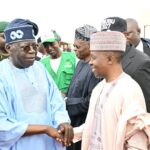
A man who does not belong to the APC is building a political coalition to secure another four years for an APC president. That alone would be an interesting political arrangement. But there is a bigger question. What happens when the man assembling the troops begins to look more consequential to the ruling party’s re-election project than some of the people who built the party and brought its president to power?
That is the question Nyesom Wike’s Rainbow Coalition has placed before the APC. What is being presented as a broad based mobilisation for Bola Tinubu’s second term ambition is also creating an uncomfortable political complication within the ruling party.
The coalition brings together politicians across party lines, but its implications reach beyond the opposition. It raises questions about who controls the machinery of Tinubu’s re-election, who gets rewarded for building it, and where that leaves the APC’s own political establishment.
While Rivers State served as the laboratory for this political experiment, the tremors have long escaped the creeks of the Niger Delta.
Across state lines, sitting APC governors, party chairmen and grassroots stalwarts are waking up to a sobering reality: under the banner of the Rainbow Coalition, loyalty to the President’s re-election is being separated from loyalty to the party itself.
Nowhere is this friction sharper than in Imo State, where Governor Hope Uzodimma, Chairman of the Progressive Governors’ Forum, PGF, has found himself at the centre of the storm. As the chief custodian of the APC governors’ collective interest, Uzodimma saw early what the Rainbow Coalition represents: a parallel political structure operating outside the party’s established hierarchy and discipline.
In Imo, where Uzodimma is already locked in bitter internal battles, including his high stakes struggle with former governor Rochas Okorocha over the Imo West Senatorial ticket, the emergence of a cross party alliance that bypasses state party structures presents another serious complication. The Federal High Court’s October 29 ruling recognising Okorocha as the winner of the disputed APC primary, which the Imo APC has rejected, has further exposed the depth of the internal contest.
Uzodimma’s warning to Imo APC members threatening to withdraw party tickets from anyone caught flirting with the coalition was not mere political grandstanding. It reflected the concern of a governor who understands that a coalition which mobilises for Tinubu at the top while backing candidates from other parties down the ballot could leave APC incumbents without the political structures they need to survive.
That same fear has turned Kwara State Governor AbdulRahman AbdulRazaq into another vocal adversary of the project. Having overhauled his state’s legislative representation by replacing serving senators and House members ahead of 2027, AbdulRazaq is acutely vulnerable to disgruntled APC heavyweights seeking alternative platforms.
A cross party umbrella promoting support for Tinubu gives aggrieved politicians in Kwara the opportunity to campaign for the President while working against the Governor’s preferred APC candidates. The emergence of the Otoge Progressives Rainbow Coalition, unveiled by Senator Saliu Mustapha after his departure from the APC and his decision to contest the Kwara Central Senate seat on the PDP platform, illustrates the problem. Mustapha has openly acknowledged the influence of Wike’s Rainbow Coalition on the political arrangement in Kwara.
To AbdulRazaq and his allies in the PGF, the danger lies in legitimising a political structure outside the APC that can coordinate presidential support while giving disgruntled politicians an alternative platform to challenge the party’s candidates at other levels.
The resistance has extended rapidly across the regions. In Ebonyi State, Works Minister David Umahi publicly declared that there was no Rainbow Coalition in the State, insisting that the APC remained firmly in control, a position backed by Governor Francis Nwifuru and the broader South East APC leadership caucus.
In Ogun State, Governor Dapo Abiodun faces a delicate balancing act following court ordered PDP reinstatements, while in Ondo State, Governor Lucky Aiyedatiwa has insisted that his State is APC all the way, backed by Ondo APC elders warning against internal sabotage. In Gombe State, the political emergence of former Communications Minister Isa Ali Pantami on the PDP platform has further strained relations with Governor Inuwa Yahaya’s political structure. Indeed, political developments across States including Cross River, Osun, Katsina, Bayelsa and Jigawa point to a wider pattern of aggrieved politicians exploring alternative political arrangements.
Yet, inside Abuja’s corridors of power, Wike and his defenders argue that the governors are misreading the political calculation. Wike maintains that his coalition actually protects the President from opposition consolidation. His argument is that by accommodating aggrieved APC politicians, he prevents them from defecting to opposition platforms and joining forces against Tinubu in 2027.
He has also invoked the 2023 G5 alliance as evidence that politicians can support a presidential candidate across party lines without surrendering their own party affiliations or abandoning their candidates in other elections. Wike has found influential allies in the National Assembly leadership, including Senate President Godswill Akpabio and Senate Leader Opeyemi Bamidele, who have spoken favourably about broad-based mobilisation for the President.
There is, however, a fundamental question Wike’s argument does not adequately resolve. If the coalition is only about securing Tinubu’s re-election, why should it also determine who gets political tickets, who receives support in legislative contests and whose political ambitions are accommodated at the expense of established party structures?
Nowhere has this arrangement moved faster from political argument to practical reality than in Rivers State. There, where Wike and Governor Siminalayi Fubara closed ranks around a joint political arrangement for Tinubu’s re-election, the coalition unveiled 49 preferred candidacies for 2027, comprising 34 APC and 15 PDP candidates.
The list covered the governorship, senatorial districts, 13 House of Representatives seats and the State House of Assembly. Of the 13 House of Representatives candidates, 10 were from the APC and three from the PDP. For the 32 State Assembly seats, 21 were allocated to the APC and 11 to the PDP. The coalition also adopted candidates for the governorship and all three senatorial districts.
For long standing APC faithful in Rivers, Bayelsa and the FCT who endured years in opposition, watching political positions and opportunities being shared with PDP allies raises difficult questions about what their loyalty to the APC has earned them. Some of those who built the party’s structures and sustained its presence through difficult political seasons may now find themselves competing for space with politicians who are only recently entering an arrangement designed around the President’s re-election.
This is where the Rainbow Coalition’s real political significance lies. It is no longer simply a question of whether Wike can mobilise support for Tinubu. It is about the political price of that mobilisation and who gets to determine the beneficiaries.
Ultimately, the crisis exposes a fundamental contradiction at the heart of the APC’s 2027 strategy. Politics requires structure and loyalty from the top to the grassroots. A presidential candidate may attract support across party lines, but a political party cannot indefinitely ignore the interests of the people whose structures, resources and political sacrifices sustain it.
By allowing a prominent non-member to build a nationwide, multi-party political apparatus around the Presidency, the APC risks winning the presidential battle while hollowing out its own house.
Hope Uzodimma, AbdulRahman AbdulRazaq, Dapo Abiodun and the sidelined faithful across the States are not necessarily opposing the Rainbow Coalition because they oppose Tinubu’s re-election. Their resistance reflects a different concern: that a ruling party cannot indefinitely separate the political fortunes of its President from the survival of the structures that sustain its power.
There is a difference between building a coalition to support a President and building a political structure that gradually makes the party itself less relevant. The first can strengthen a political movement. The second can leave its established leaders wondering what exactly they are still defending.
A party that wins the presidency while losing its grip on its governors, legislators and grassroots machinery may eventually discover that it has secured the roof while surrendering the house. The broom may still be held aloft, but who will be left to sweep?
Shaakaa can be reached: shaakaastephanie@yahoo.com