By Oluwasore Alabi
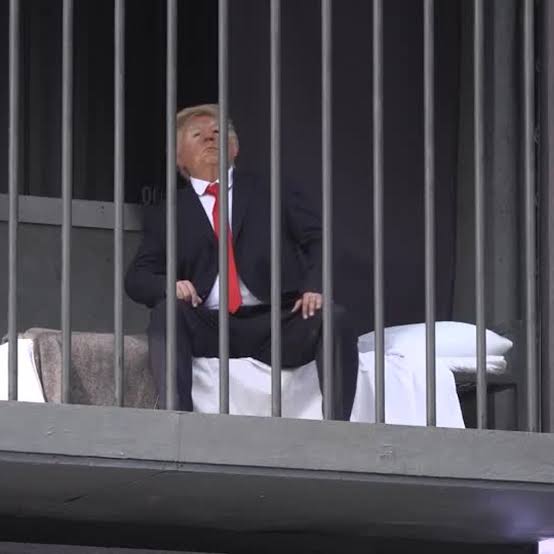
Look up in Tajrish Square, one of the busiest junctions in northern Tehran, and you will see a cell hanging several storeys above the traffic. Inside it is a man in a dark suit, a red tie and a prosthetic mask, pacing, clutching the bars, napping on a narrow bed. He is meant to be the President of the United States.
The installation went up this week, and it has already become one of the most talked-about pieces of political street theatre in the Iranian capital. Tehran’s municipal authorities, who are behind the campaign, say they want to remind residents of Iran’s demand for justice. The cell is furnished with a bed, a sink and a toilet, and the actor reportedly does not stay still.
Some reports say he rattles the bars, and at times he imitates the president’s well-known dance to the song Y.M.C.A. Media outlets close to the authorities say the display is built to run non-stop, day and night, seven days a week. Behind the cage sits an electronic billboard, and that is where the message lies.
According to Tribune’s account of the installation, it carries images of a deadly American strike on an Iranian wedding last month, so the clowning in the cell is meant to jar against the destruction on the screen. A slogan runs alongside, and one translation reads, “It is a crime not to see this scene.” Behind the spectacle is a war.
Iran has portrayed Trump as a war criminal and called for revenge since a conflict began, in the AFP’s account, with US-Israeli strikes that killed the country’s supreme leader. Political imagery across Tehran has hardened since attacks in February. The US side’s own account of these events is not part of the reports on the installation, and the war crimes charge is Tehran’s accusation.
The crowd’s reactions suggest the installation is working as theatre, at least. Drivers honk and pedestrians stop to film, and AFP reports that locals have taken selfies at the foot of the cell. One passerby joked that people would pay Trump’s bail and get him out. Others took it more seriously. A teenager shouted a threat at the actor, which shows how thin the line between performance and rage can be in a city that has lived through bombardment.
Analysts quoted in the coverage say the display is part of a wider shift. Iran’s Islamic Republic has long struggled to make its anti-American messaging resonate beyond its hard-line supporters, and anger over the military strikes has widened the audience for it. An installation that people can photograph, laugh at and shout at reaches much further than a poster on a wall.
President Trump has not commented directly on the installation. He has, however, posted AI-generated images mocking Iran’s clerical rulers or showing them destroyed by US firepower, so the two governments are, in effect, trading images across the same war.
It is hard to say who is winning that trade. What the cell above Tajrish Square shows is that the conflict has moved from the battlefield to the street corner, and that both sides now understand a picture can be as useful as a missile.