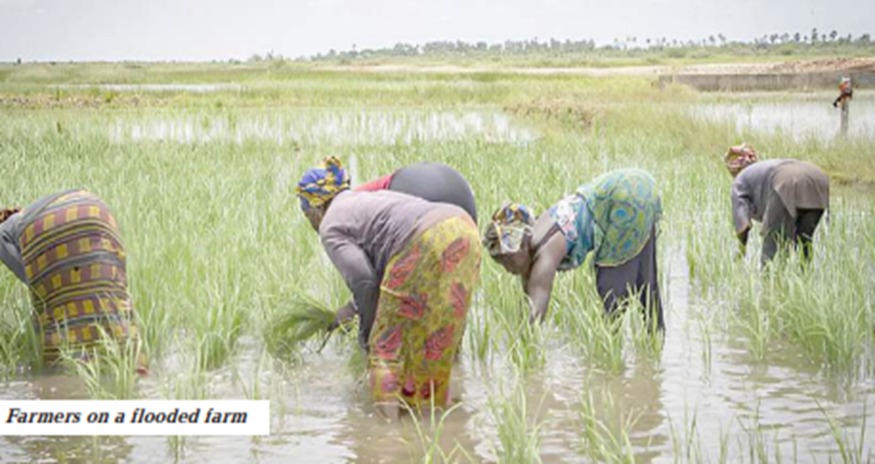
Rising temperatures, erratic rainfall, and devastating flash floods are pushing Nigeria’s food security system toward a critical juncture, leaving millions of smallholder farmers counting financial losses running into billions of Naira.
Speaking at a national climate-resilience stakeholder symposium held at 10:00 AM on Wednesday, October 7, 2026, at the International Conference Centre (ICC) in Abuja, agricultural experts and policy stakeholders warned that erratic weather patterns are severely disrupting seasonal farming cycles across the country’s main agricultural belts.
According to predictions by the Nigerian Meteorological Agency (NiMet), farmers in Northern and North-Central states, including Kano, Kebbi, Niger, and Bauchi, have faced severe mid-season dry spells and delayed rainfall onsets.
Conversely, agrarian communities across the South-East and South-South regions have dealt with unpredictable rainfall surges and localized flooding that submerged thousands of hectares of arable land.
”Climate change is no longer a distant concern; it is an immediate crisis happening in real-time on our fields,” stated Dr. Nkechi Okafor, Chairman of the All Farmers Association of Nigeria (AFAN), FCT Chapter. “The unpredictable rainfall patterns mean farmers can no longer rely on traditional planting calendars. Farmers who planted early lost their seeds to prolonged dry spells, while those who waited faced sudden, washing-away rains. The financial losses incurred across crop failure, lost inputs, and pest infestations run into billions of Naira, threatening to drive many smallholders out of agriculture entirely.”
The Food and Agriculture Organization (FAO) recently reported that over 36 million Nigerians face acute food insecurity, exacerbated by climate shocks, high input costs, and agricultural supply disruptions. Major staple crops, including rice, maize, cassava, and tubers, have recorded steep yield drops, driving food inflation further upward nationwide.
Addressing delegates during the summit’s morning panel session, environmental scientist Prof. Babatunde Bolaji Bernard emphasized that traditional, rain-fed agriculture is no longer sustainable under Nigeria’s evolving climate reality.
”We must pivot rapidly toward systemic climate-smart agriculture,” Bernard noted. “Nigeria cannot achieve sustainable food security without scaling up investment in all-year-round irrigation networks, heat-tolerant seed varieties, early-warning weather technology, and accessible agricultural insurance for smallholder farmers who bear the brunt of these disruptions.”
Stakeholders at the event urged the Federal Ministry of Agriculture and Food Security, along with state-level agencies, to accelerate the implementation of localized climate adaptation funds, expand extension services, and grant rural farmers direct access to affordable credit to cushion the impact of future climate shocks.