By Kio Amachree
Bola Tinubu Is Not a Statesman. He Is Not an Intellectual. He Is a Confidence Trick Wearing a Presidential Sash.
Let us dispense with the pretense.
Bola Tinubu is not deep. He has never been deep. He is a man who discovered early in life that if you pause long enough before speaking, if you drop your voice to the register of revelation, if you surround yourself with enough people paid to marvel at your wisdom — you never actually have to say anything that means anything. The performance of profundity is his only real skill. And it has carried him, improbably, catastrophically, all the way to the presidency of Africa’s most populous nation.
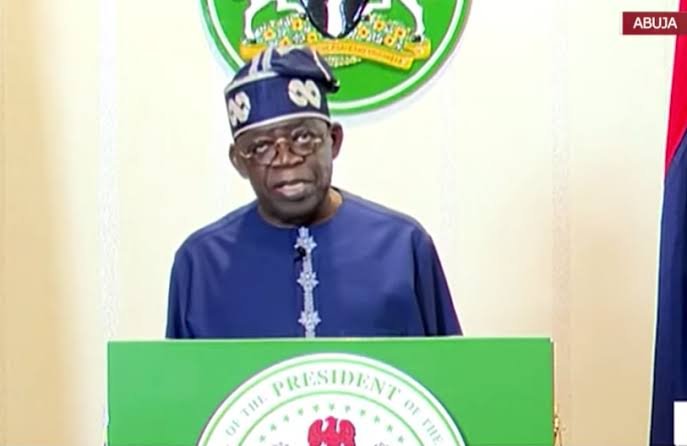
Watch him speak. Not the edited clips his handlers release. Watch the full footage. Watch what happens when a question lands that his team did not rehearse. The sentence begins. The words come out in clusters — thrown forward and then swallowed, hurled at the audience and then retrieved before they can be examined. The American accent surfaces and disappears.
The Yoruba syntax bleeds through the English scaffolding because that is where the thinking, such as it is, actually happens — and the translation never quite works. What reaches the listener is not thought. It is the residue of thought, mangled in transit, delivered with the unearned confidence of a man who has never once been told, by anyone whose salary he controls, that he has just said nothing.
That is not philosophy. That is a grift with good lighting.
I Have Seen This Before
I want to tell you about a party I once attended in New York.
The host was Adnan Khashoggi — then reputed to be the richest man in the world, the Saudi billionaire who was the toast of every room he entered. Feted. Pumped up. Celebrated as a genius of deal-making and global influence. The kind of man whose name alone was supposed to silence a room.
I watched him that night. I listened to him carefully. And I knew immediately that something was wrong.
He was a small, round man — nothing to look at, nothing commanding about him physically. When he spoke, what came out was rehearsed. Every sentence had been prepared in advance. Every observation had been road-tested. There was no spontaneity, no genuine intellectual engagement, no moment where you felt a real mind grappling with a real idea in real time. He loved the fame. He loved the limelight. But he was winging it — and I could see it, even if the room full of billionaires and socialites around me had decided not to.
I told my friends that night. Something is wrong with this man. He is not real.
I was right. When Khashoggi was no longer useful to the people whose interests he actually served, they let the whole world know exactly what he had always been: a front man. A bag man for the Saudi royal family. The money was never his. The influence was borrowed. The genius was theater. He had spent years using other people’s capital to ingratiate himself with the rich and powerful — and when that relationship soured, the curtain came down and the small round man was all that was left.
I see the same architecture in Bola Tinubu. The same borrowed grandeur. The same performance of depth from a man who has no depth to offer. The same machinery of manufactured mystique that collapses the moment the patron withdraws.
The difference is that Tinubu’s patrons have not withdrawn. Not yet. Because Gilbert Chagoury still needs his man in Aso Rock. And certain American intelligence interests still need their arrangement on the West African board to remain undisturbed.
Tinubu is not the principal. He has never been the principal. He is the face on an operation that belongs to other people — and like Khashoggi before him, the day will come when those people decide the face is more liability than asset.
The Intellectual Vacuum at the Center
There is a particular type of fraudulent mind that should not be confused with intelligence, even though it mimics it effectively enough to fool crowds. It is the schemer’s mind. It is not interested in ideas. It is interested in leverage. It does not ask what is true. It asks what is useful. It does not build arguments. It builds traps.
Tinubu is that mind. He is not intellectually dishonest in the way that an academic fudges data or a lawyer overstates a case. He is dishonest in the Trumpian sense — total, structural, foundational dishonesty, so complete that it has long since ceased to feel like lying and become simply his relationship with reality. The more you lie, the more people believe you. Repeat the myth of your own genius loudly enough and the myth becomes the man. Donald Trump understood this. Tinubu understood it before Trump made it fashionable.
The difference is that Trump is, in his grotesque way, at least intermittently coherent. Tinubu cannot sustain a paragraph. He is a schemer who lacks the intellectual horsepower to scheme in public without exposure. So he has built an entire political culture around never being exposed — a court of flatterers, praise singers, and enforcers whose job is to ensure that the question he cannot answer is never actually asked.
The Cult and Its Machinery
What surrounds Tinubu is not a political movement. It is a cult — and specifically, a tribal cult, with all the markers that phrase implies. The hero worship heaped upon this man bears no relationship to any demonstrated achievement that can survive scrutiny. His governance of Lagos was the governance of extraction: a city monetized for personal political use, its revenues converted into the loyalty networks that would eventually purchase him a presidency.
Yet his followers speak of him with the reverence reserved for the irreplaceable. He is Jagaban. He is Asiwaju. He is the architect, the oracle, the indispensable man. That none of this survives contact with his actual public performances is not a problem for the cult — it is, in a perverse way, the point. The gap between the myth and the man requires active maintenance. It requires belief that is impervious to evidence. That is what cults are for.
He is not good looking. He is not eloquent. He is not learned. He is not physically commanding. He is not morally serious. There is not one quality, examined honestly, that explains the scale of the devotion. Which means the devotion is not about him at all. It is about tribe. It is about the fantasy of Yoruba ascendancy — about what his elevation is supposed to mean for a group that has long felt politically outmaneuvered. He is the vessel. The worship is not of the man. The man is, frankly, not worshippable.
He has Kennedy’s name recognition without Kennedy’s mind. He has Trump’s shamelessness without Trump’s animal cunning. He has Khashoggi’s borrowed glamour without Khashoggi’s ability to at least maintain the illusion in a room full of skeptics. He is the least of all of them — and he sits in the highest office Nigeria has ever offered a man.
The Body That Betrays Him
He falls asleep in public. Not occasionally. Habitually. At state functions, at summits, in rooms where the cameras are running. His handlers manage it, edit around it, explain it away. But the footage exists. The body is telling the truth his biography cannot afford to tell.
He is being medicated to function. This is not speculation — it is the observable conclusion of watching a man who requires pharmaceutical assistance to remain conscious during his own presidency. On the days when the medication is working, he is belligerent and grandiose. On the days when it is not, the sentences disappear halfway through and the eyes go somewhere else entirely.
Meanwhile, Seyi Tinubu — his son, unelected, unaccountable — is doing the operational work. He is in the meetings. He is on the ground. He is exercising the authority of the office without bearing any of its constitutional obligations, while his father sits in Aso Rock and does what he has always done: plans, schemes, and extracts.
Nigeria did not elect a president. It elected a family business with state power.
The Front Man’s Endgame
A grifter succeeds not by being admirable but by making admiration feel necessary. Tinubu’s entire political life has been structured around making people feel that their futures depend on his goodwill — that to oppose him is to oppose their own interests, that to question him is tribal betrayal, that the myth must be protected because the myth is all they have.
But front men have expiration dates. Khashoggi discovered this. The money was never his. The relationships were never his. The power was on loan. When the Saudi royal family decided the arrangement had run its course, the most celebrated dealmaker in the world became a cautionary tale overnight.
Tinubu’s arrangement with Chagoury and with Washington’s more pragmatic intelligence interests rests on the same conditional foundation. He is useful until he is not. He is protected until the protection costs more than it is worth. He is the man in the chair until someone decides the chair should have a different occupant.
The difference is that when Tinubu’s patrons eventually make that calculation, it will not just be one man who falls. It will be every Nigerian who was told that this hollow, borrowed, medicated, intellectually empty front man was the best their country could produce.
He was never the best. He was never even adequate. He was available, and controllable, and that was enough for the people who actually run this arrangement.
Nigeria deserved a president. It got a placeholder.