The Federal Government has called for stronger Public-Private Partnerships (PPP) to drive sustainable reforms across the across correctional centres.
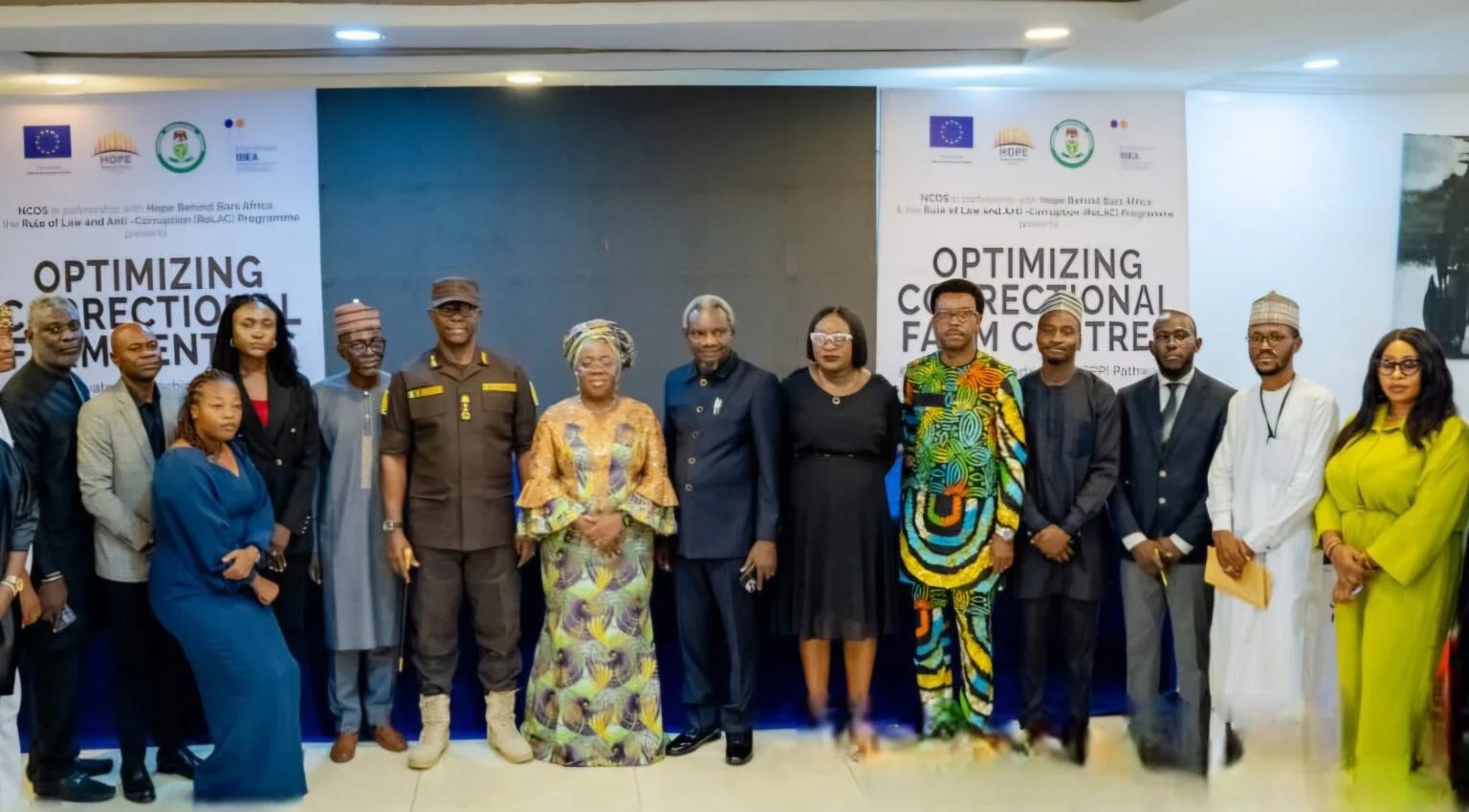
The Minister of Interior, Dr Olubunmi Tunji-Ojo, made the call in Abuja on Wednesday during a stakeholders’ dialogue on optimising correctional farm centres and expanding PPP pathways for inmate rehabilitation and reintegration.
The dialogue was organised by Hope Behind Bars Africa(HBBA) in collaboration with the Nigerian Correctional Service with the support from the Rule of Law and Anti-Corruption (ROLAC) programme, funded by the European Union and International IDEA.
The minister, who was represented by the Permanent Secretary of the Ministry, Dr Magdalene Ajani, commended HBBA for its impactful interventions in correctional centres
He said HBBA was working in at least four custodial institutions and the government was seeking to deepen and expand the collaboration through structured partnerships.
“I thank Hope Behind Batch Africa. Your partnership is a powerful testament to a truth we must all embrace, that the transformation of our correctional system is not a solitary task for government, but a collective national enterprise.
“It is a mission that demands the energy, expertise, and commitment of the private sector, civil society, and development partners alike.
“Globally, the philosophy of correctional administration has undergone a profound evolution. We have moved decisively beyond the era of incarceration as mere custodial detection.”
“In all progressive justice systems, correctional centres are now understood as crucial platforms for transformation, rehabilitation, and construction of a new lease on life.”
Tunji-Ojo said that with partnerships, correctional farm centres would be transformed into productive agricultural hub not just to feed inmates but also equipping them with skills to contribute meaningfully to society upon release.”
The Controller-General of the Nigeria Correctional Service (NCOS), Sylvester Nwakuche, said the Service was undergoing reforms to reposition facilities as centres of reformation.
According to him, NCOS operates 18 farm centres and 10 cottage industries, alongside multiple agricultural projects nationwide, which support food production and skills training.
“In addition, we run 12 agricultural projects, five pigweed projects, nine fishery projects and 11 poultry projects across our facilities all over the country.
“Our farms produce a wide range of crops including maize, rice, groundnuts, cassava, yam, soya beans, guinea corn, oil palm, millet, sorghum, cowpea and banyan seeds among others.”
Nwakuche stressed that PPP would enhance productivity, modernise operations, and improve reintegration outcomes.
He expressed hope that the dialogue would examine practical models, share experiences and identify actionable pathways for optimising correctional farm centres.
The Executive Director of HBBA, Funke Adeoye, said the “Farming Justice Project,” which began in 2014 integrated agriculture with inmate reformation, addressing food insecurity and reducing reoffending.
According to her, the initiative has since moved from concept to implementation through collaboration with NCOS,The Rule of Law and Anti-Corruption Programme (RoLAC), funded by the European Union and International IDEA.
She said currently, the project operates in multiple custodial centres, including Dukpa, Kuje, Kirikiri Female, and Oko facilities, engaging inmates in structured programmes covering behavioural reform, financial literacy, and agricultural production.
She disclosed that the programme has reached hundreds of direct beneficiaries, including inmates and correctional officers across Edo, Abuja, and Lagos, with wider indirect impacts on families, communities, and local food systems.
She noted that some correctional facilities were already generating income through the sale of farm produce to surrounding communities, while inmates are gaining skills that support reintegration after release.
She revealed that the initiative addressed two critical issues: food insecurity within custodial centres and recidivism.
Adeoye said that the dialogue would aid to refine and strengthen the training framework for wider adoption and identify practical strategies for maximising farm centre productivity, efficiency, and governance.
She added that it would explore PPP models that clearly define the roles of government, the private sector, and civil society in scaling this work.
She commended the leadership of NCOS and the Ministry of Interior for embracing partnerships with non-state actors, noting that such collaboration was backed by provisions in NCOS’ Act 2019.
Representative of ROLAC, Danladi Plang, underscored the importance of partnerships in addressing challenges within the criminal justice system.
Plang noted that collaboration between government and non-state actors provides essential resources, expertise, and innovation needed to drive sustainable reform.