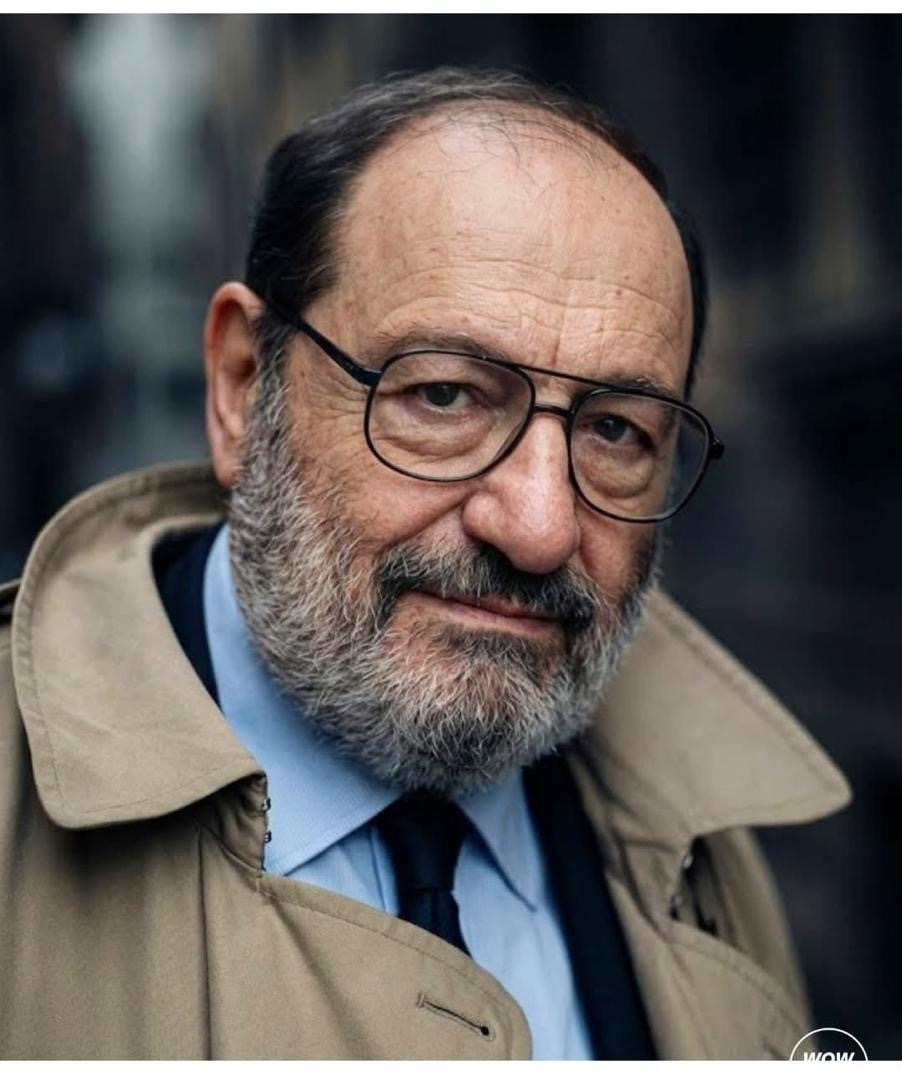
In 2015, an eighty three year old Italian philosopher described, with unsettling accuracy, what would unravel rational conversation. We now live inside the world he warned about.
Umberto Eco devoted his life to understanding how people communicate. He was a medieval scholar, a semiotician who studied signs and symbols, and the author of The Name of the Rose, an intellectual mystery that reached readers around the world. He understood how ideas spread, how language shapes what we accept as real, and how societies decide what counts as truth.
So when social media began to dominate public life, Eco watched with increasing concern.
In June 2015, during an interview in Italy, he was asked about the internet’s effect on society. His answer was direct and provocative. Social media, he said, gives legions of idiots the right to speak when they once only spoke at a bar after a glass of wine, without harming the community. Back then, they were quickly ignored. Now they have the same right to speak as a Nobel Prize winner. He called it the invasion of the idiots.
The reaction was immediate. Critics accused him of arrogance, of wanting to silence ordinary people, of being an out of touch intellectual who misunderstood democracy.
That missed his point.
Eco was not arguing against free speech. He was warning about what happens when expertise is stripped of value, when years of study and evidence are treated as equal to a stranger’s instinct or opinion.
For centuries, public discourse had filters. Newspapers had editors. Publishers relied on fact checking. Universities used peer review. These systems were imperfect and often excluded voices that deserved to be heard, while protecting entrenched power.
But they also enforced responsibility.
If you wanted to publish a medical claim, you needed proof. If you wanted to shape public opinion, you needed credibility. If you spread falsehoods, there were consequences.
The internet erased those barriers.
Suddenly, anyone could reach millions. A teenager posting from a bedroom had the same platform as a seasoned academic. A conspiracy theorist could attract as much attention as a journalist who had spent months verifying facts.
And the most extreme voices traveled fastest.
Social media platforms do not reward accuracy. They reward engagement. Anger, fear, and absolute certainty spread better than nuance.
A careful post explaining that an issue is complex and deserves thoughtful consideration rarely goes far.
A post shouting that everyone is being lied to explodes across feeds.
Eco watched this unfold as flat earth believers found each other and organized. As anti vaccine myths moved faster than public health guidance. As political falsehoods that could be disproven almost instantly became widely accepted alternative narratives.
He watched respect for expertise erode.
Climate scientists with decades of research were challenged by bloggers with no training. Doctors were dismissed in favor of influencers selling wellness products. Historians were drowned out by people who claimed to have done their own research.
That phrase became shorthand for rejecting knowledge in favor of whatever confirmed existing beliefs.
Eco understood a critical distinction. Giving everyone a voice is a beautiful ideal. Treating every voice as equally authoritative is dangerous.
A relative’s social media post about vaccines is not equivalent to a peer reviewed medical study. A viral claim of election fraud is not the same as official voting data. An influencer’s opinion on climate change does not carry the same weight as scientific consensus from NASA.
Yet online, they appear identical. They sit side by side in feeds with the same design, the same emphasis, the same algorithmic push.
Platforms do not tell users which information comes from experts and which comes from people with no relevant knowledge. They simply present everything and leave the audience to sort it out.
This is what Eco meant by the invasion of the idiots. Not that ordinary people lack intelligence, but that systems amplify the loudest and most confident voices regardless of whether they know what they are talking about.
Confidence spreads more easily than accuracy.
Nine months after that interview, in February 2016, Umberto Eco died at eighty four.
He did not live to see how completely his warning would be confirmed.
He did not witness a global pandemic where misinformation traveled faster than the disease, leading people to trust social media posts over doctors, with deadly consequences.
He did not see millions convinced that elections were stolen based on viral claims disproven again and again.
He did not see artificial intelligence making realistic fake videos possible, or automated accounts flooding platforms with propaganda.
But he identified the central danger. When every opinion is treated as equally valid, truth becomes just another opinion.
Eco was not calling for censorship. He was calling for a renewed respect for expertise, for evidence, for the labor required to actually understand complex realities.
He was reminding us that while everyone has the right to speak, not every claim deserves belief.
That a doctorate in epidemiology matters. That peer reviewed research matters. That journalistic standards matter.
And that seeing something on social media should never be the endpoint of critical thinking.
Before his death, Eco reflected on heroism, saying that the true hero is always a hero by accident, someone who dreams of being an ordinary, honest coward like everyone else.
In our current moment, intellectual honesty requires courage. Admitting uncertainty, seeking expert knowledge, and changing one’s mind in the face of evidence are no longer rewarded behaviors.
Platforms reward certainty. Algorithms favor outrage. Attention flows to whoever shouts the loudest.
Being careful, thoughtful, and humble about what you actually know has become a radical act.
Umberto Eco spent his life studying how meaning is created and shared. He watched the internet reshape communication in ways that deeply troubled him.
Not because people were speaking, but because truth was being buried beneath noise.
His warning in 2015 was not bitterness. It was an act of care, for knowledge, for public discourse, and for the possibility of understanding one another through reason instead of tribal loyalty.
We are living in the world he feared. The problem was never that foolish voices appeared. They were always present. The problem is that they are now amplified while expertise is dismissed.
Eco left us with a simple question.
What are we going to do about it?