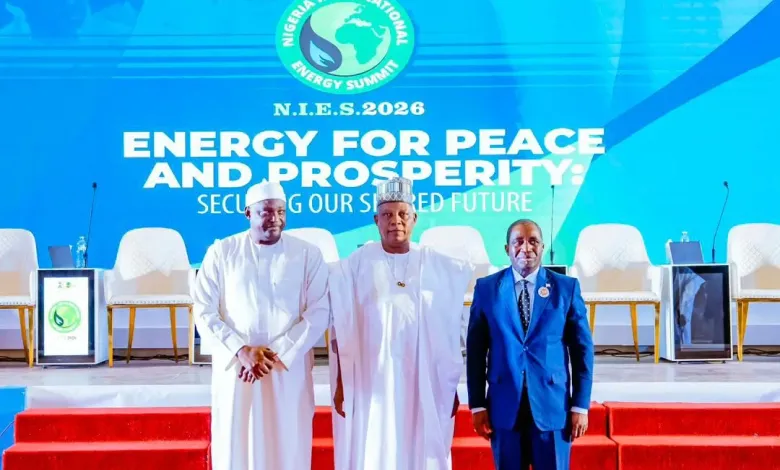
Nigeria’s President, Bola Ahmed Tinubu, alongside Presidents Teodoro Obiang Nguema Mbasogo of Equatorial Guinea and Adama Barrow of The Gambia, have reaffirmed a shared commitment to positioning energy as a foundation for Africa’s peace, prosperity, and economic resilience, calling for pragmatic cooperation that expands access, safeguards development, and strengthens continental integration.
Speaking at the 9th Nigeria International Energy Summit (NIES) 2026 in Abuja, the three leaders aligned on the need for purpose-driven energy systems, anchored in affordability, security, and cleaner solutions, to support industrial growth, social stability, and Africa’s long-term competitiveness in a rapidly shifting global energy landscape.
The summit, themed “Energy for Peace and Prosperity: Securing Our Shared Future,” underscores Africa’s growing push to align energy development with economic stability and geopolitical relevance.
Represented by Vice President Kashim Shettima, President Bola Ahmed Tinubu described energy as “the invisible force that holds the modern world together” and a central pillar of both national and global stability.
“Energy is a fulcrum of stability. We cannot afford complacency in how we manage it. We must continually reinvent how we meet our energy needs,” Tinubu said.
President Tinubu outlined ongoing reforms in Nigeria’s oil and gas sector, including the Petroleum Industry Act (PIA), which has strengthened regulatory clarity, investor confidence, and long-term sector sustainability.
Nigeria currently produces 1.6 million barrels of crude oil per day, with a government target to increase output to 2.5 million barrels per day by 2027, backed by upstream reforms, improved security, and investment recovery initiatives.
He also highlighted the Dangote Petroleum Refinery, now fully operational, as a transformative development boosting domestic petroleum supply and reducing import dependence. State-owned refineries are simultaneously being rehabilitated to improve operational efficiency and reliability.
While crude oil remains a strategic asset, Tinubu reiterated that natural gas will serve as Nigeria’s transition fuel, supporting industrialisation, power generation, and emissions reduction.
African leaders emphasized that Nigeria’s energy decisions affect the broader continent.
President Adama Barrow of The Gambia stressed the urgency of expanding reliable and sustainable energy systems across Africa, warning that millions without electricity face constraints on healthcare, productivity, and competitiveness.
“Poorly managed energy transitions can trigger social and economic crises. Affordable and diversified energy is both an economic necessity and a moral obligation,” Barrow said.
President Teodoro Obiang Nguema Mbasogo of Equatorial Guinea, represented by Deputy Minister Domingo Mba Esono Nzang, reinforced the message that Africa must lead its energy transition on its own terms.
“Energy is not just an economic commodity. It is a tool of sovereignty and a driver of long-term development,” Obiang said.
He highlighted that Nigeria’s economic and energy prosperity directly influences other African economies, particularly within the Gulf of Guinea, citing regional initiatives such as the Gulf of Guinea gas pipeline and Equatorial Guinea’s 2023 Licensing Round for onshore and offshore opportunities.
While fossil fuels will continue to support Africa’s growth, Barrow stressed that long-term sustainability depends on:
- Accelerating renewable energy deployment
- Strengthening regional power pools
- Enhancing energy efficiency
- Investing in human capital
He emphasized that Nigeria will play a critical role in driving a balanced energy strategy integrating gas, renewables, and infrastructure expansion without undermining economic growth.
The Nigeria International Energy Summit 2026 continues to serve as a strategic platform for aligning African energy priorities, fostering cross-border collaboration, and shaping policies that reflect the continent’s development needs.
A shared consensus emerged: Africa’s energy transition must be pragmatic, inclusive, and anchored in access, industrialisation, and prosperity—rather than premised on resource abandonment or exclusion.
Environment Africa Magazine is an eco-solutions focused publication, invested in delivering and promoting news, highlights and information on the environment, bridging the gap between environmental consciousness, sustainable integration of processes and business profitability. We highlight eco business interactions and provide salient green information to a strategic and key decision making subscriber base; deepening and enhancing environmental consciousness, not just in Nigeria but in Africa.