A prominent industrialist in Aba, Abia’s economic hub, Chief John Udeagbala, says digital capacity remains the core driver of modern commerce, manufacturing and global competitiveness.
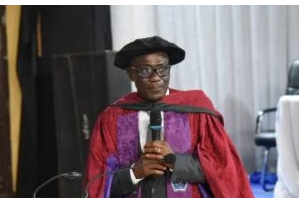
Udeagbala, a former National President, Nigeria Association of Chambers of Commerce, Industries, Mines and Agriculture (NACCIMA), spoke at the 22nd Pre-Convocation Lecture of the Ogbonnaya Onu Polytechnic, Aba, on Thursday.
He said that Nigeria must rapidly adopt Artificial Intelligence (AI) and digital technologies, if it hoped to catch up with the rest of the world.
He said that AI would help to strengthen trade and achieve sustainable industrial development.
In the lecture entitled, “Leveraging Artificial Intelligence and Digital Technologies for Trade and Sustainable Industrial Development in Nigeria,” he reflected on some urgent national economic needs.
He said: “This is not theory because digital technology is the currency of the future economy and any nation that fails to embrace AI will be left behind.”
He said that Industry 4.0 technologies, such as AI, Automation, Internet of Things and Cloud Computing, have become global standards for industrial productivity.
“Digitalisation is no longer optional, it has become the infrastructure of modern trade,” Udeagbala said.
He recalled promoting digital-economy advocacy during his tenure as NACCIMA chief and at an international conference on digital transformation in 2023.
“That conference proved one fact – which is that a vibrant digital economy is essential for job creation and national growth,” he said.
He also said that the South-East Chambers of Commerce, Industries, Mines and Agriculture had also pushed for the establishment of digital hubs across Nigeria’s geopolitical zones to support innovation among youths.
“The vision is simple: create hubs, where Nigerian youths can build solutions, startups and digital products,” the business mogul said.
He cited the instances of Nigerians excelling in digital innovation, including InterSwitch’s Mitchell Elegbe, Flutterwave’s Olugbenga Agboola and Paystack’s Shola Akinlade.
“These success stories show what is possible and I mention them to challenge you,” Udeagbala told the graduates.
He also referenced local Aba innovator, Tochukwu Chukwueke, recently appointed Vice-Chairman, Abia Digital Economy Advisory Committee.
“Great innovators are not far from here. One lives right here in Umuatako in Aba,” he said.
Udeagbala said that Dangote Cement and Nigerian Breweries stand as examples of Nigerian firms already leveraging AI for supply-chain efficiency and quality control.
“Those Dangote trucks you see nationwide are monitored by AI in real-time, this is what modern industry looks like,” he said.
He urged the graduates to acquire tech-related skills in order to bridge the digital skills gap in the state and country at large and become digital innovators, providing solutions that would boost small and medium-scale enterprises development.
Udeagbala further said that the development would help small and medium enterprises in Aba and the nation to adopt AI-driven solutions to improve production, design and trade processes.
“Aba is a manufacturing laboratory. You must help SMEs modernise with digital tools,” he said.
He warned that Nigeria faced a major digital skills gap, in spite of the rising opportunities.
“A study conducted among 100 NYSC members showed only 19 of them had any digital skills, that is basic MS Excel, – that is a crisis,” he said.
According to Udeagbala, educational curricula were outdated, making graduates unprepared for modern job demands.
“Do not wait for the curriculum to change, make efforts to acquire digital skills yourself,” he said.
He also encouraged the graduates to enroll in national programmes, such as the Federal Government’s 3MTT digital talent initiative.
He commended the Management of the polytechnic for strengthening technical training and collaborating with industries.
“In less than two years, the rector has repositioned this institution impressively,” he said.
Udeagbala also announced a collaboration between his company and the institution to enhance practical industrial exposure.
“We agreed to partner, so students can gain hands-on technical experience in our organisation,” he said.
He further urged the graduates to embrace innovation rather than simply seeking jobs.
“Do not merely look for employment, but seek to innovate,” he said.
He emphasised that AI mastery, data analytics and digital proficiency would define their success.
“Your diploma is the foundation, while your digital skills are the structure you must build,” he said.
He encouraged them to adopt life-long learning and forge partnerships that create real industrial solutions.
“Do not wait for the industry to change, be the catalyst,” he said.
Earlier in an address of welcome, the Rector of the institution, Dr Christopher Okoro, described the annual pre-convocation as an opportunity for students and staff members to engage industry experts and learn practical insights.
Okoro described Udeagbala as an accomplished businessman, who would share his experience on leveraging AI and digital technology in his lecture.
He also said that the knowledge would contribute to trade and sustainable industrial development in Nigeria, and highlighted modern tools for entrepreneurship and business growth.
He said that the discussion aligned with the State Government’s agenda for business-driven technological advancement.
Okoro also said that in 14 years, the polytechnic held only three convocations, while the ceremony was happening back-to-back for the first time in the history of the institution under the present administration.