By Dr. Charles Obiajulu Ugwu
The New Reckoning
Imagine a world that awakens not to the siren’s shrill or the gavel’s echo, but to the hum of human contradictions that are vibrant, messy, unpredictable but channeled, not condemned. Imagine a society mature enough to know that the so-called “deviant” is not its disease but its undeveloped intelligence; that what we have spent centuries trying to suppress might, in fact, be the missing fuel for collective evolution.
Every civilization, from the tribal to the technocratic, has shared one reflex: to detect the misfit, brand it dangerous, and build fortresses of law and punishment around it. Deviance whether in the form of corruption, disorder, rebellion, or the quiet refusal to conform has been treated as a tear in the moral fabric, a leak in the social machine.
The assumed cure has always been control. Yet, despite centuries of control in the forms of new laws, new prisons, new committees, new crusades, the “deviant” remains. The very systems designed to suppress them have only made them more sophisticated, more embedded, more inventive.
What if the problem is not the deviant, but the design? What if our failure lies not in our lack of control, but in our obsession with it?
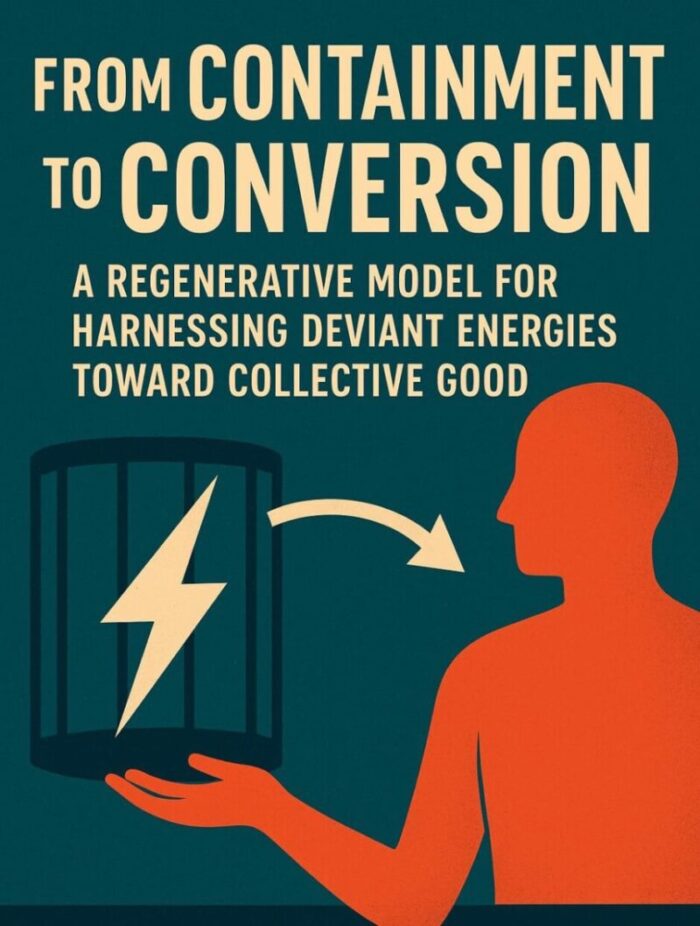
This essay invites us to stand at the edge of a new governance frontier and to shift from containment to conversion, from the futile policing of difference to the regenerative harnessing of human variability. It is a call to turn what we call deviance into design input, what we label corruption into creative energy, what we dismiss as nuisance into necessary feedback.
The Dead Weight of Containment
Containment is a heavy, expensive, and ultimately self-defeating enterprise. It builds bureaucracies to police behaviours it scarcely understands, erects moral walls that crumble under their own hypocrisy, and consumes the energy that could have built new worlds. The more we spend to isolate the deviant, the less adaptive our systems become.
Across societies, billions are spent annually on the architecture of controls around anti-corruption agencies, surveillance systems, enforcement units, disciplinary panels. Yet corruption flourishes. Thefts evolve. Fraud adapts. Disorder finds new masks. The conclusion should be clear: deviance is not a bug in the system rather it is a system response, a signal that something deeper requires reconfiguration.
The sociologist Émile Durkheim once argued that a society without deviance is impossible, because deviance is the proof that the social body is alive and that it reacts, stretches, redefines itself. Every act of deviation, from the petty bribe to the grand rebellion, carries information about the conditions that produced it. But we seldom listen; we punish instead of learning.
By treating deviance as defect, we commit epistemic suicide as we destroy the very data that could have helped us evolve.
Deviance as Data, Not Defect
Every deviant act is an encrypted message about the human condition. The corrupt official signals the poverty of recognition and the skewed incentive structure. The rebellious youth signal the sterility of belonging. The opportunist, the lazy, the insubordinate all are mirrors reflecting our institutional blind spots.
A regenerative society would not ask, “How do we eliminate these people?” but rather, “What truth about our structure are they revealing?”
To see deviance as data is to accept that human behaviour is information that are messy, contradictory, and often inconvenient, but profoundly useful. It is to replace the moral reflex with the design reflex; to ask not who is wrong, but what is misaligned.
This is not to romanticize corruption or celebrate indiscipline. It is to recognize that force-fitting moral conformity has failed. Our obsession with purity has yielded stagnation, not progress. What we require is not moral cleansing but systemic intelligence in the form of an ability to convert friction into propulsion.
The Conversion Thesis
Here lies the heart of the model: deviant energy, when understood and redirected, can become regenerative energy.
Every “negative” human impulse carries a positive twin ambition, risk-taking, cunning, defiance. The corrupt officer’s drive for advantage, the opportunist’s instinct for gaps, the rebel’s contempt for authority is not to be erased but repurposed. What if we built systems where that hunger for gain aligns with the collective good? Where the instinct to break rules becomes the courage to innovate?
Imagine a governance system where, instead of punishing the corrupt official endlessly, we redesign the incentive terrain so that their self-interest coincides with public value creation. Where systems of transparency, community oversight, and performance-based rewards make honest work more profitable than manipulation.
Containment diminishes energy. Conversion expands it. Rather than expending force to erase human variance, we can design ecosystems that use it.
From Control to Cohabitation
This new governance philosophy is not about indulgence; it is about intelligence. It calls for a shift from control to cohabitation. Control is reactive; cohabitation is adaptive. It acknowledges that society is not a battleground between the “good” and the “bad” but a living field of competing logics seeking expression.
Cohabitation means designing social and institutional spaces where diversity of motive, identity, and behaviour coexist productively. The informal economy, often treated as nuisance, could be seen as a laboratory of efficiency and improvisation. The risk-seeking maverick, once tagged insubordinate, could become a frontier innovator. The dissenter, once silenced, could be integrated as the system’s critical conscience.
This model does not erase boundaries; it redraws them intelligently. It accepts that not everyone must be virtuous for society to flourish rather what matters is that even the self-serving can find their profit in serving the collective.
The Regenerative Engagement Model (REM)
This regenerative approach can be structured through what I term the Regenerative Engagement Model (REM), a four-layered framework for transforming deviance into contribution:
Recognition before Rejection:
Every deviant behaviour carries a logic. Before condemnation, decode it. Ask: what unmet need, what social asymmetry, what psychological or systemic vacuum drives this act?
Reframing Incentives:
Realign the reward structure so that contribution pays better than manipulation. Make transparency the most efficient form of self-interest.
Cohabitative Ecosystems:
Build flexible institutions that allow multiple behavioural archetypes to exist without wrecking the system just as biodiversity sustains an ecosystem, behavioural diversity sustains a society.
Conversion through Value Expansion:
Grow the collective pie. If corruption consistently consumes 30% of productivity, aim to grow output by 100% rendering the loss negligible in macro terms. The goal is not moral purification but systemic abundance.
By these pillars, governance evolves from an exercise in moral policing to one of cognitive design. The state ceases to be a warden and becomes an architect.
Landscapes of Application
Across sectors, this shift from containment to conversion opens new possibilities:
In Public Governance:
Rather than endless witch-hunts, governments could build “transparency economies,” where community data, open dashboards, and performance-linked contracts make honesty the most rewarding path.
In Corporate Systems:
Instead of expelling the “rule-breakers,” companies could create innovation sandboxes— zones for controlled rebellion where the risk-takers test new ideas under bounded accountability.
In Informal Economies:
Instead of harassing street vendors or transport operators, urban authorities could co-design flexible regulatory regimes—recognizing their contribution and integrating them into the value web.
In each instance, the idea is simple: design systems that metabolize difference. What we once fought, we now harness.
Toward a Conversion Civilization
The ultimate goal of this paradigm is civilizational. It asks humanity to graduate from the primitive reflex of exclusion to the mature intelligence of conversion. It suggests that no energy moral, emotional, social is inherently wasteful. That every deviation, every defiance, every disobedience, when properly understood, can become a raw material for evolution.
In this conversion civilization, governance would no longer rest on fear and punishment but on architecture and participation. Leaders would no longer play gods dispensing morality, but designers cultivating alignment. Justice would not merely punish wrongs but repurpose energies.
The deviant becomes the unfinished citizen. The rebel becomes the experimental wing of society. The dishonest becomes an incentive case study.
It is, admittedly, an unsettling vision, one that offends the moral absolutist. But history is on its side. Humanity has always advanced by integrating what it first rejected: witches became scientists, rebels became founders, heretics became saints. Every deviation, once decoded, has expanded our collective vocabulary of being.
The Epilogue: The Last Frontier of Governance
We stand today at the edge of our greatest paradox: our systems are collapsing not because of too much deviation, but because of too little imagination. We keep trying to perfect control when the world demands capacity to convert.
Containment drains vitality; conversion releases it. The former breeds exhaustion, the latter evolution. The former chases purity, the latter builds resilience.
If we truly desire a regenerative future, we must stop excommunicating our own diversity. We must design for it, cohabit with it, and make it pay dividends.
The deviant’s shadow, once harnessed, becomes the society’s new light.
The question is not how to rid the world of its deviants it is how to design systems so intelligent that even their deviations become instruments of collective ascent.
That is the task of the next generation of leaders not to cleanse, but to convert; not to condemn, but to comprehend; not to contain, but to co-create.
About the Author
Dr. Charles Obiajulu Ugwu is a management consultant, adaptability thought leader, and regenerative systems expert. Known for his contrarian yet deeply constructive voice, he pioneers frameworks that reimagine leadership as cognitive architecture and society as an evolving ecosystem. His work bridges philosophy, strategy, and neuro-adaptive science, inspiring leaders to build antifragile systems that grow through volatility. Dr. Ugwu’s thought leadership challenges orthodoxies and opens new pathways for collective transformation one paradigm at a time.