By Agbeze Ireke Kalu Onuma, AI-KO
“The people are the most important element in a nation; the spirits of the land and grain are the next; the sovereign is the lightest.” – Mencius, c. 300 BCE
“Nothing is more dangerous than to permit one citizen to retain power for a long time.” – Simón Bolívar, Angostura Address, 1819
“Tyranny is a kind of monarchy which has in view the interest of the monarch only.” – Aristotle, Politics, Book III
The returns from America reached Lagos in the small hours of Wednesday, and by dawn the verdict was in. The Democratic Party had won the House of Representatives. Then, a little before midnight in Washington, it won the Senate as well.
Donald Trump, who spent weeks insisting that he was not on the ballot while urging the country to vote as though he were, lost both chambers of Congress in a single night. Tuesday, 3 November 2026, will be remembered as the day the American electorate took its president by the collar and told him, with a firmness that few pollsters had dared to forecast, that it had seen enough.
I have no vote in America and no party there. I have a country whose fortunes are tied, in ways small and large, to what Washington decides, and a long habit of watching how power behaves when it is checked and when it is not. That is the vantage from which I read this result. A Nigerian does not watch an American election as a spectator at someone else’s football match. The price of our crude, the terms of our trade, the tone of our diplomacy, the fate of our aid and the safety of our relatives abroad all move, sometimes by a whisper and sometimes by a thunderclap, when the American mood shifts. On Tuesday it shifted by a thunderclap.
Nothing about the night was small, and nothing about it should be inflated. What follows sets out what happened, why it happened, what it means for Trump and for the movement that bears his name, for America and Americans, for the wars and quarrels of the wider world, for Nigeria, and finally for ourselves. Every foreign election worth studying is a mirror, and the face that looks back from this one is partly ours.
THE NIGHT AND THE NUMBERS
Begin with the Senate, because it was the chamber nobody expected to move. Republicans went into the night holding 53 of the 100 seats, and Democrats needed a net gain of four. They took seven. Roy Cooper beat Michael Whatley in North Carolina. Annie Andrews flipped South Carolina in what the American press called a stunning upset. James Talarico defeated Ken Paxton in Texas, a seat Republicans had held since 1988, and did so although Republicans vastly outspent Democrats in the most expensive race of the cycle.
Sherrod Brown unseated Jon Husted in Ohio. Josh Turek won the open seat in Iowa. Adam Hamilton won in Kansas, becoming the state’s first Democratic senator in almost ninety years. And in Maine, Troy Jackson defeated Susan Collins, ending a Senate career of nearly three decades that had survived every previous Democratic assault.
The Democrats also held what they had to hold. Jon Ossoff was re-elected in Georgia, Abdul El-Sayed kept Michigan, and the open seats in Minnesota and New Hampshire stayed in Democratic hands. On the latest projections the party stands at 54 seats to the Republicans’ 44, with the last races still being counted. CNN called the Senate for the Democrats at 11:35 p.m. Eastern time.
The House fell first. MS NOW called it for the Democrats just before 10 p.m., and the party’s estimated total stands near 245 seats to 160, with the remainder still to be called. Districts that Trump carried in 2024, some by as many as 18 points, changed hands across Pennsylvania, Kentucky, Arizona, North Carolina, Wisconsin and New Jersey. Hakeem Jeffries, the minority leader, now stands in line to become Speaker, and would be the first Black Speaker in the country’s history. Robert Garcia of California, the incoming chairman of the Oversight Committee, offered the administration a two-word greeting on social media: “Lawyer up.”
The state houses told the same story, and told it louder. Keisha Lance Bottoms won the governorship of Georgia, defeating a billionaire who had poured more than $200 million of his own money into the race, and becomes the first Black woman to govern an American state. Gina Hinojosa beat Greg Abbott in Texas, the first Democratic governor there in 35 years and the state’s first Latina governor; with Talarico’s win, Texas gave the Democrats a statewide victory for the first time since 1994.
Amy Acton took Ohio, Rob Sand took Iowa, David Crowley took Wisconsin, Jocelyn Benson held Michigan, Josh Shapiro and Katie Hobbs were returned in Pennsylvania and Arizona, Deb Haaland won New Mexico as the first Native American woman to lead a state, and Xavier Becerra won California. The party is on course to hold a majority of the nation’s governorships for the first time in two decades. The Republicans have their consolations. Byron Donalds won Florida and becomes the first Black Republican elected governor in American history; Marsha Blackburn took Tennessee and Tommy Tuberville took Alabama.
The geography is more instructive than the totals. On the Sunday before the vote Trump held his closing rallies in Iowa and Kansas. On Tuesday night both states sent Democrats to the Senate. His handpicked Senate candidates in South Carolina, North Carolina and Texas all lost races that Republicans had expected to win. The map Republicans redrew in their favour in a string of red states, meant to bank extra House seats before a single ballot was cast, turned on its authors: Democrats won two Florida districts that had been redrawn to suit the Republicans, and took an Alabama district that was redrawn after the Supreme Court’s ruling on the Voting Rights Act. In Florida the results pointed to a very large swing of Latino voters back towards the Democrats.
WHAT THE VOTERS SAID
Elections are decided in kitchens before they are decided in ballot boxes, and the American kitchen was angry. In the NBC News exit poll Trump’s approval stood at 38 per cent, the lowest recorded for a sitting president on Election Day since 2008. About six in ten voters said their vote was meant either to support or to oppose him, which settles the question of whether he was on the ballot. He was the only item on it.
The anger had a price tag. Nearly nine in ten voters called the cost of living crucial to their decision. Seventy-nine per cent said inflation was causing financial hardship in their families. About 65 per cent said his tariffs were damaging the economy, and 62 per cent held him personally responsible for high prices. Three-quarters rated the economy as bad, and most laid the blame at his door. Before the vote, CNN had already measured his approval on the economy at 27 per cent and on inflation at 23 per cent. This is the man who won in 2024 by persuading voters that he alone could bring prices down. On the morning of the vote he declared that inflation was “solved”. They answered at the polls.
The second wound was the war with Iran. The conflict, in which the United States and Israel are engaged, has pushed up fuel prices and inflation, and the American public has not supported it. Voters carried both the wallet and the war into the booth. A former American ambassador said the week before that the Iran war was among the factors that would decide the election, and it was.
The third concern was less about money than about the character of the presidency. About six in ten voters said Trump puts his own interests ahead of the country’s. About seven in ten told CNN that Congress was not doing enough to check presidential power. In NBC’s polling, government corruption and threats to democracy ranked directly behind prices among the issues that troubled voters most. A people who feel their president treats the state as personal property will eventually look for a way to take it back, and a midterm is the lawful way.
Then there is the coalition itself, which cracked in places it was never supposed to crack. Independents who voted broke for the Democrats by double digits. Democrats narrowed the Republican advantage among white voters from the midterms of 2018 and 2022. Among white voters without college degrees, the heart of the Trump coalition, his net approval has fallen by 18 points since his second term began. Before the vote, his approval among Republicans had slipped to 74 per cent from 88 per cent early in 2025, and one in five Republicans outside the MAGA core said they preferred a Democratic Congress. These are the numbers of a movement whose edges are peeling while its centre holds.
In fairness to the winners, they were not loved. Polls before the vote found a sizeable share of Americans doubting that the country would be better off under a Democratic Congress, and on the question of who would fight corruption better, a third of voters said neither party. The Democrats won because the other side was intolerable to a majority, not because they had been embraced. I return to that at the end.
TRUMP AFTER TUESDAY
His reaction was a study in two stories told at once. Before the polls had closed on the West Coast he was posting that he was not on the ballot. As the losses piled up he telephoned the networks. He told CBS he congratulated the Democrats and looked forward to working with them. He told Fox that the Democrats “did a good job” and that voters simply “didn’t like the candidates”. He told the New York Times he would respect the results. And he declared that had he been on the ballot, Republicans would have won in a landslide.
Credit what deserves credit. A president who refused for weeks in 2020 to accept a lost election, and whose supporters stormed the Capitol in the aftermath, has this time congratulated his opponents and said he will honour the outcome. For a man of his record that is not a trivial concession, and it is to the credit of the American system that the margin left no room for the alternative. But the second story, that the defeat belongs to the candidates and not to him, will not survive the exit polls. The candidates were his candidates, chosen by his endorsement, and they lost in states he carried by double digits two years ago.
In November 2006 George W. Bush lost both houses of Congress over an unpopular war. The next day he stood in the White House, called the result “a thumping”, and announced the resignation of his Defense Secretary, Donald Rumsfeld. The country, and the world, assumed the war would now be wound down. Within two months Bush did the opposite. He ordered a surge of some twenty thousand additional troops into Iraq, defying the verdict of the voters who had just spoken.
The story matters because Trump is the first president since Bush to lose both chambers in a midterm, and because the American people are again repudiating a president over an unpopular war and the prices that came with it. Bush’s lesson is that a defeated president does not always retreat. Sometimes he escalates, because the one domain where Congress cannot easily stop him is the one where he can act alone.
That is the position Trump is in. He is 80 years old and cannot run again. His party has lost the machinery that shielded him. Between now and January 2029 he has a presidency with the largest freedom of action and the smallest accountability to his own voters that any president can have. Analysts who study these moments say most presidents in his position turn to foreign policy, because Congress can obstruct them least there. European analysts warn that a constrained Trump at home may be a more erratic Trump abroad. The warning deserves to be taken seriously, and the rest of the world will be living with the consequences.
What can the new Congress actually do? It takes its seats on 3 January 2027. Before then, the Republicans keep control, and the first test comes quickly: temporary government funding runs out on 11 December. After that the Democrats chair every committee. They can subpoena officials, open investigations into the administration, and write the spending bills, which gives them the power of the purse over the Iran war and everything else.
They hold the Senate, which means that cabinet nominees and judges will no longer glide through on party lines. The House alone holds the power of impeachment, and whether Democrats reach for it will be decided under the weight of what they promised voters, which was mainly lower prices and a check on the Iran war. Their own plan for the first hundred days is built around those two things.
What Congress cannot easily do is take away the president’s unilateral powers. The Supreme Court ruled 6–3 on 20 February that he could not impose tariffs under the emergency powers law he had relied upon. The administration moved at once to other legal authorities. A blanket 10 per cent tariff under one of them lapsed in July, and was replaced by duties of 10 to 12.5 per cent on some sixty countries under a different authority. The Courts checked him; the Congress did not; and now the voters have. That is three checks, and each needed the other two.
THE FATE OF TRUMPISM
Distinguish the man from the movement, because the movement is where the argument now lives. Trumpism is a coalition of grievance, nationalism, hostility to immigration, protectionism and contempt for institutions that its supporters believe have failed them. It has won the presidency twice and lost the midterm contests of 2018 and now 2026. The pattern is by now unmistakable. Trumpism commands the voters Trump himself summons to the polls and fails to transfer them to anyone else. His endorsement is a personal asset that cannot be inherited.
Americans have seen this before in other forms. In the summer of 1938 Franklin Roosevelt, fresh from a landslide re-election and impatient with Southern Democrats who blocked his programme, toured the country to unseat them in their primaries. In the Georgia town of Barnesville he stood on the same platform as Senator Walter George, the man he wanted gone, and urged the voters to choose another. Georgia kept George. Most of the incumbents Roosevelt targeted survived, and the purge became a cautionary tale about the limits of a popular leader’s reach over local loyalties. A president’s popularity is borrowed from his own ballot line. It does not travel with his endorsement. Trump has learned the same lesson at a larger scale, in states that supposedly belonged to him.
The deeper difficulty for Trumpism is that it was sold as the cure for the cost of living and has become its cause in the minds of the voters. It promised lower prices and delivered tariffs, a war and a fuel bill. A movement can survive a lost election. It struggles to survive the discovery by its own followers that its central promise was false. That discovery is under way, and the figure of one in five non-MAGA Republicans preferring Democrats is how it first shows in the data.
None of this means Trumpism is finished. Among those who identify with the MAGA movement, his approval is still near-unanimous, at 93 per cent in the last NBC poll. The Republican leadership in Congress has no intention of surrendering. The Senate Republican leader, John Thune, vowed that his members would not stand idly by while the Democrats’ left wing attempted to unwind what Republicans have done.
The House Speaker, Mike Johnson, said he was disappointed. The Vice President, JD Vance, who called this the most important midterm of his lifetime, had said nothing at the time of writing. That silence is the first move in the real contest that opens now: who inherits the movement when the man himself leaves the stage in January 2029. Byron Donalds’s victory in Florida adds another name to the list of those who will claim the estate.
The movement’s deepest flaw is the one named in the epigraphs at the head of this piece. Mencius taught more than two thousand years ago that the people are the weightiest element of a state and the ruler the lightest. Aristotle described tyranny as the form of rule that serves the interest of the ruler alone. A politics built around the person of one man, around loyalty to him rather than service to the public, has an expiry date written into its design. Six in ten American voters told the pollsters that they believed he served himself first. A movement cannot outrun that perception for long.
AMERICA AND AMERICANS: THE REPUBLIC’S IMMUNE SYSTEM
For two years the question hanging over America was whether its institutions would bend. Tuesday suggests they bent without breaking. The voters have spoken in large numbers, the votes have been counted, the loser has accepted the result, and a judge had, weeks earlier, blocked the Department of Homeland Security from carrying out election-related sweeps in nine states. The Supreme Court limited the president’s tariff powers. State governments, led by governors of both parties, have been the first line of resistance. A republic is at its strongest when its separate parts check one another without waiting for permission, and this is what happened.
Two caveats must follow. First, the voters did their part. They did not do it alone, and they did it only because the ballot remained a real instrument. Where the courts or the counting had failed, Tuesday would have gone differently. Americans who think the lesson is that the system takes care of itself will be disappointed the next time. Second, what comes next is dangerous in a different way.
Democrats now control the subpoena. Their incoming Oversight chairman has told the administration to hire lawyers. A country that begins to govern itself through investigations and counter-investigations, each side avenging the other, can wear out its democracy as surely as a coup can. The Democrats must investigate where there is wrongdoing and legislate where there is a mandate, without confusing the two. Americans voted for lower prices. They did not vote for a trial.
The electorate itself deserves a fresh look. The Latino swing in Florida and Texas, the erosion among white working-class voters, the independents who broke for the Democrats by double digits, and the fact that Republican voters crossed party lines more readily than Democrats all show a people more fluid than the pundits assume. Coalitions that looked permanent in 2024 dissolved in two years. Neither party owns any group of voters. That should humble both of them, and it should hearten anyone who fears that politics in the United States has hardened into two armed camps.
The Democrats carry their own burden. They have won an election by being the alternative, and they now have to be the answer. Prices will not fall because a Congress was elected, and the Iran war will not end because a subcommittee has met. Their 2028 prospects improved on Tuesday, with new governors in the swing states and new faces in the Senate who may be in the national conversation soon. But a party that won as the opposition to one man has to find a case for itself, or the swing voters who moved in 2026 will move again.
THE WORLD AFTER TUESDAY: WARS, TRADE AND STRONGMEN
Begin with Iran, because that is where the American Congress has the sharpest tools. The new majority intends to use the power of the purse and the War Powers Act to constrain the war, and hearings are certain. A former ambassador expects Congress to curb the president’s ability to wage war in the Middle East through spending. But the war is not over, and the Bush lesson of 2006 hangs over every forecast. A president repudiated at home can still escalate abroad. For the Middle East, for oil markets and for everyone whose fuel and food are priced by them, the question is whether Trump bargains his way out or doubles down. For a country like Nigeria, which sells crude and imports refined products, a war that moves the oil price cuts both ways, and neither way is under our control.
Ukraine and Europe will feel the change differently. A Democratic Congress is sympathetic to Kyiv, and Democrats have promised to look again at sanctions on Russian energy. Analysts say it could pass new Ukraine assistance, put aid for Ukraine into law, and use its committees to question the administration’s dealings with Moscow. But a Congress that appropriates is not a Congress that spends. A president who chooses not to disburse the money has ways to do so, and the courts move slowly.
Trump does not need congressional consent for his diplomacy with Russia, and a Democratic House can bristle at it without being able to compel him to change it. European analysts name what they fear: that a president with a weakened hand at home will look for victories abroad, perhaps in arrangements with Moscow and Beijing that come at the expense of Ukraine and Europe. For the Europeans the midterms bring a check, and also more uncertainty. Ukraine itself, in the Democrats’ own plans, is not where the first hundred days will be spent.
Trade is the area where Congress is weakest. Tariffs now rest on executive authorities that do not require a vote, and they are hard to unwind once imposed. Anyone who expects a Democratic Congress to dissolve the tariff wall is likely to be disappointed. What the majority can do is make trade policy more predictable and more accountable, and the newly arrived pressure from voters, 65 per cent of whom told pollsters tariffs were hurting the economy, may move the White House further than any statute could. On the night itself, stock futures dipped as the results came in, a reminder that markets dislike uncertainty more than they dislike either party.
Then there is the lesson for strongmen and would-be strongmen across the globe. Leaders everywhere who built themselves in Trump’s image, who rule through personality, grievance, the loud promise and the attack on institutions, have now been shown the limits of the model. A government that cannot control the price of bread will not be saved by theatre. The ballot, where it is real, remains the most efficient instrument ever devised for retiring a leader who has stopped serving. Those who rule by fear and by fiat will study the American result for how to avoid it. Those who live under them will study it for hope.
One further caution. Foreign Policy magazine warned before the vote that Democrats should not read the results as a wholesale rejection of change in foreign policy. American voters rejected one disastrous war and a regime of costly tariffs. They did not vote for a return to the world as it was before 2016. Whoever governs America next will still be asking its allies to pay more, and its rivals to bargain harder. The world should not expect a restoration. It should expect a recalibration.
NIGERIA AND THE WASHINGTON WEATHER
Consider where Nigeria stood a year ago. On 31 October 2025 Trump redesignated Nigeria a “Country of Particular Concern” under the American law on religious freedom, declaring that Christianity faced an existential threat here. Within days he ordered the Pentagon to prepare for possible action and said the United States might go in “guns-a-blazing”. The presidency in Abuja said it was shocked. President Tinubu answered that Nigeria is governed by constitutional guarantees of religious liberty. An adviser to the president said Nigeria would welcome American help against terrorism. By February 2026, the reports said, the threats had turned into something closer to partnership, with American support for Nigeria’s own military goals against armed groups.
The suffering that gave this controversy its force is real. Nigerian Christians have been killed in villages and on farms by armed men for years, and Nigerian Muslims have been killed beside them. The Nigerian government has always said that the attackers do not choose their victims by creed, and the Nigerian reality bears that out, as the American lawmakers who disagreed with the designation also noted. Both things are true. The failure is the state’s: it has not protected its citizens, and it does not matter to a widow in Benue or Zamfara whether the bullet was fired in the name of religion, banditry or land. The foreign debate dwelt on the label. The Nigerian victim lives with the fact.
Now the Congress that took up this cause changes hands. In February 2026 the House Appropriations Committee and the House Foreign Affairs Committee delivered a joint report on the persecution of Christians in Nigeria to the White House. The appropriations law for the current year withholds funding from the Nigerian government until it acts to stop violence against Christians, according to the committee’s own account. Congressman Riley Moore marked the anniversary of the designation on 1 November by saying it was the right decision. The Republican chairmen who led that work, Brian Mast at Foreign Affairs, Chris Smith on its Africa subcommittee and Tom Cole at Appropriations, lose their gavels in January. But their cause does not disappear.
Concern for Nigerian Christians has support in both parties, and in Trump’s evangelical base it has a constituency that will not let it die. What changes is the framing. A Democratic House is more likely to treat Nigeria’s violence as a failure of governance with many victims than as a war on one faith. Abuja will be relieved to see the charge of religious persecution lose its force. It should expect, in its place, the harder charge of a state that cannot protect its people.
Expect also a closer reading of everything else: of how the Nigerian security forces treat civilians when they are fighting alongside American help, of press freedom, of elections, of the conduct of public officials. Democrats in Congress have historically pressed on these questions. The Nigerian elite that had grown comfortable with a Washington interested mainly in a single theme will find a Washington asking about much more.
Aid and trade will also move at the edges. American foreign assistance was cut heavily under this administration, and the American development agency’s West Africa hub in Nigeria shut down in 2025. Congress holds the purse, and a Democratic Congress is historically friendlier to development spending, though the same experts who say so note that a president can decline to spend what Congress appropriates.
The African Growth and Opportunity Act, the trade preference law on which Nigeria is among the largest beneficiaries, now runs to 31 December 2028 after the Senate approved a three-year extension in August. But the tariff of 12.5 per cent that Nigeria has faced since July, one of seven African economies hit with it, rests on executive power and will not be touched by the new Congress. Analysts note that for non-oil exports such as cocoa, sesame and cashew, the preference does not shield them from that surcharge.
A quieter result deserves mention too. Four Nigerian-Americans won office on Tuesday: Will Jawando as county executive of Montgomery County in Maryland, with about 78 per cent of the early count; Junior Ezeonu, aged 27, to the Texas House; Oye Owolewa to the Council of the District of Columbia; and Carol Kazeem in Pennsylvania. A diaspora that votes, runs and wins is an asset whose value a country in Nigeria’s position has seldom grasped. Treated as more than a source of remittances, it is a channel into the American system that no embassy can replicate.
The strategic lesson for Abuja is the oldest one in foreign relations: do not tie your country’s fortunes to one man’s goodwill. In the weeks after the threats of 2025, Nigeria’s government did what it needed to, engaged the one person who counted, and turned a crisis into cooperation. That was skilful. But arrangements negotiated with a single patron are as durable as his standing, and his standing fell on Tuesday. Nigeria must now build ties that work across the aisle, in both chambers, with both parties’ staff, with the committees that will examine every arms sale and every aid line, and with the American public. The government that once relied on a single channel should open ten.
OUR OWN COUNTRY: THE MIRROR
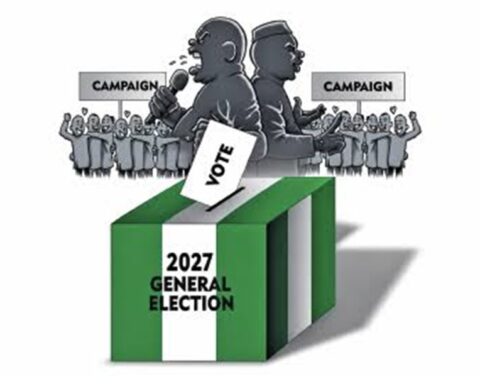
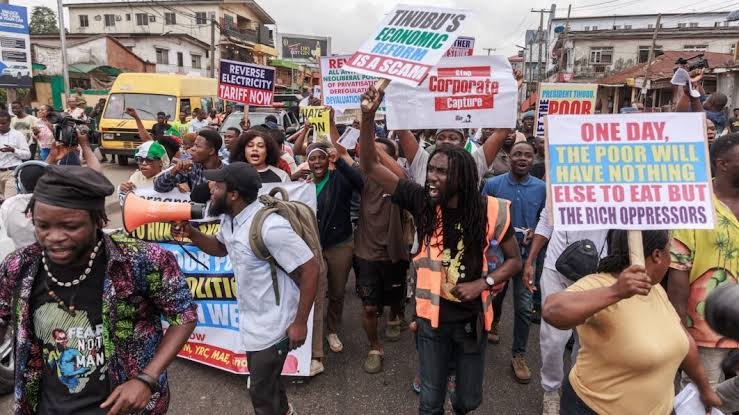
What American voters did to their president over the price of food and fuel, Nigerian voters are entitled to do to theirs. No Nigerian needs an exit poll to know what dominates the household conversation: the price of garri and petrol, school fees, the cost of getting to work. The American example is a reminder that a leader who tells a hungry people that the problem is solved will be answered at the polls, if the polls are free. Our own general elections of 2027 are ahead of us. The question is whether our ballot is still an instrument that can deliver such a message.
The second lesson is about candidates. Trump’s chosen candidates lost, in states he won, because voters judged the individuals in front of them and not only the label behind them. Nigerian parties hand out tickets in back rooms, impose candidates on constituencies that did not want them, and expect the voters to be grateful. The American result is a rebuke to that method. Where voters have any freedom of choice, the quality of the person on the ticket decides more than the party or the patron. A party that cannot vet its own candidates is writing its defeat before the election.
The third lesson is about how to lose. In March 2015 Goodluck Jonathan telephoned Muhammadu Buhari to concede the presidential election, before the electoral commission had completed its declaration. The call is widely credited with sparing Nigeria the violence that many feared, and it remains the finest act of Jonathan’s political life. Trump, in 2020, did the reverse, and the United States paid for it with the assault on its Capitol. On Tuesday night he did better, and the manner of it mattered.
A democracy is measured less by how its winners celebrate than by how its losers leave. Both presidential elections in Nigeria since 2015 have ended in tribunals. The tribunals have their place. But a political class that treats every defeat as theft teaches the public to distrust every result, and a public that distrusts every result will eventually stop voting or start fighting.
The count itself deserves a paragraph. American networks called the House within hours of the polls closing and the Senate before midnight, and the loser’s telephone calls followed before dawn. Nigerians know a different rhythm: results that crawl in over days, portals that stall at the critical hour, as the electronic results portal did in 2023, and a public left to guess. Trust in a count is built before the vote, in the machinery, in the transparency of collation and in the independence of the umpire. A people who cannot trust the count cannot accept the verdict, and a verdict that is not accepted settles nothing.
I confess to a particular envy as I read these returns. It is not envy of America’s wealth or power. It is envy of a people who, angry and tired, could walk to a polling place, express that anger in a manner that counted, and wake to find the result respected. The Nigerian voter is no less angry and no less tired. What the Nigerian voter too often lacks is the certainty that the anger will arrive at its destination undiluted. Closing that gap is the work of the next decade, and no foreign election will do it for us.
The fourth lesson is for Ndigbo, and for every community in Nigeria that has been taken for granted by those who court its votes and ignored by those who rule. The most striking feature of Tuesday was how quickly large blocs of voters moved. Latinos swung. The white working class eroded. Independents leaned. No group is anyone’s permanent possession, and a vote that is taken for granted will be withdrawn, while a vote that is ignored will be cast elsewhere.
The energy that gathered behind Peter Obi in 2023 was such a movement, and the establishment that mistook it for a passing mood, and the leaders who traded it for crumbs, should look carefully at what happened in Texas. A bloc that knows its own power and uses it as a bloc cannot be dismissed, and a bloc that sells its power piece by piece will always be paid in crumbs.
The fifth lesson is humility about the whole business of foreign saviours. It is tempting to read an American result and wait for it to fix our problems. It will not. Washington’s attention is a weather system and not a policy, and the weather changes. The killers in our villages will not be stopped by an American hearing. The price of bread will not fall because Congress has changed colour.
Our security must be built by Nigerians, with Nigerian soldiers who are properly equipped and led, Nigerian police who are trusted by the communities they serve, and Nigerian courts that convict. Our trade must be widened beyond the United States, within the African continental market and toward every customer who will pay. Our diplomacy must serve the Nigerian people and not the vanity of a patron in any capital. We should watch America as one watches a neighbour’s house. We should not try to live in it.
WHAT TUESDAY DOES NOT MEAN
It does not mean the end of Donald Trump. He has two years of presidential power in front of him, and the limits on that power are real and narrower than the headlines suggest. It does not mean the end of Trumpism, which has a loyal core, a hungry succession and a party that has not yet found its own voice. It does not mean that Democrats have been given a blank cheque; the polls show that voters want their party’s promises kept, not their opponents’ defeat savoured. It does not mean that the United States has returned to the foreign policy of the years before 2016, because voters rejected one war and one tariff regime, not the idea that America should drive harder bargains. And it does not mean that democracy in America is safe. It means that democracy in America held on Tuesday, and that is a different and more modest claim, and a far more useful one.
THE WEIGHT OF THE PEOPLE
By the time I finished reading the returns, dawn had broken over Lagos, the first buses were moving, and the vendors were setting out their wares. A day was beginning, for people whose lives will be shaped by decisions made in a city more than five thousand miles away, and who had no say in them. I thought of the American voters, in their millions, who had spent a Tuesday in line, and who had changed the course of their country without firing a shot.
Mencius told his king that the people are heavy and the ruler is light. In Washington, the people have just reminded the sovereign of his weight. The question for Nigeria is whether our own people will be given the chance to do the same, and whether, when the chance comes, they will have the courage, the organisation and the patience to use it.