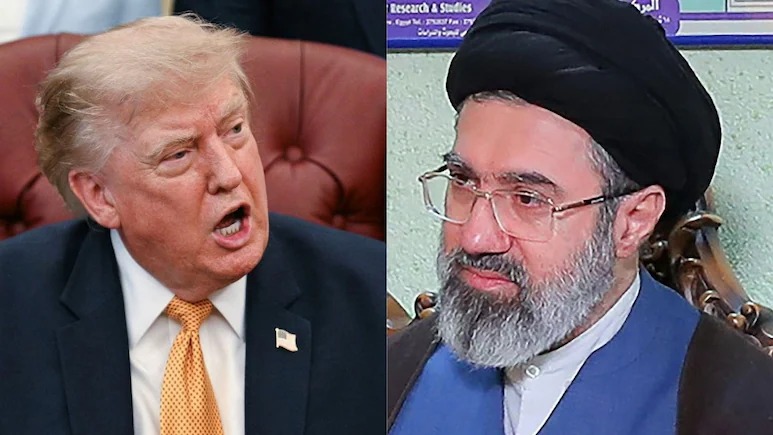
Iranian officials fired back on Saturday at U.S. President Donald Trump after he announced plans to declare the Strait of Hormuz a territory of the United States following what he described as an impending U.S. victory over Tehran.
The sharp diplomatic exchange underscores escalating rhetoric over the crucial energy passage, where commercial shipping has slowed to a near standstill.
Speaking on Friday, August 14, 2026, during an address to law enforcement personnel at the Police Academy Center for Training and Intelligence in Garden City, New York, President Trump declared his intention to take control of the waterway.
”After we finish defeating Iran, which is being very badly defeated pretty soon I’ll be declaring the Hormuz Strait a territory of the United States,” Trump told the crowd.
Trump reiterated claims that the U.S. military exercises “total control” over the passage, pointing to an active U.S. naval blockade that he dubbed a “wall of steel.” Acknowledging that the conflict has driven up global energy prices, Trump asked the American public to accept higher fuel costs to ensure Tehran is prevented from acquiring a nuclear weapon.
Tehran rejected Trump’s assertions on Saturday, August 15, asserting that the Islamic Republic maintains sovereign control over the choke point.
Iranian Deputy Foreign Minister Kazem Gharibabadi issued a firm statement on X (formerly Twitter), declaring that Washington could not annex the vital conduit through political rhetoric or military force.
”The Strait of Hormuz cannot be seized by tweet, nor by aircraft carrier, nor by issuing an order, nor by an election speech,” Gharibabadi stated. “The Strait of Hormuz has been Iranian, is Iranian, and will remain Iranian. This strait will only be closed and opened under Iran’s command.”
In a separate statement on Saturday to the Iranian news outlet Shahrara News, Foreign Minister Abbas Araghchi emphasized that while indirect discussions mediated by Oman regarding designated maritime transit corridors were ongoing, full access to the waterway would remain blocked until Washington accepts Tehran’s conditions and ends its military campaign.
The rhetoric follows months of heightened conflict in the region since the outbreak of hostilities in late February 2026. The Strait of Hormuz, which ordinarily handles nearly one-fifth of the world’s petroleum and natural gas supplies, has seen traffic plummet.
According to tracking data from Kpler, only two commercial vessels transited the strait on Friday, down from an average of over 130 daily transits prior to the conflict. Energy markets have reacted sharply to the standoff, with Brent crude nearing $90 a barrel and U.S. gasoline prices rising toward $4 a gallon as naval blockades and regional volatility continue to disrupt supply lines.