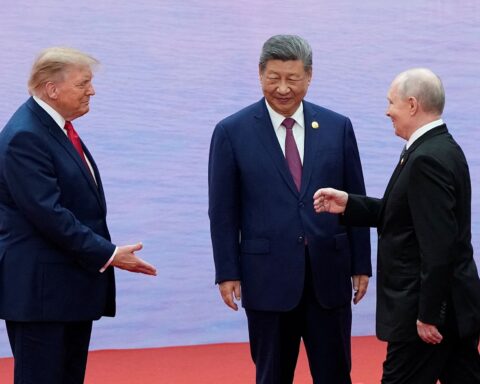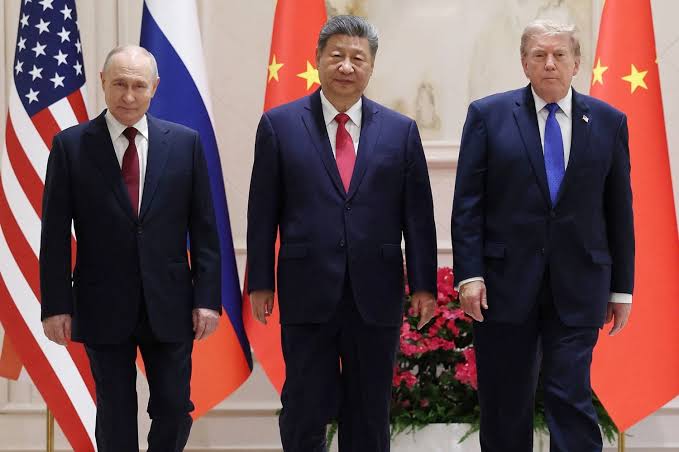
Chinese President Xi Jinping, U.S. President Donald Trump, and Russian President Vladimir Putin issued a joint four-point “Declaration toward Peace” on Thursday following their first-ever trilateral summit in Shenzhen.
The historic 80-minute meeting, held at the lakeside Kylin Villa resort on the sidelines of the 33rd Asia-Pacific Economic Cooperation (APEC) Economic Leaders’ Meeting, yielded commitments to nuclear risk dialogue, United Nations reform, energy market stability, and state official immunity, though it stopped short of announcing breakthroughs on ongoing wars in Ukraine and Iran.
The unprecedented three-way talks took place on Thursday, November 19, 2026, at Kylin Villa (Qilin Shanzhuang), a state guesthouse nestled in the hills of northwest Shenzhen in China’s southern Guangdong province.
Following earlier bilateral sit-downs at the same venue, including a roughly 40-minute meeting between Trump and Putin and an hour-long session between Trump and Xi, the three leaders convened around a dark round table at approximately 4:30 p.m. local time (08:30 GMT). After 15 minutes of televised opening remarks, the leaders met behind closed doors before concluding their discussions at 5:50 p.m. local time (09:50 GMT).
Preparations for the gathering had been underway since Kremlin spokesman Dmitry Peskov and presidential aide Yury Ushakov confirmed in September and November that the three capitals had agreed to the sidelines meeting, culminating in Trump’s arrival at Shenzhen Bao’an International Airport on Wednesday, November 18, where Xi broke decades of diplomatic protocol to greet him on the tarmac.
Shortly after the talks concluded, the White House, the Kremlin, and Chinese state media simultaneously published the joint statement, formally titled the U.S.-Russia-China Heads of State Declaration toward Peace. In the text, the three leaders outlined four core areas of consensus, beginning with a pledge on nuclear risk reduction.
Reaffirming that “a nuclear war cannot be won and must never be fought,” Washington, Moscow, and Beijing committed to conducting dialogue on reducing nuclear risks and preventing weapons proliferation, marking a critical step following the February 2026 expiration of the New START treaty.
As permanent members of the U.N. Security Council, the three powers also agreed to pursue United Nations reform so the body can respond more effectively to global challenges and fulfill its mandate of maintaining international peace and security.
Addressing economic pressures amid ongoing disruptions to global oil supplies caused by the U.S.-Iran conflict and the war in Ukraine, the three nations further pledged to bolster global energy stability by increasing the production and supply of refined petroleum products and ensuring stable energy flows.
Finally, the declaration took aim at international judicial bodies, recognising state consent and the immunity of state officials as paramount while asserting that the International Criminal Court (ICC) and similar tribunals “must not abuse their jurisdiction”, a direct rebuke to a court that has issued an arrest warrant for Putin and faced U.S. sanctions under the Trump administration.
During the open portion of the summit and in subsequent official briefings, leaders and spokespersons framed the meeting as a milestone in great-power diplomacy.
Greeting Xi and Putin at Kylin Villa, Trump declared, “We are really making history,” adding that “no peace was ever forged by declining opportunities for engagement,” before the White House released the formal text of the declaration shortly ahead of his departure from Shenzhen Bao’an International Airport for Washington.
In Beijing and Shenzhen, Chinese Foreign Ministry Spokesperson Mao Ning relayed Xi’s assessment on social media that the summit was “positive, constructive, and very productive,” noting that the three nations “share the same view on safeguarding world peace,” echoing her pre-summit remarks that the three countries, as founding U.N. members, shoulder a special responsibility for strategic stability.
Meanwhile, Putin described the talks as “open” and “very useful,” stating that the three leaders had written a new “page in the history of diplomacy” and shared converging interests in resolving regional conflicts, including Ukraine.
Earlier in the day, Kremlin aide Yury Ushakov had briefed journalists in Shenzhen following the preparatory Trump-Putin bilateral, confirming that Ukraine was the central topic of discussion and noting that the Russian president emerged in a “simply excellent” mood.
While state media in Beijing and Moscow hailed the declaration as a landmark step toward a multipolar world, international observers quickly noted that the final text omitted any direct mention of the nearly five-year Russia-Ukraine war or the ongoing conflict in Iran.
With neither Ukraine nor major U.S. allies in Europe and Asia represented at Kylin Villa, analysts characterized the summit as a triumph of diplomatic optics rather than an immediate catalyst for conflict resolution.