By Emmanuel Gandu
HIGHLIGHTS
✓ Quote of the day
✓ Excerpts
✓ Prelude
✓ Nigeria – a checkered political history
✓ 1960 – 1966 political violence
* Wild wild west
* NPC and NEPU violent clashes in the North
* Tiv riots
✓ 2011 post election violence
* Jonathan wins
* Buhari weeps on National TV and radio
* Violence unleashed on the North
✓ Political violence ahead of 2027
✓ 2026 Electoral Act on political violence
✓ Root causes of political violence in Nigeria
✓ Concluding Remarks
QUOTE OF THE DAY
“What difference does it make to the dead, the orphans and the homeless whether the mad destruction is done under the name of totalitarianism or in the holy name of democracy”?
– Mahatma Gandhi
EXCERPTS
[{ The perpetration and escalation of violence by individuals, political parties, and state-sponsored thuggery, arson, and murder of the opposition destroys and erodes public confidence in democracy. These infractions not only paralyzes civil administration, makes governance difficult, but goes a long way to create a complete breakdown of law and order.
Regrettably, this chaos had provided the direct justification for Nigerians to reject and denounce the ballot box in preference for the barrel of the gun. This led to the January 15, 1966 military coup d’etat that overthrew the government of the First republic and ended Nigeria’s first democratic experiment }]
[{ Lamentably, despite decades after independence, events in Nigeria indicates that Nigerians have not learned any democratic lessons.
It therefore remains to be seen whether Nigerians would again play into the hands of the dictatorial and totalitarianism of the men in uniform or be civil and defend their so called “Nascent democracy” by shunning political violence.}]
PRELUDE
The story of Nigeria’s First Republic remains a powerful reminder of how hope can falter when political gladiators turn political competition into violence, thuggery, regional/ethnicized allegiance, corruption, and inducement.
Unfortunately, these vices were aggravated by unchecked and impartial officiating and policing.
Expectedly, the escalation of both political party and state-sponsored violence, thuggery, arson, and murder of the opposition not only destroyed and eroded public confidence in the ballot but also paralyzed civil administration in the “wild wild west”, encouraged a dangerous rivalry between the North’s two political parties, and ignited the Tiv riots in the Middle Belt.
Subsequently, the chaotic situation over the country created a complete breakdown of law and order, leading to a public preference for the barrel of the gun in place of the ballot box.
By 1966, violence and thuggery had replaced dialogue.
These series of unhealthy do-or-die political competition provided the canon fodder and direct justification for the January 15, 1966 military coup that overthrew the First Republic and ended Nigeria’s first democratic experiment.
As the soldiers stroke, it led to the killing of some key political leaders including Sir Abubakar Tafawa Balewa, Prime Minister of Nigeria, Sir Ahmadu Bello (Sardauna of Sokoto) the Premier of Northern Region, Chief Samuel Ladoke Akintoa Premier of Western Region, Chief Okotie – Eboh Federal Minister of Finance.
Regrettably, the first strike by the soldiers and subsequent series of military interventions in the polity initially seen as a rescue mission turned out not to be, as these events eventually led Nigeria into a bitter 30 months civil war from 1967 to 1971, decades of authoritarian military rule.
Yet, the issues that doomed that First Republic remains and still echo in today’s contemporary Nigeria’s politics. It’s disheartening that the Nigerian politician have not learned any lessons, probably due to the high level of the Monetized polity. The rest of the world’s democracies had since left Nigeria behind.
The lesson is clear: democracy cannot thrive on violence, thuggery, ethnicized allegiance, electoral fraud, corruption and inducement.
It requires justice, credible, free and fair elections, good and inclusive governance, institutions and leadership that rises above ethnicity, party, and individual loyalties.
Only by confronting these old fault lines can Nigeria build the stable and inclusive democracy its founders once envisioned.
NIGERIA – A CHECKERED POLITICAL HISTORY
Nigeria’s checkered political history cannot be written without stating the role played by Britain.
Beginning from the scramble for Africa in 1880 to the Berlin Conference Partitioning of Africa in 1884 – 1885, leading to years of colonial rule culminating in the 1914 Amalgamation of Northern and Southern Protectorates, and finally to independence on October 1st 1960, ending several decades of British colonial rule.
When Nigeria gained that independence, the country emerged as Africa’s most populous and one of the most promising democracies.
The First Republic governed under a federal constitution modelled on Britain’s Westminster Parliamentary system aimed to balance regional autonomy with national unity.
Yet within just six years of independence, optimism turned into disillusionment due to political violence and turmoil.
Sadly, the violence and political turmoil that engulfed Nigeria’s First Republic reflected deep rooted ethnic, regional, and political divisions that the post colonial federal system failed to reconcile. Regrettably, corruption, electoral malpractice, impartial government institutions and partisan policing undermined the people’s confidence in democracy. Anarchy was let loose on the land. The soldiers stroke.
Therefore, understanding how this breakdown occurred is key to explaining Nigeria’s circles of political instability from independence to date in order for the country to avoid another truncation of party democracy through military coup.
1960 – 1966 POLITICAL VIOLENCE AND THUGGERY
At independence Nigeria was a federation of three powerful regions – Northern, Western, and Eastern; each with its own Premier, Legislature, and Civil Service. In 1963 a fourth region, the Mid West was created from the Western Region, partly to ease ethnic tension. As it were, the political parties reflected these regional identities.
During Nigeria’s first republic, violence and thuggery became systemic tools used by the regional and national political parties to silence the opposition, rig elections, and capture state power.
Built on a Westminster parliamentary system and marked by sharp regional, ethnic, and religious divisions quickly degenerated into a do-or-die struggle. This is how things played out:
✓ Western Region “Wild wild west.”:
Following a bitter intra-party crisis within the Action Group (AG) between Chief Obafemi Awolowo and Chief Samuel Ladoke Akintola, violent protests and clashes among their supporters was the order of the day. This era gave birth to “Operation Wetie” (meaning douse with petrol) where political thugs target the opposition party members by setting fire on their homes and property, as well as using gruesome methods of spreading petrol on tires and placing such tires around victims necks and setting them ablaze.
✓ Northern Region party clashes:
There was intense rivalry between the ruling Northern People’s Congress (NPC) and the populist opposition Northern Elements Progressive Union (NEPU) with headquarters in Kano.
As expected, party thugs and youth wings were regularly deployed and mobilized to break up rallies, intimidate, harass, and let loose mayhem and violence on opposition party candidates and their property.
✓ The Tiv riots in the Middle Belt:
In the Middle Belt, political violence peaked during the 1964 Tiv riots which were tied to resistance against the dominant Northern People’s Congress (NPC) regional structure that sidelined the people of the Middle Belt. This violence was associated with the United Middle Belt Congress (UMBC) led by J.S Tarka. The violence resulted in hundreds of deaths.
About 10 years after that Tiv riots, Nigeria’s regional political party rivalry and violence was visited on Joseph Tarka, Yakubu Gowon’s federal minister of communications. In this case, Tarka’s Tiv kinsman Godwin A. Dabo was used as a political stooge to force Tarka resign his ministerial position in 1974 from accusations of corruption. The whole political vendetta was planned by political opponents. This was an extension of political aggression carried over from years of Tarka’s activism during the Tiv riots.
It was widely viewed as being sponsored by rival political factions particularly elements from the Western Region and their co conspirators Northern elements who’s interest was not only to pay Tarka back in his own coins for his role in denying them the Middle Belt support to their various regional political parties, but the aggrieved Northern interests was as well, seeking to neutralize Tarka’s growing national influencing as the leader of the Middle Belt.
This is how far and dirty political rivalry and violence can go in Nigeria.
2011 POST ELECTION VIOLENCE
Following Nigeria’s April 16, 2011 presidential election, deadly riots erupted across the Northern states after incumbent president Goodluck Jonathan, a Christian from the Niger Delta in Southern Nigeria, of the People’s Democratic Party (PDP) was declared winner over opposition candidate Muhammadu Buhari, a Muslim from Katsina, of the Congress for Progressive Change (CPC).
Goodluck Jonathan won the election with 22,495,187 votes while Muhammadu Buhari came second with 12,214,853 votes.
However, Buhari in a widely televised and radio press conference rejected this results, alleging electoral rigging, and even wept publicly on National TV and radio.
This action was the canon fodder for his supporters to go wild with violence across the North.
According to Human Rights Watch, well over 800 people (conservatively) were killed in 3 days of continues violence, and over 65,000 displaced across 12 Northern states of Kaduna the highest with hundreds of deaths, Kano, Bauchi, Gombe, Adamawa, Niger, Bornu, Yobe, Jigawa, Nasarawa, Plateau, and Katsina.
The violent attacks targeted Christians, National Youth Service Corps (NYSC) members, Churches, election officials, Police stations, public figures’ homes, business and private buildings, and Mosques.
Ironically, and according to Corinne Dufka, Senior West African Researcher at Human Rights Watch, “This April 2011 election were heralded as among the fairest in Nigeria’s history, but they also were among the bloodiest.”
Lamentably this election divided Nigeria the most along ethnic and religious lines despite the wide margin of votes between Jonathan and Buhari.
POLITICAL VIOLENCE AHEAD OF 2027 ELECTIONS
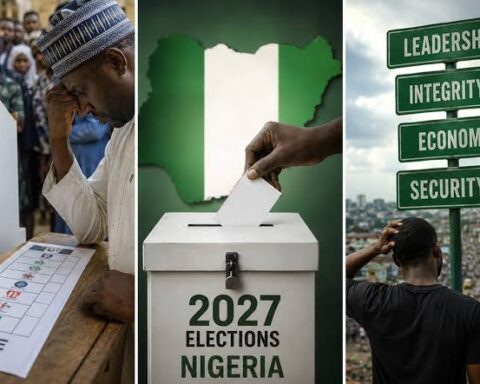
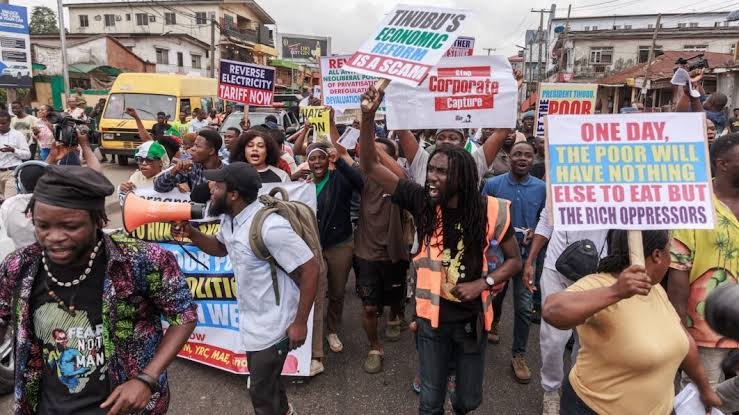
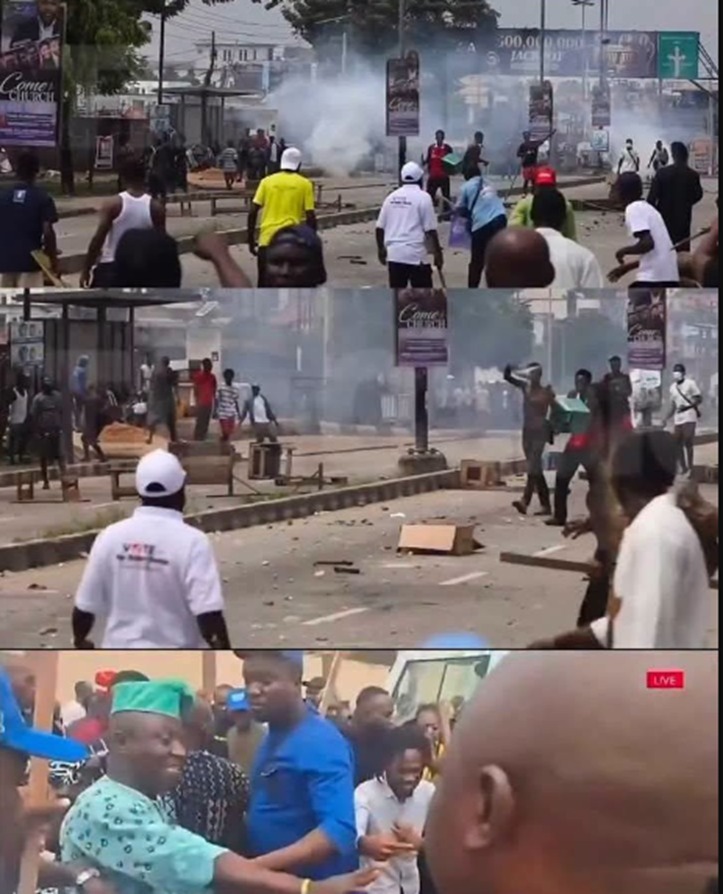
As violence take center stage by political party supporters ahead of the January 2027 elections, concerned Nigerians and friends of the country have called on the security forces to investigate the circumstances surrounding the rising incidents of violence and thuggery.
These incidents of violence across the country have led to several deaths of not only party supporters but even passersby.
Political party materials like billboards are destroyed, unprintable name calling of opposition candidates is the order of the day, destruction and vandalization of vehicles and buildings of opposition politicians is alarmingly on the increase, arson and burning down of opposition party properties by thugs is a daily affair, denying opposition parties from holding rallies and political meetings in many states is without caution by INEC, Stoning and pelting of opposition campaign convoys is dangerously left and unhindered by security agencies, Tinubu’ convoy was attacked by thugs after Friday mosque in Abuja, NDC vehicles have been riddled with bullets, windscreen of opposition party vehicles have been smashed, Kwankwaso’s convoy have been attacked in Kano, Obi is not welcome to campaign in APC controlled states, etc, etc.
As the situation gets uncontrollable, you hear things like “Tinubu must go”, “Ba ma yi”, “Atiku must go”, “Obi is not welcome here”,
Concerned voices about the alarming spate of violence include the following:
* The Nigerian Defence Minister, General Christopher Gwabin Musa (Rtd.) sent a strong warning to politicians ahead of the 2027 general elections. According to Musa, “We have seen this film before.”
* Former Nigerian president Goodluck Ebele Jonathan warned Nigerian politicians not to burn down the country. In his words – “We have seen the smoke, but we pretend not to see the fire.”
* A former president of the ECOWAS Commission, Dr. Omar Alieu Touray warned Nigerian politicians to see political competition as a contest of ideas and policies not a fight of tribe, religion, or region for power, as this could destroy national cohesion and threaten democracy.
* On its part, the Kukah Centre’s Election Security Information Hub and the National Peace Committee Secretariat documented 109 political violence cases in violations of the National Peace Accord across 26 states and the Federal Capital Territory (FCT) between August 19 and October 27, 2026 ahead of the 2027 elections.
Unfortunately, these raging and rising incidents of violence is becoming dangerously alarming, and if left unchecked will engulf and consume the entire country. If that happens (God forbid), Nigeria may descend into anarchy, reminiscent of the 1960 – 1966 anarchy that led to the end of the First Republic.
For now, its either Nigerians make the best situation of the ballot box or we be forced to the dictatorial and totalitarianism of the barrel of the gun.
2026 ELECTORAL ACT ON POLITICAL VIOLENCE
The Electoral Act 2026 outlines key constitutional safeguards to curb electoral violence.
These infractions are enshrined in section 92, 95, 96, 97, 121 – 128.
They include conditions that may lead to candidate’s disqualification, prison sentence, payment of fines, suspension/cancellation of elections.
* Section 92 empowers the Independent National Electoral Commission (INEC) to suspend elections in volatile areas.
* Section 97 prohibits the use of or threat of force or violations during political campaigns.
* Sections 121 – 128 penalizes violence, voter intimidation, and ballot box or BVAS snatching with 12 months to 5 years of imprisonment.
* Section 95 states:
1. The police to provide adequate security for political rallies and processions.
2. Political parties and candidates cannot be blocked from holding constitutional political meetings or rallies, and any scheduling disputes are to be resolved consultatively by the police.
3. State and FCT Commissioners of Police must ensure adequate security for peaceful rallies, with support from NSCDC and other federal agencies.
* Section 96 prohibits with penalties the following:
1. Use of abusive and divisive language that directly or indirectly injures religious, ethnic, tribal, or sectional feelings.
2. Places of religious worship, police stations, public offices, etc are not to be used for political activities.
3. Use of private militia, and armed private security by political parties is prohibited.
4. Use of masquerade during campaigns are prohibited.
ROOT CAUSES OF POLITICAL VIOLENCE IN NIGERIA
(1) Ethnic and regional hegemony:
Political parties are largely ethnically and regionally based, thereby turning electoral contests into existential ethnic survival battles where people vote for candidates from their tribe or region – no thanks to mantras like “it is my turn”, “rotation”, “zoning”.
The earlier Nigerians realize that democracy cannot thrive on divisive rhetorical analysis, the better. Democracy requires justice, free and fair elections, and a people that rises above ethnic and regional divisions.
(2) Corruption in government and public office:
Governance places high stakes in public office. This guarantees patronage, oversight control, exclusive access to public funds. Ultimately, it makes political office intensely lucrative, and hence fiercely contested.
Little wonder, Winston Churchill in 1947 described democracy as “…..the worst form of government.”
(3) Monetized political system:
The use of money to buy votes in the conduct of Nigeria’s elections by both the political parties and the aspirants is becoming so alarming, unbearable, unethical, that the system throws up the ticket for the highest bidder. This leaves much to be desired.
Using the APC party and the sale of its tickets for contest of positions in the 2023 election to buttress this argument suffices.
As at Friday May 6th 2022, The APC recorded the following revenue from the proceeds of sales of forms/tickets to candidates seeking interest to contest the various positions :
1. 241 aspirants picked senatorial forms sold for twenty million Naira per form. ie 20m x 241 = N4,820,000,000 ( that is over 4.8 billion naira).
2. 821 aspirants Picked forms/tickets for House of Representatives sold for 10m per form. A total of N8,210,000,000 was realized. ( that is over 8 billion naira).
3. 1,505 aspirants Picked States House of Assembly forms/tickets sold at 2m per form. 3,010,000,000 was realized from the sales (that is over 3 billion naira).
4. 48 aspirants Picked Governorship forms/tickets sold at 50m per form. 2,400,000,000 was realized from the sales. ( that is over 2 billion naira).
5. 25 aspirants Picked Presidential forms/tickets sold at 100m Naira per form. A total of 2,300,000,000 billion naira was realized.
Grand total of 20,740,000,000 Naira was realized (20.7 billion + approx)*
IMPORTANT POINTS TO NOTE.
1. These payments came from less than 3,000 Nigerians into the coffers of APC
2. Over 95 % of these 3,000 aspirants are people who have been around the corridor of power.
To put it in another way, this money was moved from Nigeria public coffers into private pockets and then re directed into APC coffers.
3. This money gave APC the power to dominate and influence the 2023 elections as they chose.
4. It is the masses of Nigeria and the opportunity for development that will pay back with multiple interests all these monies flowing to the politicians.
5. Since the stakes are high, every politician goes to any length to win, even if it means killing his opponent in the political contest.
(4) Youth unemployment and hunger:
The high level of unemployment and widespread poverty is exposing the vulnerable youths for recruitment as thugs, armed gangs and agents of violence by politicians.
Worried by the unfortunate level of unemployment especially in democratic countries, Pope John Paul II offered this advice – “Democracy creates favourable conditions for the free exercise of economic activity, which will lead to abundant opportunities for employment and sources of wealth.”
(5) Weak law enforcement:
The judicial system and the police have been compromised, politicized. Because they have become partisan due to alleged accusations of inducement, they are unable to be be fair, just and prompt in the arrest and prosecution of perpetrators of political violence.
These failures leads to the drift towards impunity of anarchy.
(6) Umpire (INEC) impartiality and partisanship:
INEC have been accused severally of doing the bidding for the political party of the government in power. Such accusations include a compromised voter register, aiding electoral fraud, and influencing or refusal to abide by the guidelines as enshrined in the Electoral Act.
Further than that, electoral malpractices are allegedly committed and or aided by INEC officials right from the polling unit, ward level, local government collation center, and up to the state collation center.
Lamentably, voting materials, ballot boxes, BVAS, IREV, and the transmission of results are known to not function effortlessly thereby leading to glitches.
When these infringement persist the opposition political parties resort to self-help by embarking on violence as the only alternative to ascertain their voice and to reclaim their stolen mandate.
CONCLUDING REMARKS
In 1863, a former American president described democracy as – “Government of the people, by the people, for the people, shall not perish from the earth.” – Abraham Lincoln.
But the reverse of that definition is the case in Nigeria where democracy is by the political thieves, who sponsor political thugs, to unleash violence on the people, while they concentrate on looting the country’s resources to their foreign bank accounts.
Contrary to Abraham Lincoln’s definition, democracy in Nigeria is creating poverty, hunger, unemployment, armed robbery, teenage pregnancy, out-of-school children, banditry, rape and kidnapping for ransom, and all manner of criminality.
If this is what democracy will continue to unleash upon Nigerians, then, Abraham Lincoln had better keep his democracy.
Although there is a ray of hope at the end of the tunnel from one former Roman Catholic Pontiff who encouraged the practice of democratic rule. In his words –
“Democracy creates favourable conditions for the free exercise of economic activity, which will lead to abundant opportunities for employment and sources of wealth.”
– Pope John Paul II.
However, the perpetration and escalation of violence by individuals, political parties, and state-sponsored thuggery, arson, and murder of the opposition destroys and erodes public confidence in democracy.
The collapse of Nigeria’s First Republic revealed the fragility of the country’s democratic foundations. Ethnicized politics, electoral fraud, and regional distrust eroded national unity.
Lamentably, political violence unchecked by impartial policing or strong institutions made democracy unsustainable. When the soldiers intervened through a military coup in 1966 many Nigerians welcomed it as a corrective measure unaware it would usher in decades of dictatorship and authoritarian rule.
These democratic infractions not only paralyzed civil administration, made governance difficult, but goes a long way to create a complete breakdown of law and order.
Regrettably, this chaos had provided the direct justification for Nigerians to reject and denounce the ballot box in preference for the barrel of the gun, thereby led to the January 15, 1966 military coup d’etat that overthrew the government of the First republic and ended Nigeria’s first democratic experiment.
Yet those issues that doomed the first republic – corruption, exclusion, violence, ethnicity, and distrust between regions still echo in Nigeria’s modern politics.
Lamentably, despite decades after independence, events in Nigeria indicates that Nigerians have not learned any democratic lessons.
It therefore remains to be seen whether Nigerians would again play into the hands of the dictatorial, authoritarian and totalitarianism of the men in uniform or be civil and defend their so called “Nascent democracy” by shunning political violence.