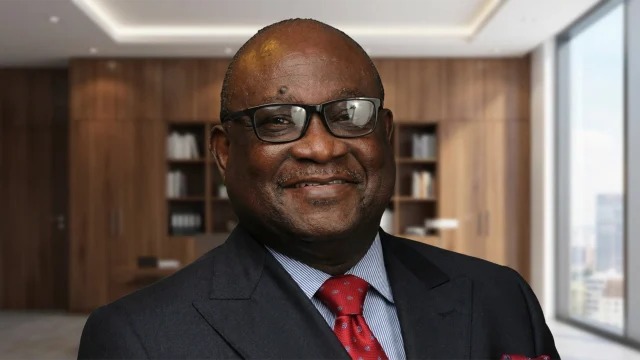
Lagos, Nigeria, 22 October 2026 — Udeme Ufot, Group Managing Director of SO&U and Member of the Order of the Federal Republic (MFR), has challenged the School of Media and Communication (SMC) at Pan-Atlantic University to move beyond incremental curriculum updates and summon the courage to undertake a fundamental rethink of how strategic communicators are trained for a networked world.
Delivering the keynote address at the school’s 20th-anniversary Festival of Ideas, Ufot congratulated the institution on the milestone and reflected on its origins. He recalled remembering the school “being just an idea” and noted that the late Professor Albert Alos, the pioneer Vice-Chancellor of Pan-Atlantic University, had sought industry validation—later persuading SO&U to sponsor one of its first executive programmes. He observed that the school had evolved in tandem with an industry in which digital platforms, barely considered at its founding, had become central to marketing communications.
Ufot stressed that the theme— “Daring the Future of Strategic Communications Education in a Networked World”—placed the emphasis on courage rather than prediction. “We are not here to predict what the future of communication will look like. We are here to ask a more important question: Do we have the courage to shape it?” he said.
He argued that simply adding social media, artificial intelligence and digital modules to an existing curriculum would be insufficient. The relationships between organisations and audiences, the speed of information, the nature of influence and societal expectations had all changed fundamentally.
Strategic communication, he insisted, must begin with a clear understanding of the problem, the people, the context and the realistic role communication can play. At SO&U, the guiding principle of “Creativity That Works” means that ideas must change perception, behaviour, trust, relationships or business outcomes rather than merely attract attention.
Ufot challenged Nigeria’s communicators to become innovators, not consumers. “For too long, our communication education has sometimes been treated as a consumer of ideas developed elsewhere. I believe we should dare to reverse that relationship. Nigeria offers the world valuable lessons in understanding diverse audiences, informal economies, cultural negotiation, community, resilience and trust. These are not limitations; they are sources of knowledge,” he said.
He added: “Our opportunity is to turn those experiences into scholarship, ideas, frameworks and practices that can contribute not only to Nigeria and Africa, but to the global conversation.”
Ufot called for stronger town-and-gown alliances so that graduates become doers who deliver results, not merely talkers. He urged the school to teach students to ask better questions in an information-rich environment, to develop cultural intelligence that keeps Nigerian communicators globally connected without becoming culturally disconnected, and to treat Nigeria’s lived experience, including diverse audiences, informal economies, community, and resilience, as intellectual assets rather than constraints.
Mr Ufot affirmed: “We must teach future professionals that what is possible is not always right, what is trending is not always true, and that engagement does not always create value.
“Strategic communications cannot be fully understood from a textbook. It is a discipline of practice. You learn from people, markets, culture and mistakes, and sometimes most from the moments when the plan does not work”
He closed by challenging the school not only to prepare students for today’s industry but also to help them redefine it, discover what it does not yet know, and equip them with the confidence, judgement and courage to shape the future. “Twenty years ago, this School dared to begin. Today, it has the opportunity to dare again,” he said.
Professor Abigail Ogwezzy-Ndisika of the Department of Mass Communication, University of Lagos, and Mr Kingsley Uranta of Channels Television led a robust discussion of the paper. Dr Chike Mgbeadichie moderated as engaged and excited students raised numerous questions.