The Chairman and Chief Executive Officer of United Nigeria Airlines (UNA), Professor Obiora Okonkwo (OFR), has called on Nigerian tertiary institutions to urgently reform the nation’s educational framework by prioritizing practical skills, technological innovation, and entrepreneurship over the simple acquisition of academic certificates.
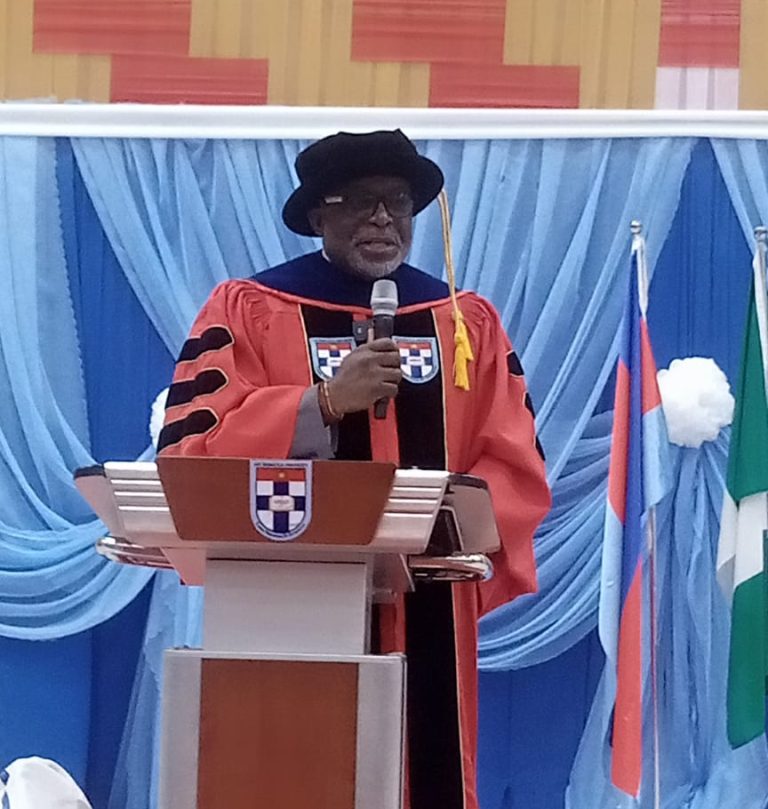
Professor Okonkwo made the call on Tuesday, October 20, 2026, while delivering the 14th Convocation Lecture of Afe Babalola University, Ado-Ekiti (ABUAD) at the Alfa Belgore Multipurpose Hall in Ado-Ekiti, Ekiti State.
Speaking before an audience of academics, industry captains, students, and policymakers, Professor Okonkwo delivered a paper titled: “Functional Education and the Nigerian Project: Strategic Human Capital Development for National Renewal.”
Addressing the gathering, Professor Okonkwo stated that Nigeria’s socio-economic renewal depends on transitioning from a certificate-driven educational model to a competence-based paradigm.
”The guiding principle should be simple: education must produce capability, because the ultimate measure of an educational system is not the certificates it awards, but the capacity it creates in its people to build, solve, innovate and transform society,” Okonkwo stated.
He noted that although governments, university administrators, and corporate employers have advocated “functional education” for decades, the system has struggled to translate theoretical concepts into actionable solutions for national growth. He urged graduating students not to treat their degree certificates as the final destination, but rather as tools for practical contribution.
Emphasizing that technical expertise without moral integrity poses a risk to sustainable growth, Professor Okonkwo highlighted the necessity of character in educational development.
”Excellence without integrity is dangerous; competence without character is unstable; innovation without ethical restraint is destructive rather than transformative,” he remarked, citing civil rights leader Dr. Martin Luther King Jr., as well as scholars Francis Fukuyama and Douglass North on institutional trust.
To bridge the gap between classroom theory and industry requirements, Okonkwo highlighted practical collaborations between academia and industry.
As a key example, he cited the strategic 10-year framework between United Nigeria Airlines and ABUAD, under which approximately 20 final-year aeronautical and aerospace engineering students undergo structured industrial training annually.
The inaugural cohort is currently undergoing a six-month intensive practical program covering aircraft maintenance, avionics, safety protocols, and aviation operations at the airline’s engineering facility in Lagos.
The Convocation Lecture drew widespread praise from key stakeholders present at the event; Aare Afe Babalola (SAN), Founder and Chancellor of Afe Babalola University, commended the address as one of the most insightful presentations delivered at the university.
He announced plans to forward copies of Professor Okonkwo’s blueprint to President Bola Ahmed Tinubu, the Federal Ministry of Education, and the National Universities Commission (NUC) for policy integration.
Professor Peter Okebukola, former Executive Secretary of the NUC, endorsed the recommendations, noting that aligning university curricula with direct economic demand is critical for national development.
Professor E. Smaranda Olarinde, Vice-Chancellor of ABUAD, noted in her remarks that the convocation lecture serves as a vital national platform to address structural challenges in higher education and present actionable policy recommendations.
Mazi Osita Okonkwo, Managing Director of United Nigeria Airlines, was also present alongside other university officers and aviation executives.