The sweeping disruption began on Friday afternoon, November 13, when radar and telecommunications systems started experiencing widespread instability across regional Air Route Traffic Control Centers nationwide during a scheduled technology upgrade at 3:36 p.m. EST.
Within eighteen minutes, at 3:54 p.m. EST, the Federal Aviation Administration issued an immediate nationwide ground stop for all departing commercial flights.
During the shutdown, only critical medical evacuations, lifesaving cargo, and law enforcement flights were permitted to take off, while air traffic controllers safely guided roughly 3,100 airborne flights already en route to their destinations.
Technicians worked for more than four hours to stabilize and thoroughly test the network before the FAA officially lifted the ground stop and reopened the airspace at 8:15 p.m. EST on Friday, or 01:15 GMT Saturday.
The four-hour freeze marked the first nationwide ground stop in the United States since a computer system malfunction in January 2023, and only the second time federal regulators have ordered such a sweeping measure since the September 11, 2001, terrorist attacks.
Speaking during an evening press briefing at the White House on Friday, U.S. Secretary of Transportation Sean Duffy attributed the failure to overloaded, decades-old telecommunications infrastructure rather than a system-wide electrical blackout. Explaining that legacy switches, routers, and 1980s copper lines had become overwhelmed, Duffy noted that the aging network went down everywhere simultaneously.
The Transportation Secretary, who had formally requested $30.1 billion from Congress on Thursday, November 12, to overhaul the nation’s air traffic control network, renewed his call for immediate emergency modernisation funding.
While confirming that full system functionality had been restored, Duffy cautioned travelers that returning to normal operations would take time and emphasized that passenger safety remained the agency’s top priority.
Joining Duffy at the White House briefing, Secretary of Homeland Security Markwayne Mullin sought to quell public anxiety and online speculation regarding national security.
Mullin stated unequivocally that federal investigators had seen zero evidence of a cyberattack or artificial intelligence intrusion, assuring reporters that the public, flights, and lives were never at risk and that the FAA had enacted the halt strictly out of an abundance of caution.
On Capitol Hill, lawmakers echoed calls for urgent infrastructure reform, with House Aviation Safety Caucus Chairman Rep. Nick Langworthy (R-N.Y.) stating that Congress could no longer afford to delay modernization, and Sen. Eric Schmitt (R-Mo.) describing the outage as a wake-up call and a major public safety and national security issue.
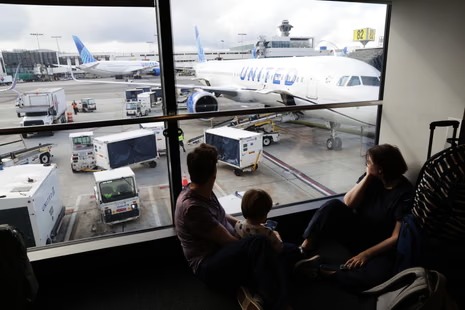
By Saturday morning, the cascading impact of the Friday evening shutdown remained severe across major travel hubs, including Chicago O’Hare International Airport, Los Angeles International Airport, New York’s LaGuardia Airport, Orlando International Airport, Baltimore/Washington International, and Washington Dulles International Airport.
According to tracking platform FlightAware and The Associated Press, between 6,000 and 8,000 flights were canceled nationwide from Friday night into Saturday morning, alongside more than 26,000 global delays that left over 1.5 million passengers stranded or disrupted.
Major carriers, including American Airlines, United Airlines, Delta Air Lines, JetBlue, and Air Canada, worked overnight to reposition out-of-place aircraft and flight crews after JetBlue canceled all remaining domestic flights on Friday evening and Air Canada temporarily suspended U.S.-bound routes.
Aviation authorities advised all passengers scheduled to travel over the weekend of November 14–15 to verify their flight status directly with their airlines before heading to the airport.