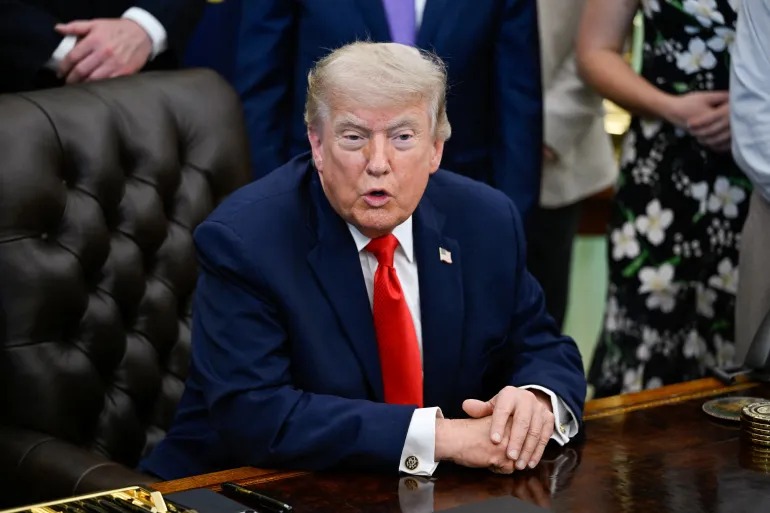
In a major breakthrough following months of devastating conflict, U.S. President Donald Trump announced that a comprehensive peace agreement has been reached with the Islamic Republic of Iran, effectively bringing an immediate and permanent end to military operations across all regional fronts, including Lebanon.
The agreement, which caps nearly four months of devastating warfare that disrupted global energy markets and upended the Middle East, will see the immediate lifting of the U.S. naval blockade on Iranian ports and the reopening of the strategic Strait of Hormuz.
President Trump took to social media on Sunday afternoon to declare the conflict resolved, marking a major foreign policy milestone and regional peace for the MiddleEast.
”The Deal with the Islamic Republic of Iran is now complete. Congratulations to all!” Trump wrote on Truth Social. “I hereby fully authorize the toll free opening of the Strait of Hormuz, and, simultaneously herewith, authorize the immediate removal of the United States Naval blockade. Ships of the World, start your engines. Let the oil flow!”
The announcement followed a statement from Pakistani Prime Minister Shehbaz Sharif, who acted as a key mediator alongside Qatari negotiators. Sharif confirmed that both Washington and Tehran have declared an “immediate and permanent termination of military operations on all fronts, including in Lebanon.”
An official diplomatic signing ceremony is scheduled to take place this coming Friday, June 19, in Switzerland.
The core of the economic breakthrough centers on the Strait of Hormuz, a vital maritime chokepoint responsible for the passage of roughly a fifth of the world’s oil consumption. The waterway has been heavily restricted and besieged by naval clashes since late December of last year, sending shockwaves through global energy markets.
Under the terms of the newly brokered agreement, the passage will be completely open to international shipping with no transit fees or tolls enforced by Tehran. The United States will concurrently dismantle its naval blockade of Iranian ports, allowing commercial trade to resume.
G7 nations, spearheaded by a joint UK and French naval task force, will immediately begin an intensive demining operation in the strait to ensure safe passage for commercial tankers.
The path to peace was nearly derailed early Sunday following an Israeli airstrike on a suspected Hezbollah target in Beirut, Lebanon. The strike drew rare public criticism from President Trump, who noted on social media that the attack “should not have happened, particularly on a special day when we are so close to a Peace Deal with Iran.”
Iran’s Deputy Foreign Minister, Kazem Gharibabadi, subsequently confirmed the agreement on state television, indicating that Tehran would begin implementing its provisions immediately following Friday’s formal signing.
While the full text of the memorandum of understanding remains under wraps, senior U.S. officials indicated that the package hinges on strict nuclear non-proliferation guarantees. Iran has reportedly agreed to halt any pursuit of nuclear weaponry and permit the U.S. to oversee the management and potential extraction of its highly enriched uranium stockpiles.
World leaders have swiftly reacted to the news with a mixture of relief and cautious optimism. UK Prime Minister Sir Keir Starmer praised the breakthrough as a “hugely important step forward” while emphasizing the critical need to maintain freedom of navigation.
”Our priority is that this becomes a durable and lasting peace,” Starmer said, confirming that British forces stand ready to assist in securing the waterway.
Oil futures dipped sharply in late-night trading following the announcement, signaling immediate market relief at the prospect of restored global shipping lines.