By Nduka Nwosu
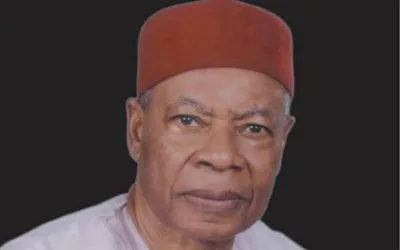
Ambassador Arthur Mbanefo (CON, MFR), the Odu of Onitsha, and once Nigeria’s Permanent Representative to the UN, and I crossed each other’s paths while I was a literary correspondent contributing to the Art/Life column created by Dele Giwa in the Daily Times.
When the pantheons of Nigerian mythical art and mythology are chronicled, there is no doubt Mbanefo will stand tall as a reference point, as a first among equals from the many titans that traversed that space of mortals transformed into the immortal Igurube, which the legend Bruce Onobrakpeya celebrated in his 1990s exhibition. That was when the locusts returned as reincarnates and messengers of Ieschouah, the great architect of the universe.
The focal point of Mbanefo’s perception of art, especially Nigerian art, could be likened to the mindset of Papus, a co-founder of The Martinist Order (TMO) who celebrated the Christ in mystical tradition.
Mbanefo saw everything positive in Nigerian art and was unlike Werner Spies and, in fact, Gottfried Benn, who chided German artists, minus Max Ernst, for travelling to France in search of validation and patronage. German art critics considered this attitude a condescending gesture to French masters.
It was a case of identity versus dominance. For Mbanefo, Nigerian art was the Obatala or Orisha of all art.
He promoted and patronised Nigerian and African art, opening several exhibitions with famous quotations.
I raised these issues when he turned 70 and stood him out as a Masquerade of African Art in my write-up in the Guardian Art column edited by Jahman Anikulapo.
Once, he invited me to Nike Lake Hotel, Enugu, before it was declared open, showcasing an array of art collections both paintings and sculpted works, in surreal garments typical of the emerging style of the Japanese-American sculptor Isamu Noguchi known for his blend of the East and West culture, leaning on a synthesis of modernism, the third, perfect point of the mystical triangle.
Noguchi, like the Dutch painter Piet Mondrian who created the Broadway Boogie Woogie, based on his interpolation of New York as a city of great vibes in the 1940s, had translated his art forms to sync with the choreography of Martha Graham, and scenarios that put new life into our appreciation of nature.
Did these characters impress Mbanefo in his days?
Was he aware of such scenarios between landscape and images, between images and imageries, between jazz and Afrobeat, comparisons of different milieus generally?
Possibly.
At this time-the 1980s, that is, art was more of an altruistic venture, less an investment locked up to appreciate in value over time as retrospectives to be exhibited much later, primarily to attract millions of naira or dollars, as a commercial venture.
There were exceptions, though. After taking me round the National Theatre to behold the presence of his artistic and sculpted designs, it did not take much to hazard a guess that in addition to being a director of the then leading advertising agency Lintas, my friend Erhabor Emokpae had become a success story in his chosen profession.
There was also Adebayo Adeleke, an engineer and property developer, the brain behind the now exclusive and privileged resort-the Banana Island but more importantly, another art enthusiast and promoter in this context, who sponsored the writing and publication of: ‘A Life with the Gods in their Yoruba Homeland,’ by Susan Wenger and Gert Chesi, sold at Falomo Shopping Centre at Awolowo Road, Ikoyi.
Mbanefo appreciated all of these essences and more.
What was intriguing was how his knowledge of numbers complemented seamlessly his active avant-gardism in the promotion of art and its blend with themes reflective of the various departments of human endeavour.
His image looms large, pushing boundaries with depths of innovation, even now that he has joined the big masquerades-the Nnukwu Mmanwus of our time.
Mbanefo was the silent worker who saw beyond the mere presence of 20th-century art, a welding of yesterday and today, in an attempt to divine what tomorrow portends for man.
Art to him was beyond the ordinary. It was spiritual and divine; through it man can have a glimpse of the ethereal, acquiring as it were, Adam’s lost spiritual flesh and with it, experience a test of Eden, man’s lost paradise.
In its depth, it took sentient form, and Being (God) assigned it dimension, transforming its adherents into other levels of existence and contemplation.
This background or proposition conforms with the mystical invocation that says to Being or to God, there has never been a beginning, for nothing cannot give rise to something, a reflection of the philosophical and cosmological arguments against linear time where nothing (ex-nihilo) gives rise to something, supported by the Big Bang theory.
No!
Art, Nigerian art, of course, conforms with the existence of a Divine Being and cannot be an vehicle for the practice of witch craft and occult fellowship, wrongly perceived in Erhabor Emokpae’s description of the Lord’s Last Supper.
Mbanefo belonged to the above school of thought, which also postulated that in the long run, art is a catalyst, a harbinger of what is to come, an effervescence that would crystallise to give the future a direction.
He was a promoter of his uncle or kinsman Ben Enwonwu, a real master and celebrated painter and sculptor with global recognition, Nigeria’s art ambassador at the international scene.
Mbanefo reminds me of Okpu Eze, sculptor, surrealist, and President-Emeritus, Society of Nigerian Artists (SNA), who named one of his sculpted works Ikenga, a mark of scholarship and recognition in Igbo culture.
According to Eze, Ndi Igbo recognise, and value affluence as an art of greatness because poverty is an art of nothingness, and nobody celebrates it. Ikenga, as a philosophy of achievement, goes beyond physical acquisition to the wealth of mind and soul.
I once visited Wole Soyinka in the home of his adopted son, Yemi Ogunbiyi (Activity). It was a modern shrine of artworks. Soyinka sat there in a serene atmosphere, projecting a halo, an aura of an elevated soul.
I have seen Okpu Eze in that meditative mood, surrounded by his artistic presentations, which he claimed were vehicles of communication with past masters, ditto for Ben Enwonwu at his Ikoyi home, insisting no one could leave with his originals uninsured.
Did I meet Mbanefo seated in a hallow of his art shrine or altar at his Kingsway Road residence, meditative and contemplative? He was always so anyway, at home and at work. He was simple and great at the same time.
Mbanefo exuded the qualities of Ikenga. He was an Ikenga in human form. The Nigerian art space in his days and long before his arrival was and still is, a marketplace of great ideas. It was a shrine of futuristic concepts separate from the banality of airport art.
It became and still is a Mecca of some sort, with scouts encouraging natives to sell their totems, their contacts with their gods, and for peanuts. These shrines called originals appreciated in value once they were smuggled out of the country, into millions of dollars at Sotheby’s and the Museum of Modern Art (MOMA).
This was how the Benin and other African and Nigerian artworks were looted by the invading colonial masters.
In their search for new themes that would drive European art, the likes of Pablo Picasso and Georges Braque came to Africa and left with Cubism.
The Mbanefos resisted this unfolding adultration with a patriotic movement of patrons that turned Nigerian art into a Holy Grail whose message was the long forgotten and suppressed African religion.
In art, Nigerian art, to be specific, can be found signs and symbols as well as passwords, which, when unveiled, provide the secret key in our reintegration with the Almighty.
Enwonwu, Mbanefo, the Nsukka School of Uli Art, with Obiora Udechukwu, an art teacher whose 1980s exhibition – No Water to Drink, attracted critical attention and acclaim, bubbled in the Nigerian art space with their idioms and themes.
There was also the Ghanaian teacher and sculptor El Anatsui; the ABU and Oshogbo schools populated by great masters like Onobrakpeya, Dele Jegede, David Dale, Susan Wenger (Adunni Orisha), Twin Seven Seven et al. Wenger’s former husband, the German Ulli Beier, was active in organising the Oshogbo School into a formidable movement.
For Mbanefo, these actors were just reflections of Igurube, the locust, the messenger of the divine in the world of art.
So when I critiqued the sculpted works of the Ife University Art School mounted on exhibition at the gallery of the National Arts Council in the 1980s, under DG Aig Imoukhuede, as essentially Mexican in content and style, especially the Cock series, a protest party led by Head of Department Babatunde Lawal, visited Daily Times, associating me with the Art of Unpatriotism and demanded for a better write up after a visit to the school’s studio.
Mbanefo would have felt differently from my observation.
I was not surprised he ended up having a daughter-in-law in the person of Sally Uwechue-Mbanefo whose artworks were exhibited by her employer, the International Merchant Bank (IMB) in the 1990s.
Beyond that, Mbanefo was a Nigerian icon, a trail blazer statesman who lived a spiritually uplifting life in many departments of human endeavour.
I will close this tribute with a famous quote whose author I cannot remember: “The Adept is at his best only with the Adept. Around him is a sacred circle, and within it only, the Elect is allowed to enter.
The Brotherhood of Consecrated Lives admits those who are worthy and those who are excluded, exclude themselves.”
May his soul rest in peace.