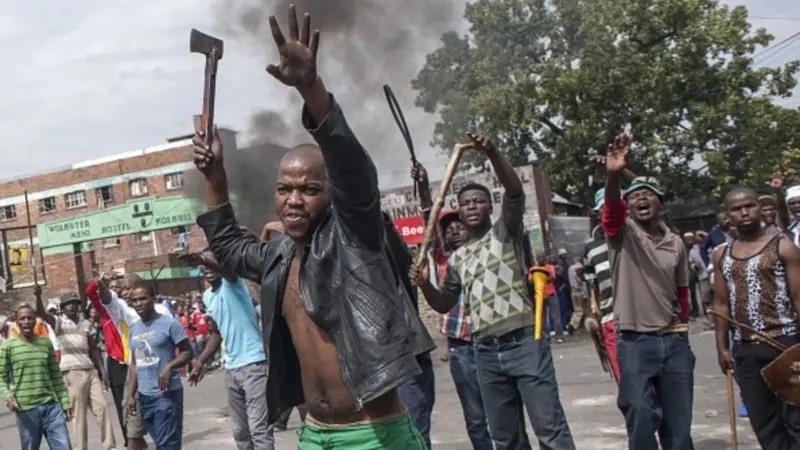
The renewed xenophobic attacks and threats against Nigerians in South Africa (SA) underscore the failure of the South African government to manage post-apartheid regime as well as their Nigerian counterpart’s failure to build a strong virile Nigeria.
The worsening economic hardship in both countries is at the root of the escalating turmoil. While Nigerians are migratory birds looking for greener pastures in South Africa, the South Africans, who rarely travel out of their country, are opposed to seeing other Africans coming to take or share whatever economic means of livelihood meant for them.
The current situation, since the month of April 2026, is that fresh anti-foreigner protests and violence are happening in East London, Cape Town, Durban, KwaZulu-Natal, and Gauteng. Protesters have targeted foreign-owned shops, with looting, destruction of property, and injuries reported. The protests are meant to pressure the SA government over foreign nationals.
The “Go back and fix your country” rhetoric shows South Africans confronting migrants, including Nigerians and Ghanaians, telling them “We don’t want you here” and “fix your countries”. In one clip, a Nigerian trader was ordered to pack up his goods and leave. Another video showed a migrant surrounded by a mob questioning why he was in SA instead of improving his home nation.
The launch of ‘’Operation Dudula targeting hospitals, shows the gravity of the protests. The anti-migrant group Operation Dudula has been blocking foreigners from public hospitals. Leaders were filmed ordering non-South Africans to “stand up and leave our hospital”. Nigerian leaders say women are “giving birth on bare floors” due to being denied care. The group claims to fight illegal immigration and drug trafficking, but human rights groups accuse them of vigilantism.
Recent anger was triggered by the controversial installation of a Nigerian Igbo chief, Solomon Eziko, as “Igwe Ndigbo” on South African soil. This is insensitive and provocative. Protests in Eastern Cape turned violent, with reports of Nigerians being “humiliated, battered, and their businesses shut down”.
In a Government response, the Deputy Minister Thandi Moraka said such hostilities “do not represent her government’s policy” and that SA “remains a warm and welcoming nation”. She said measures are being taken to ensure safety and dignity of Nigerians.
Speaking on behalf of Nigeria, NiDCOM advised Nigerians in SA to “shut their shops and avoid confrontation.’’ The Nigerian consulate warned against engaging protest groups and crowded areas. Nigeria’s Ministry of Foreign Affairs is reportedly investigating the threats. Previously, Nigeria sent special envoys and withdrew from WEF in SA over attacks.
Xenophobic violence against Nigerians in SA isn’t new. At least 127 Nigerians were believed killed over a 3-year period before 2023. In 2019, attacks led to reprisals in Nigeria: Shoprite, MTN, and PEP stores were looted and vandalized in Lagos, Abuja, and other cities. Some 319 Nigerians were evacuated from SA in previous evacuations.
Protesters blame foreigners for unemployment, crime, drug trafficking, and strain on public services like hospitals. Authorities note economic hardship and competition for services fuel tensions.
Based on current advisories and lessons from past waves, the mmediate safety steps include shut your business temporarily: NiDCOM’s advisory specifically told Nigerians to “shut their shops and avoid confrontations” as attacks escalate. Protests in Gauteng, Durban, Cape Town, and East London have led to looting of foreign-owned shops.
Avoid confrontation: Don’t argue with mobs or protest groups. Videos show traders being surrounded and ordered to leave. Walk away. Stay away from hotspots: Avoid crowded areas, protest routes, and known flashpoints. Keep a low profile: Limit movement, especially at night. Don’t wear clothing that loudly identifies you as Nigerian if tensions are high locally.
Protect your documents and legal status Carry valid papers: One video showed a Ghanaian aggressively questioned over immigration documents and accused of fraud. Have your passport, visa/permit, and business registration ready.
Enter SA legally: SA’s Deputy Minister stressed they “encourage all who come to South Africa to do so through legal means”. Legal status gives you more protection if police intervene.
Access to essentials: Operation Dudula has blocked foreigners from public hospitals. If denied care, go to private hospitals if possible, or contact the Nigerian consulate. Have emergency supplies. Stock food, water, medicine for a few days in case you need to stay indoors during unrest.
For emergency, contact the Nigerian Consulate-General, Johannesburg: NiDCOM says the mission “remains operational and is working with South African police authorities to ensure the safety of Nigerians”. Report threats, attacks, or denial of services. NiDCOM monitors the situation and issues advisories. SA government says measures are being taken to ensure safety.
If you’re attacked or your business is looted, leave immediately-property can be replaced, not you. Document it-video/photo if safe, but don’t risk your life for it. Report to consulate/SA police. This is needed for diplomatic pressure and insurance. Don’t retaliate. Individual retaliation puts you at more risk legally. Stay in touch with Nigerian Union South Africa (NUSA) and local Nigerian community leaders. They often share real-time safe routes and updates.
Nigeria has airlifted citizens during past waves. If violence worsens, watch for consulate announcements on evacuation. Know your rights: SA’s official position is that xenophobia “does not reflect government policy”. You’re entitled to police protection if you’re there legally.
Bottom line: De-escalate, document, and get help. The SA government has assured safety, but on the ground, NiDCOM says the risk is real right now.
At this juncture, it is pertinent to ask if xenophobic hostilities can ever end. The answer is yes but only if the underlying drivers are fixed. Xenophobia isn’t “natural” it flares when specific pressures collide. And SA’s case shows exactly what those pressures are.
On the economic front, SA has 32.9 percent unemployment as at Q1 2026. When jobs, housing, and hospital beds feel scarce, “foreigners” become an easy scapegoat. Protesters literally say “we want you to fix your countries” and blame migrants for limited employment.
Service delivery failure: Operation Dudula blocks hospitals because locals believe foreigners are overwhelming clinics. If public services were well-funded and accessible, that trigger weakens.
Political weaponization: Politicians and local leaders sometimes deflect anger at government failure onto migrants.
During elections, anti-immigrant rhetoric spikes. Impunity: Past attacks had 289 arrests, but convictions are rare.
When mobs face no consequences, it signals tolerance.
Criminal stereotyping: Nigerians get tagged for drugs/fraud. One bad actor taints the whole community in people’s minds.
What it would take to to end is to fix the economy and services: More jobs and functioning hospitals/clinics reduce zero-sum thinking. If there’s “enough to go around,” the blame game loses power.
Consistent law enforcement: Prosecute xenophobic violence like any other hate crime. SA says “this isn’t government policy”- but enforcement has to match the words.
Political will: Leaders must stop dog-whistling during campaigns. Ramaphosa’s government says SA is “warm and welcoming”- that needs to be repeated loudly and acted on.
Integration programs: Grassroots initiatives that put Nigerians and South Africans in business/school/community projects together. Personal contact kills stereotypes faster than speeches.
Media accountability: Viral videos spread “go back to your country” rhetoric fast. SA media and social platforms need to counter it, not amplify it.
In Nigeria and other origin countries, the taunt “fix your country” stings because it has truth. If Nigeria’s economy, security, and opportunities improve, fewer people would migrate out of desperation, and those abroad have leverage.
Diaspora diplomacy: Strong, organized Nigerian communities that contribute visibly to SA-jobs, taxes, community projects-change the narrative from “takers” to “partners”.
The hard truth is hostility won’t end with just “assurances” or one meeting in Abuja. It ends when ordinary South Africans stop feeling like they’re losing because of foreigners, AND attackers know they’ll be jailed, not celebrated.
Until unemployment drops, services improve, and politicians stop using foreigners as punching bags, flare-ups will return. But they’re not inevitable forever. Rwanda post-1994, Colombia-Venezuela tensions cooling, and other cases show that with deliberate policy and time, societies can move past this.
Nigeria helped SA immensely during apartheid regime. Nigeria was one of South Africa’s most important international allies in the fight against apartheid.
For instance, Nigeria expelled SA from the Commonwealth: In 1961, Prime Minister Abubakar Tafawa Balewa lobbied for and secured South Africa’s expulsion from the Commonwealth after the 1960 Sharpeville massacre.
Though not bordering SA, the African National Congress (ANC) named Nigeria a “front-line state” for its commitment.
– UN leadership: Nigeria chaired the UN Special Committee against Apartheid. At the 1977 World Conference for Action against Apartheid in Lagos, Oliver Tambo praised Nigeria and the conference pushed for arms embargoes and SA’s UN expulsion. Gertrude Shope of the ANC later thanked Nigeria for its “commendable work” leading the committee.
From the early 1960s, Balewa was the first leader to give direct financial aid to the ANC. In the 1970s, Nigeria gave $5 million annually to the ANC and Pan Africanist Congress. That’s billions in today’s money.
Southern Africa Relief Fund (SAFR): Set up in 1976 by Nigeria to support victims of apartheid, provide education, and promote welfare. General Obasanjo’s military government contributed $3.7 million. Obasanjo personally gave $3,000; each cabinet member gave $1,500. All civil servants/public officers donated 2 percent of monthly salary.
Students skipped lunch to donate. In 6 months by June 1977, popular contributions hit $10.5 million. The fund later exceeded 20 million naira.
Nigeria issued more than 300 passports to South Africans seeking to travel abroad during apartheid. This helped ANC members and activists operate internationally when SA restricted their movement.
In 1989, Margaret Thatcher visited Nigeria twice in one week. She told Gen. Ibrahim Babangida that F.W. de Klerk wanted to end minority rule, and asked Nigeria to verify de Klerk’s commitment. Nigeria played back-channel role to confirm de Klerk was serious, helping pave the way for negotiation.
Musician Sonny Okosun released “Fire in Soweto” in 1977 to commemorate the 1976 Soweto uprising. Oliver Tambo, at the 1977 Lagos conference, ended his speech with “Long live the Federal Republic of Nigeria!”.
Some estimates say Nigeria spent $61bn total to help free SA, though the most documented figures are the $5m/year to ANC/PAC and millions in SAFR.
Ironically, despite this history, many young South Africans don’t know it — the Apartheid Museum in Johannesburg doesn’t mention Nigeria’s contributions, which feeds resentment during today’s xenophobic tensions.
“Nigeria-phobia” in South Africa started after apartheid ended in 1994, not during it. During apartheid, Nigeria was actually one of South Africa’s biggest allies-funding the ANC, issuing more than 300 passports to SA activists, and leading the UN anti-apartheid committee.
Dr. Onyekakeyah, former member of The Guardian Editorial Board, is a public affairs commentator and a Daily Query columnist.