The Third International Sudan Conference, held in Berlin on April 2026, serves as a critical milestone in the international response to a conflict now entering its fourth year.
Co-hosted by Germany, France, the UK, the US, the EU, and the African Union, the summit focused on two primary pillars; humanitarian relief and political transition.
The conference resulted in significant financial and diplomatic commitments. Donors pledged approximately €1.3 billion to €1.5 billion (roughly $1.4B–$1.6B) to address what is currently the world’s most severe humanitarian emergency.
The diplomatic effort is led by a five-party mechanism known as the Quintet, which included The African Union (AU),The United Nations (UN), The European Union (EU), The Intergovernmental Authority on Development (IGAD), The League of Arab States
Sudanese civilian groups and political networks signed a joint document aimed at consolidating a unified position. This “roadmap” prioritizes the protection of infrastructure, the curbing of hate speech, and a transition toward a civilian-led democratic government.
Despite the diplomatic push, the conference faced immediate pushback from the ground in Sudan. The Sudanese government in Khartoum, led by Prime Minister Kamil Idriss, was notably not invited. Idriss labeled the exclusion a “fatal mistake” and declared the conference’s outcomes irrelevant.
Organizers defended the exclusion of warring factions (the SAF and RSF) to prevent the humanitarian forum from being used as a platform for political recognition by the military actors.
While the Quintet focuses on a political dialogue, a separate “Quad” track (led by the US) continues to focus on a military ceasefire, highlighting the complex, multi-track nature of the peace efforts.
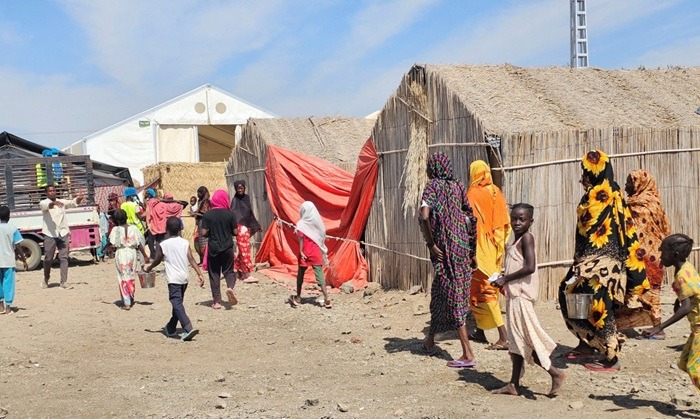
The conference took place on the third anniversary of the war’s outbreak (April 15, 2023). To date, the conflict has claimed over 150,000 lives and displaced millions, creating a humanitarian vacuum that the Berlin summit desperately sought to fill before the regional stability of East Africa is further compromised.