By Charles Obiajulu Ugwu -PhD
We do not pray. We negotiate at gunpoint with a deity we suspect is hard of hearing.
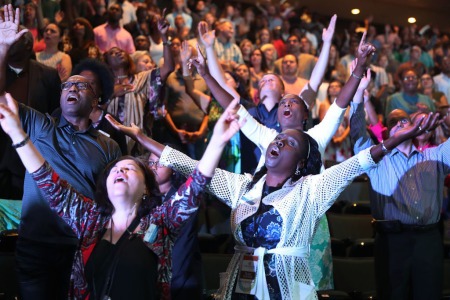
Step into any Nigerian prayer ground on a Friday night or a Sunday morning, and the first thing that registers is not the theology. It is the volume.
Microphones strain past their tolerance. Voices climb octaves they were not built to sustain. The same petition is hurled at the heavens for the fifteenth time in twelve minutes, each round louder than the last, as though the previous fourteen had been swallowed by atmospheric interference and only enough decibels could break through. Hands chop the air. Feet stamp. Bodies sway and shudder. Pastors pace the stage with the cadence of military commanders and the diction of debt collectors. The God being addressed is, on the evidence of the addressing, either deaf, distracted, stubborn, or under siege from forces that must be shouted into retreat.
This is the auditory reality of contemporary Nigerian worship. It is not an aberration. It has become the dominant grammar, and it deserves interrogation.
Something is theologically peculiar about a nation that calls itself the most prayerful on earth and yet must raise its voice each year, as though last year’s intercession had failed audit. Pew Research Center finds that daily prayer is overwhelmingly a habit of middle-income and lower-income countries, with Nigeria and the Philippines near the top, while wealthy societies such as Japan and France barely pray at all. By raw religious volume, Nigeria sits at the apex of the global league table.
By every other measure intercession is supposed to influence, including peace, prosperity, and ordinary human dignity, the country sits considerably lower than any rational supplicant should find comforting. The World Bank’s most recent country update reports that wage growth has lagged inflation, real incomes remain under pressure, and poverty levels have barely shifted. The Multidimensional Poverty Index places Nigeria among the most acutely deprived populations on earth: 33 percent of the country is multidimensionally poor, and another 17 percent is one bad season away from joining them.
That is the productivity question no homily addresses. We pray more than almost any nation on earth. We receive less than nations that hardly pray at all. What if the volume itself is part of the diagnosis?
What We Lost in Transit
The faith Nigerians inherited, in both its Christian and Islamic forms, came packaged with prayer disciplines of striking solemnity. The Christian gospel preserves the most explicit instruction the founder ever gave on how to pray, and it is the precise inverse of what is now performed in his name. The Greek word translated as vain repetitions in Matthew 6:7 is battalogein, which simply means babble: rapid, mindless speech. The instruction was not against repetition itself. Older liturgical traditions, Catholic, Orthodox, Anglican, preserve repetition as devotional rhythm without offence. What Jesus targeted was the assumption underneath the pagan ritual the verse referenced, namely the belief that the gods had to be appeased through correct formulas, every relevant deity named, every right word said, lest a curse follow.
Read that description again, slowly, and ask whether it belongs to a first-century Mediterranean ritual or to a Friday vigil in Lagos.
Islamic tradition is, if anything, more emphatic on the interior discipline of prayer. The concept of khushu, the inner state of humility and stillness without which the five daily prostrations are performed but not received, is foundational. The Qur’anic standard is set without ambiguity: successful are the believers who are humble in their prayers. The classical guidance instructs the worshipper to choose a clean and quiet place precisely so that nothing in the environment competes with the act.
Neither founding tradition prescribed shouting. Neither modelled aggression. Neither treated the deity as an absent-minded landlord who must be hammered on the door before he will collect the rent. The originators of both faiths approached God in postures of stillness, lowered voices, lowered gaze, and a great deal of silence. The Nigerian re-engineering of all this is therefore not a faithful inheritance. It is a substitution.
How the Substitution Happened
The substitution was not accidental, and it is not primarily a failure of piety. It is the product of a particular theological movement that arrived at a particular economic moment, and married a civilisational anxiety that was already in the room.
The theological vehicle is what scholars now describe with technical precision as warfare prayer. Prayer becomes a weapon of battle against spiritual forces understood to torment human life socially, economically, and personally. The cosmology is total. Poverty is no longer the consequence of failed industrial policy. It is the manifestation of a curse, inherited perhaps from a great-grandfather’s libation.
Joblessness is no longer the consequence of macroeconomic collapse. It is the operation of a marine spirit attached to one’s destiny by a covenant one never personally signed. Marital strife is no longer two adults negotiating poorly. It is an enemy in the village, assigned. Every misfortune has a perpetrator, every perpetrator a frequency, every frequency a counter-frequency, and the counter-frequency is delivered through prayer expressed as combat.
The grammar that follows is unavoidable. Researchers who have sat through these sessions report that prayer becomes an act of war that the worshipper must survive by any means necessary. The violence lives in the language of death, blood, and goriness, and in the embodied actions enacted alongside the words: loud chants summoning and addressing spectral figures, discerning spirits supposedly lodged within matter, revoking them by name.
The actual lexicon, as recorded in field studies, runs like this. Covenant and power of kolanut and alligator pepper linking me to evil ancestral powers, die, in the name of Jesus. Covenant and power of any libation, die. Power of any mark or incision linking me with evil ancestral powers, die. These are not requests. They are commands issued by mortals to spiritual entities, and the volume is functional. The louder the command, the more authority is assumed in the issuing of it.
The grammar then escapes the prayer ground. Recent academic work confirms that Pentecostal warfare expressions have lodged themselves in everyday Nigerian language, shaping how we trade, campaign, court, and quarrel. The combat posture has become the national posture. We do not converse. We confront. We do not request. We declare. We do not deliberate. We rebuke.
The economic context for the substitution is the second layer. Warfare prayer metastasised precisely as Nigeria’s developmental compact collapsed. The Structural Adjustment Programme arrived. Wages were eviscerated. The middle class shrank. The state withdrew from the basic provisions of governance. Into that void, Pentecostal Christianity in particular offered an alternative engineering of upward mobility, one that did not depend on a broken state and could be operated by the individual in her bedroom at three in the morning. If the road would not be built, one could pray against the spirit of bad roads. If the hospital had no drugs, one could rebuke the spirit of sickness. If the salary could not feed the family, one could declare prosperity in the name of Jesus. The volume rose in direct proportion to the failure of every other instrument of national life.
The civilisational layer is the third. African expressive culture is naturally vocal. Yoruba talking drums, Igbo masquerade chants, Hausa praise singing all sit within a register that prizes audible intensity. But the Nigerian taste for theatrical emphasis has fused with the warfare doctrine and the economic anxiety to produce something genuinely new: neither traditionally African nor historically Christian nor classically Islamic. It is a hybrid, it is loud, it is exhausting, and it has become so pervasive that to pray quietly in a Nigerian gathering is now read as evidence of weak faith.
The louder the petition, the more visible the petitioner. The more visible the petitioner, the more rewarded by men.
The God who hears in secret
The Performance Economy
There is a dimension polite religious commentary tends to avoid, but Fault Lines exists to say what polite commentary avoids. Nigerian public prayer has become a performance economy, and loudness is its currency.
Watch carefully who shouts loudest at the next prayer gathering you attend. The pastor calibrates his voice not to be heard by God, who, if the theology is taken at face value, is already present and listening. He calibrates it to be heard by the congregation, who are assessing his anointing.
The congregant calibrates her own shout not for divine reception but for social reception, to demonstrate to the row behind her that she is a serious believer, that her temperature is high, that she belongs to the inner circle of the truly committed. The decibel level is a social signal. It is a way of being seen praying. It is, in the precise category Jesus warned against in the verses immediately following the one about babbling, prayer offered at the street corner to be admired by men.
This is the deep paradox the Nigerian prayer style has produced. A people whose founding texts both insisted that the highest prayer is performed in secret, in stillness, in a closet with the door closed, has built a religious culture in which the highest prayer is now performed under stage lighting, amplified through industrial speakers, broadcast on satellite television, and judged by the visible intensity of the supplicant. The transaction is no longer between the soul and God. It is between the performer and the audience, with God present as a notional witness whose function is largely decorative.
If the founding instruction was correct, that the Father who sees in secret rewards in secret, then by the same logic the Father who hears the marketplace prayer has no further reward to dispense. The reward has already been collected at the point of performance: the applause, the social standing, the reputation for seriousness, the pastoral favour, the network of co-religionists who now regard one as a brother or sister of substance. The divine account has been settled. There is nothing left in it to draw upon.
The Correlation Question
Here is the heart of the matter. Is there a causal link between the volume and aggression of Nigerian prayer and the comparative paucity of national outcomes? The question is too important to answer carelessly. Three honest readings of the correlation present themselves, and intellectual honesty requires that we examine each.
The simplest reading, favoured in certain pulpits, is supernatural. God himself is offended by the manner and therefore withholds the response. This reading is internally coherent within the tradition that produced the warning against vain repetitions, but it is empirically unfalsifiable and therefore analytically unproductive. We cannot adjudicate divine preference from this side of the veil.
The sociological reading is harder to dismiss. The disposition that produces shouted prayers also produces shouted politics, shouted commerce, shouted relationships, shouted everything. A nation that approaches its God as an adversary to be subdued by intimidation will tend to approach its institutions, its colleagues, its neighbours, and its own future by the same method.
The prayer style is not a discrete liturgical preference. It is the audible signature of a wider civilisational posture, one that mistakes loudness for power, theatrics for substance, and demand for entitlement. The nations whose lives are easier, to borrow the framing of the question that prompted this essay, are nations whose populations have learned to operate by quieter and more disciplined methods across every domain of life, prayer among them. Their quiet prayer is downstream of a quiet competence that pervades the whole society.
There is a third reading, and it is the most uncomfortable. If prayer is, among other things, the formation of the praying person, then four decades of warfare prayer have formed a particular kind of Nigerian. They have formed a citizen whose default posture toward reality is grievance, whose default explanation for failure is the malevolence of an unseen enemy, whose default response to obstacle is to denounce rather than to analyse, whose default theory of success is to seize rather than to build.
The warfare prayer trains the worshipper to believe that the universe is a hostile arrangement in which her flourishing is being actively prevented by hidden powers who must be combatted without ceasing. This is not a worldview that produces engineers, scientists, institution-builders, patient capital, or long-horizon planning. It produces a citizen permanently at war, permanently fatigued, permanently waiting for the next deliverance, and permanently mistaken about why deliverance does not arrive.
The correlation, then, is not that loud prayer fails to be heard while quiet prayer is answered. The correlation is that loud prayer is the audible expression of a cognitive and dispositional condition that, expressed across every other domain of national life, is itself the cause of the deficits the loud prayer is then deployed to remedy. We pray loudly because we are anxious. We are anxious because we have built nothing in which to trust. We have built nothing in which to trust because the energy that might have gone into building has been diverted into the prayer that was meant to substitute for the building. The circle closes on itself.
What the Quieter Nations Are Actually Doing
The observation that less religious nations enjoy better material outcomes is not new, and it requires careful handling. It is not that the absence of prayer produces prosperity. China’s atheism has not made it humane. Western European secularism is not a model of flourishing on every metric that matters. The Scandinavian welfare states succeed for reasons that have far more to do with high institutional trust, low corruption, near-universal education, and small homogeneous populations than with any view on intercessory prayer.
But there is one feature the quieter societies share that deserves attention. In every one of them, the dominant disposition is agency exercised through patient construction. The Dutch do not pray against the sea. They build dykes. The Japanese do not rebuke the spirit of earthquakes. They engineer their buildings. The Singaporeans do not declare prosperity over their economy. They convene their planners and execute their industrial strategy with monastic discipline.
Where they pray, they pray briefly and quietly. Where they work, they work patiently and well. The relationship between their prayer and their results is not direct causation. It is correlation through a deeper common factor, namely a civilisational habit of trusting that disciplined effort produces results, and that the proper request to make of the universe is for intelligence and stamina, not for the universe to be rearranged to suit one’s preferences.
The Nigerian prayer, by contrast, is structurally a request that the universe rearrange itself. The volume rises because the request is, on inspection, unreasonable, and the requester suspects it. We are not asking for the strength to build the road. We are asking for the road to appear. We are not asking for the wisdom to manage the money. We are asking for the money to multiply. We are not asking for the character to lead the family. We are asking for the spirit of disobedience to leave the child. The deity addressed in such prayers is being asked, in effect, to spare the worshipper the requirement of human effort, which is the requirement under which human flourishing has always been organised. No deity in any serious theological tradition has ever agreed to that bargain. Loudness does not change the answer.
A Fault Lines Proposition
If the analysis is sound, then the remedy is not louder prayer. It is also not less prayer, and it is certainly not the abandonment of the religious disposition that, properly disciplined, has shaped every great civilisation in human history. The remedy is the restoration of prayer to the function the founding traditions assigned to it, which is the formation of the praying person into someone capable of bearing the answer when it arrives.
That requires a recalibration the current ecclesiastical economy may be too entangled to bear. It would mean pastors who teach silence as a discipline rather than performing intensity as a brand. It would mean congregations that measure spiritual seriousness by interior transformation rather than audible enthusiasm. It would mean an Islamic practice that recovers khushu as the actual standard, not ritual completion as the actual standard. It would mean Christian practice that takes Matthew 6 with the literalness it claims everywhere else. It would mean a national religious culture that produces fewer celebrities and more saints, fewer warriors and more workers, fewer declarations and more decisions.
It would also mean, finally, sitting with the most difficult truth any honest analysis of Nigerian prayer must eventually arrive at. The God to whom Nigerians address themselves so vigorously has, on the audited evidence of four decades of national outcomes, declined to deliver on the terms requested. There are only two ways to read this. Either God is indifferent, in which case the prayer is pointless. Or God is not indifferent, in which case the prayer is being declined for reasons the praying nation has not yet been willing to examine. The first reading is foreclosed by the very theology that makes the praying possible. The second remains open, but it is hard, because it requires the praying nation to consider whether its prayer has become, in the strict technical sense of the founding text, vain.
The shouting at God will continue. It is embedded in too many livelihoods to be reformed by argument. But somewhere in this country, in a quieter room, with the door closed, someone is praying as the originators of the faith instructed. That person will probably not be famous. That person will probably not be amplified. That person will probably be doing other things between prayers, things that look very much like work. And in that person, in the small institutions such persons build, and in the patient labour they perform with their hands and their minds and their disciplined attention, the country’s actual answer is already on its way.
It will arrive quietly. It always does.
VERIFICATION LEDGER
Every empirical claim in this essay is documented below with sources verified at the time of writing. Statements without sourcing here are analytical interpretations, not factual claims, and are presented as the author’s reasoning.
1. Comparative prayer rates, Nigeria versus high-income countries. Pew Research Center comparative survey work establishes that daily prayer rates are highest in middle-income and lower-income countries including Nigeria and the Philippines, and lowest in wealthy nations such as Japan and France. Pew Research Center, Spirituality and Religion: How the US Compares With 35 Other Countries, June 2025.
2. Nigeria’s standing on global religiosity metrics. Pew’s multi-metric religiosity work, combining affiliation, weekly attendance, daily prayer, and self-reported importance of religion, places Nigeria at or near the top of global rankings. Pew Research Center religiosity surveys aggregated across multiple years.
3. Nigerian multidimensional poverty. Per the 2021 survey reported in the 2024 Global MPI, 33.0 percent of the Nigerian population, approximately 73.7 million people in 2022, are multidimensionally poor, with an additional 16.6 percent classified as vulnerable. The intensity of deprivations among the poor is 52.9 percent. UNDP, Global Multidimensional Poverty Index 2024; OPHI Nigeria Country Briefing, October 2024.
4. Nigerian wage and income stagnation. The World Bank’s most recent country assessment confirms that wage growth has lagged behind inflation, leaving real incomes under pressure and poverty levels largely unchanged. World Bank, Nigeria Development Update, as reported April 2026.
5. Greek term battalogein in Matthew 6:7. The Greek verb at the centre of the ‘vain repetitions’ instruction is battalogein, which scholarship variously renders as ‘babble,’ ‘stammer,’ or ‘heap up empty phrases.’ The translation history is discussed across both Protestant and Catholic exegetical sources, with standard New Testament Greek lexicons and multiple translations (KJV, NASB, ESV, NIV, NLT) confirming the semantic range.
6. The pagan context referenced by Jesus. Scholarly consensus, including Catholic apologetic commentary on Matthew 6:7, holds that the practice Jesus referenced was the pagan ritual logic in which deities had to be appeased through the recitation of correct formulas and the naming of all relevant gods, lest a curse follow.
7. Khushu as the soul of Islamic prayer. The concept of khushu, meaning humility, reverence, and mindfulness, is established in Qur’anic teaching (notably Surah Al-Mu’minun 23:1 to 2) and elaborated extensively in classical and contemporary Islamic devotional literature as the inner state without which the outward forms of salat are spiritually incomplete.
8. Qur’anic instruction on quiet, distraction-free prayer. Standard Islamic devotional guidance instructs the believer to seek a clean and quiet space for prayer to minimise distractions and enable deeper spiritual focus.
9. Warfare prayer doctrine in Nigerian Pentecostalism. The phenomenon of warfare prayer is documented across multiple peer-reviewed studies. The doctrine treats prayer as combat against spiritual forces understood to be the cause of social, economic, and personal afflictions. International Journal of Research and Innovation in Social Science, A Critical Assessment of ‘Warfare Prayers’ Among Christians in Nigeria Pentecostal Churches, 2024; Journal of African Cultural Studies, 2025.
10. Ethnographic record of warfare prayer language. Field research at Nigerian Pentecostal prayer gatherings has recorded the use of declarative combat language directed at ancestral spirits, marine forces, and inherited covenants, with examples including imprecations against the powers of kolanut, alligator pepper, libation, and ancestral marks. CAS-E research note, Violent Prayers in Nigerian Pentecostal Churches, 2024.
11. Migration of warfare language into general Nigerian discourse. Recent academic work establishes that Pentecostal warfare expressions have moved beyond the prayer ground into everyday Nigerian language, influencing exchanges in the economy, politics, and popular culture. Journal of African Cultural Studies, Volume 37, Number 4, 2025.
12. Religious composition of Nigeria. Per Pew Research Center 2024 estimates, Nigeria’s population is approximately 52 percent Muslim and 46 percent Christian, with about 1 percent practising traditional faiths and 1 percent other religions. Pew Research Center, 2024 religious composition estimates.
About the Author
Charles is a contrarian thinker writing from Lagos