By Khaleed Yazeed
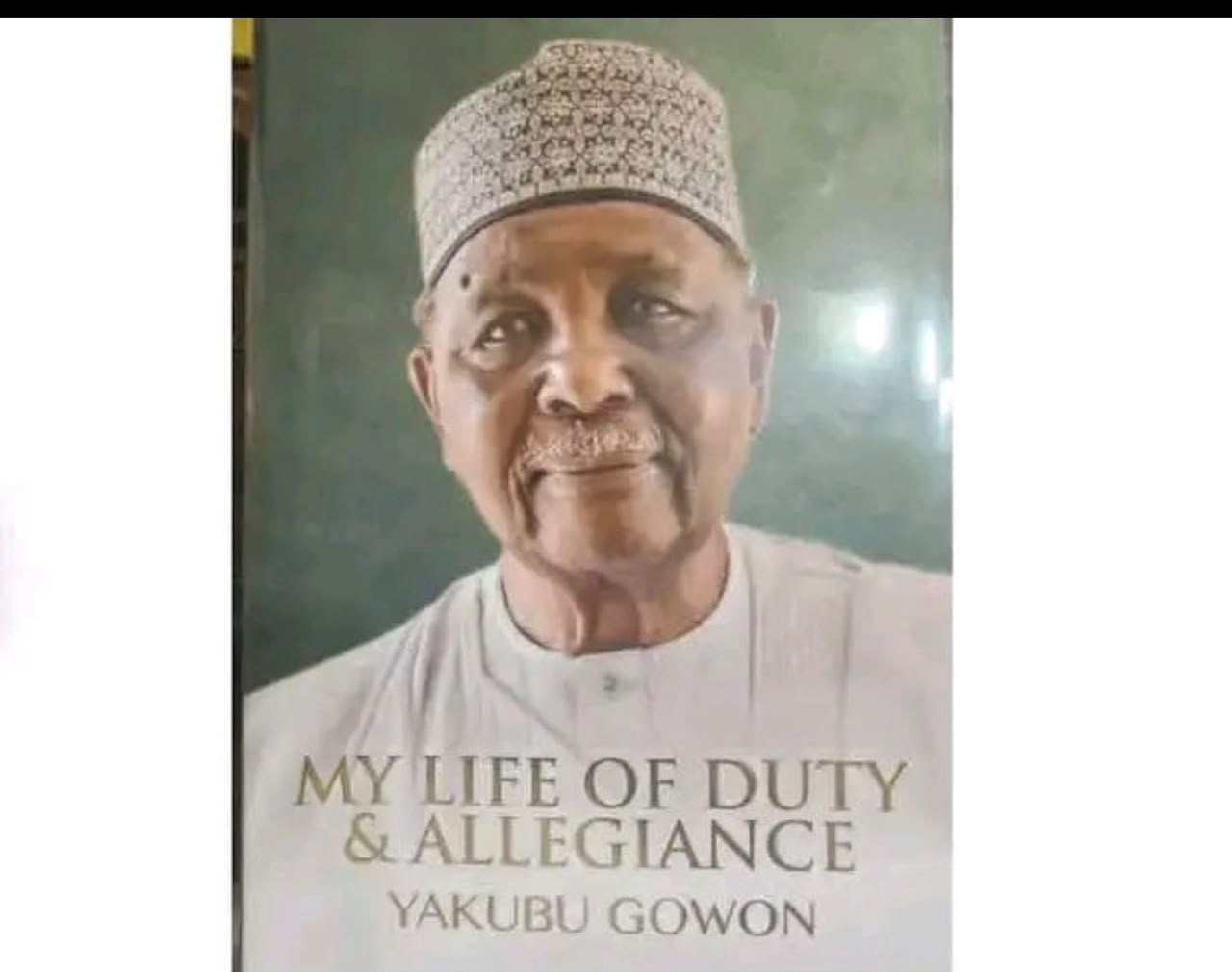
I have completed reading General Yakubu Gowon’s 881-page memoir, My Life of Duty and Allegiance. I read every page, from the opening reflections on his childhood in Daura and Wusasa to the closing chapters on his exile, his prayers, and his long twilight as an elder statesman. I read it slowly, the way a man reads a document he knows will settle something inside him, and I read it with a question burning in my chest: how was the North led into a war that consumed more than a million lives, and how was that story sold to us?
From my own understanding of those 881 pages, one conclusion stands above every other. Gowon is judging himself. He has convicted himself. He has written the indictment in his own hand, signed it with his own name, and published it for the world to see. A prosecutor becomes unnecessary here. A truth commission becomes redundant. Historians need not comb through archives in London and Lagos, because the general has laid the evidence on the table himself, chapter by chapter, page by page, and invited us to examine it.
For sixty years, the North was fed a story. We were told that the civil war was forced upon a reluctant federal government by the ambition of one man. We were told that our leaders tried to save lives, that they were pushed into war against their will, and that the starvation of Biafran children was an unfortunate necessity of a conflict we did not start. We were told that the blockade was a military measure, that the bombing of markets was collateral damage, and that the slogan “No victor, no vanquished” was a genuine embrace of reconciliation.
My Life of Duty and Allegiance was supposed to be the final word on all of that. It was supposed to be the moment when the old general, at ninety-one, would look us in the eye and tell us the truth about what he did and why he did it.
What he gave us instead is a document so riddled with internal contradictions, so burdened by demonstrable falsehoods, that it has become the very instrument of his own conviction. The North was fooled by design, and the general’s own book is the blueprint of that design.
EXHIBIT A: The Phantom Rescue and the Authorised Arrest
On page 201, Gowon presents himself as a man desperately trying to save the life of his superior, General Aguiyi-Ironsi, during the chaos of the July 29, 1966 counter-coup. He writes:
“On impulse, I called the airport at Ikeja to instruct Major Paul Dickson who oversaw the airport to send a helicopter to Ibadan to evacuate the Supreme Commander.”
It reads like a story of loyalty, a young officer trying to rescue his commander from the mutineers. The trouble is that the story collapses the moment you examine it.
Investigators have established that there was no Major Paul Dickson in the Nigerian Armed Forces on July 29, 1966. The only Paul Dickson who existed at the time was an Air Force staff sergeant whose duty involved controlling sentries at the airport, a man who could not conceivably have been handed a military rescue operation stretching across 113 kilometres of road and airspace. The hero of page 201 is a ghost, and the helicopter never left the ground.
The lie runs deeper still. While Gowon claims he was trying to save Ironsi, a documented telephone conversation from that same day reveals what he was actually doing. In Lindsay Barrett’s biography of General T.Y. Danjuma, Gowon is recorded authorising the arrest of the Supreme Commander:
Danjuma: “We want to arrest the Supreme Commander.”
Gowon: (after a long silence) “Can you do it?”
Danjuma: “We’ve got the house surrounded and sealed off Sir. We can do it.”
Gowon: (after another long pause) “Alright but please make sure there is no bloodshed.”
That silence is the most eloquent passage in the entire affair. A man weighing a decision. A man understanding precisely what he is authorising. A man giving the order and then attaching a condition to it, as though a request for restraint could cleanse what followed.
Here lies the conviction. Gowon did not try to save Ironsi. He authorised his arrest. The helicopter of page 201 was invented to distance him from the counter-coup and from the massacres of Igbo officers, civil servants, traders, and families that followed across the North. We were told the counter-coup was a spontaneous reaction to the January killings, a moment of uncontrolled fury. The general’s own record shows a calculated transfer of power, and he stood at its centre.
EXHIBIT B: The Shivering Fever and the Betrayal of Aburi
The Aburi Accord was the last real chance to stop the slide into war. Gowon signed it in Ghana in January 1967. He returned home and reneged.
In his memoir, he offers an explanation that reads as both pathetic and revealing. He says he agreed to the terms while suffering from a “shivering fever,” and he has told interviewers that he was so ill he “could not make a decision” upon returning to Nigeria.
That is a medical alibi offered in place of a political confession. The Aburi proceedings were recorded on tape. Gowon can be heard on that tape as a lucid, engaged negotiator who agreed to a confederate structure with remarkable composure. He did not sound like a man incapacitated by malaria. He sounded like a leader who signed a deal and then panicked when he returned to Lagos and met the civil servants and military advisers who feared the loss of federal power.
The consequence arrived in March 1967 as Decree No. 8, which unilaterally inserted clauses giving the Head of State veto power over the regions. That decree violated the Aburi spirit in its letter and its logic. Gowon then told the North that the Igbo were the aggressors, that they wanted to break the country, that the federal government had no choice. The truth sits in a different place entirely. He signed a peace agreement and then broke it. The war that followed came as a choice, and he made it.
We in the North were handed a narrative of reluctant duty. We were told our sons were going to the front to defend the nation. We were not told that the leaders had signed away the very arrangement that would have made the war unnecessary.
EXHIBIT C: The “Thousands” That Were Millions
Perhaps the most damning falsehood in the book is one of arithmetic. On page 467, Gowon refers to the victims of the war as “thousands who perished.”
Thousands.
The figure is a deliberate minimisation of a catastrophe. General Ibrahim Babangida, writing in his own memoir, states that over two million Biafran civilians, many of them children, died of starvation and disease alone. That figure excludes those killed by the mass bombing of civilian populations, by ground operations, and by the diseases that followed displacement.
“Thousands” is a word for a stadium. Millions is a word for a civilisation’s grief. By shrinking the dead into a footnote, Gowon attempts to erase the scale of what the blockade accomplished. The North was told that the starvation was an unfortunate side effect of military strategy. The record suggests something else: hunger was a weapon, hunger was sustained deliberately, and hunger remains the one subject the general cannot bring himself to describe with accuracy.
EXHIBIT D: The Frame-Up of Ironsi
To justify the July counter-coup and the pogroms against Igbos in the North, the narrative needed a villain. Gowon chose General Ironsi.
On pages 164 to 166, 172 to 173, and 188 to 189, Gowon paints Ironsi as a man who “must have known what was happening” during the January 1966 coup, suggesting complicity in the killings. That implication did enormous work. It told the North that the Supreme Commander was part of the plot. It told soldiers that their rage was justified. It told civilians that the Igbo community as a whole had authored the deaths of their leaders.
Then, on page 185, Gowon reverses course and exonerates the same man he had just implicated.
That reversal is a strategy rather than a slip of memory. He first planted the seed of Ironsi’s guilt to pacify the North and give cover to the violence that followed. Later, in a quieter passage, he acknowledges the truth. The order of those pages matters more than their content. Plant the accusation where it will do the most damage, then withdraw it where it will attract the least attention.
We were told Ironsi was a traitor. We were told the Igbo were the enemy. The general’s own book shows that he knew the narrative was false, and he allowed it to stand because it served his purpose.
EXHIBIT E: The Convenient Silence on the Blockade
The general’s memoir discusses the blockade as a strategic necessity, and it discusses starvation as a consequence of war. What the memoir struggles to confront is the ordinary experience of the blockade: the food that could not pass, the relief flights that were obstructed, the children who died in their mothers’ arms while the federal government argued about sovereignty.
A memoir is judged by the questions it refuses. Page after page is devoted to cabinet meetings, diplomatic missions, the mechanics of military command, and the general’s relationship with his officers. The camera lingers on the corridors of power and turns away from the compound where a mother buried her son. The North accepted that framing for two generations. A war was fought in the name of our unity, and the suffering that followed was placed at the door of the other side.
EXHIBIT F: The Lie of “No Victor, No Vanquished”
The phrase “No victor, no vanquished” has been repeated for fifty-six years as though it were a policy rather than a speech. Gowon offers it in the memoir as a statement of intent, a promise of reconciliation, a gesture of mercy from a victorious commander.
The history that followed tells a different story. The vanquished returned home to find their savings erased by the demonetisation of Biafran currency. They returned to find their properties declared abandoned and seized. They returned to a region that received a fraction of the reconstruction money spent elsewhere. They returned to a federal structure that concentrated power in the hands of the men who had won.
A phrase that promised equality became a phrase that allowed the country to move on without ever having to account for the war. The slogan served the victor. It gave the North a sense of its own generosity while the East carried the bill.
The Verdict: He Convicted Himself
I did not write this article to attack Gowon for the sake of attacking him. I wrote it because I read his book, and I could not set it down without recording what I found there.
He offers a phantom rescue to obscure his role in a coup. He offers a fever to obscure his betrayal of a peace accord. He offers “thousands” to obscure millions. He offers a frame-up to obscure the truth about the violence that consumed the North.
The North was not fooled because we are simple people. We were fooled because we trusted our leaders. We were told a story that made us feel righteous, that made us feel like victims defending our own land. The general’s own words show that the story was manufactured, and manufactured for a purpose.
The civil war ended in 1970. The lie has lasted for sixty years. It is time to end it.
Khaleed Yazeed
Founder, Wakilin Yamma Youth Development Network
Katsina State, Nigeria