By Sonnie Ekwowusi
It was Cardinal John Henry Newman who wrote in his famous book, The Idea of a University that university education should not merely train people for jobs or produce professional qualifications, but should cultivate the whole human person, especially the intellect, character and capacity to pursue truth.
If there is one person in whom Cardinal Newman’s thought rang true and found a resounding expression, it is Prof. Albert Alos, a Spanish-born Nigerian academic, co-founder of Lagos Business School (LBS), pioneer Vice-Chancellor of Pan-Atlantic University, Lekki, Lagos, and a renowned institution-builder.
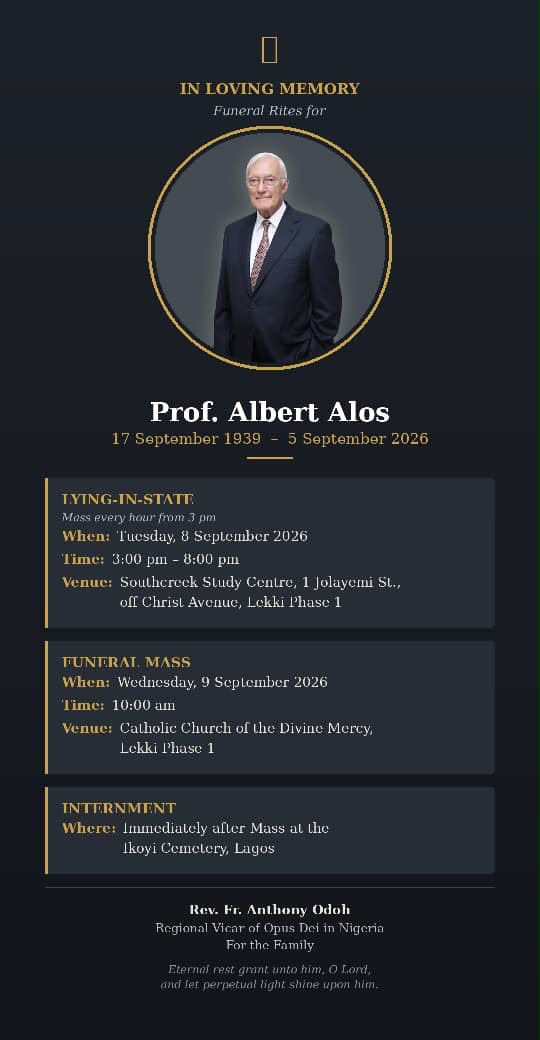
Albert died at 11:30 a.m. on Saturday, September 5, 2026, aged 86. Albert not only imbibed Cardinal Newman’s legacy but he taught it and inscribed it in the Nigeria University system.
I am pained to pen down this tribute because I was privileged to attend the same conference with Prof Alos at the Iroto Conference Centre, Ogun State shortly before his passing.
About four days before his death, he had complained to one of us that his heart was not pumping very well. The next morning, he was quickly rushed to a Lagos hospital, where he was placed on oxygen. Three days later, he passed away after having been placed in the ICU.
Prof. Albert Alos’ sudden death hit me so hard. During our conference, we had conversations, especially at table, about how to build a virtuous society and restore integrity to the university. On learning that I was involved in resolving some human rights crises, he spontaneously raised his clenched hands in front of me and said: Sonnie, fight on
As I scribble this, I can still hear Alos’ words: Sonnie, fight on. I reckon that these words will imbue me with a certain resilient and rejuvenated spirit in the struggle to clothe the naked public square.
Like yours sincerely, Albert was an unrepentant crazy fan of Barcelona FC. During the conference, both of us were sneaking out to watch Barcelona’s La Liga football matches. I remember the La Liga match played on August 31 2026 between Barcelona and Rayo Vallecano, in which Barça thrashed Rayo Vallecano 5–2.
I remember that while our eyes were glued to the television watching the match, Prof. Alos, who sat in front of me, was motioning with his hands for the players to launch an attack, as if he were coach Hansi Flick instructing the players.
Barcelona controlled a record 68.5 per cent of possession and had 26 shots to secure the vital three points. However, when Rayo shocked Barcelona by scoring first, I noticed that Prof. Alos became very uncomfortable. Anyway, the brilliance of new player Antonio, Raphinha and Lamine Yamal, eventually led Barça to a resounding victory.
Since the sad news of death of Albert broke, many who knew him, especially those in the university community, have been completely shattered. Prof. Alos was not just a university man; he was a veritable university teacher and builder, the type who crossed difficult boundaries to reset the culture and character of the university. Albert had positively impacted the lives of many.
He came to Nigeria on October 17, 1967, aged 28, at the beginning of the Nigerian Civil War. And he never left Nigeria before death came calling. At the time of his sudden death, Albert had spent a gargantuan 59 years in Nigeria. In 2023, Albert was naturalised and became a Nigerian citizen, motivated by his long-standing love for Nigeria.
Why did Albert leave the comfort and economic boom of Barcelona, Spain, to come to Nigeria at the time the Civil War was beginning? Albert came to Nigeria at the age of 28 to assist in rebuilding the Nigerian university system.
He recalled that as he disembarked from the Nigerian Airways plane, which flew from Nairobi to Lagos on that fateful day in October 1967, some fierce-looking armed Nigerian soldiers surrounded him, wondering about the mission that had brought him to Nigeria at a time when the Civil War had broken out. Unpocketing his University of Ife letter of appointment, he told the soldiers that he had come to take up a lecturing job at the then University of Ife, now Obafemi Awolowo University.
Most Europeans who come to Nigeria for the first time have interesting stories to tell. Albert had his first baptism of fire in Nigeria when, after immigration clearance, he stood dumbfounded at the conveyor belt, waiting for a long time for his luggage to be brought out. Thereafter, he encountered dense, mismatched traffic at the Yaba, Lagos junction.
His first cultural shock was when he saw a number of Molue and Danfo buses cruising and criss-crossing the roads, with many passengers, including market women carrying food baskets on their heads and babies strapped to their backs, running helter-skelter to board the moving Molue and Danfo buses. He felt sorry for the poor women passengers chasing moving Molue and Danfo buses that would not stop for them to board.
Albert was one of the first lecturers in the newly established Department of Electronics and was involved in curriculum development and the establishment of the university’s engineering laboratories.
In 1971, he moved to the University of Lagos, where he taught Electrical Engineering, conducted research and undertook industrial consultancy.
He was particularly involved in the development of the university’s Control Engineering Laboratory. He was appointed Professor of Electrical Engineering in 1983.
He subsequently moved to the University of Ibadan, where he became Professor and Head of the Department of Electrical Engineering. He helped establish the department within the newly created Faculty of Technology and developed its Electrical Engineering programme to the level of professional accreditation by COREN. He retired from the university system in 1992, after about 25 years in Nigerian universities.
After retiring from the university system, Albert Alos turned his unceasing gaze increasingly towards management education. In 1993, Prof. Alos joined the prestigious Lagos Business School (LBS) and became its Director-General in the same year, with the new task of developing a business school of international standard and ensuring that its management education was relevant to Nigeria’s business environment.
Under his leadership, LBS developed executive management programmes and strengthened its relationship with industry. He also taught operations management and strategy at LBS, consulted for businesses and wrote case studies dealing particularly with Nigerian enterprises and business growth.
One of his notable works is a book right in front of me titled The Pains and Gains of Growth, which examines the experiences of growing businesses and entrepreneurs. I have just read a few lines of Prof. Alos’s magnum opus, titled Not by Chance. This book is a detailed account of Prof. Alos’s memories of LBS, with chapters on the secret, if you like, behind the success of LBS, as well as the continuity and future of the institution.
That future is what led Prof. Alos to play a decisive role in transforming LBS into a university. In 1996, he led the process of working with the government to secure approval for the establishment of a private university. When government approval was eventually granted in January 2002, LBS became the first school of what was then called Pan-African University, now Pan-Atlantic University (PAU).
As fate would have it, Prof. Alos became the pioneer Vice-Chancellor of the prestigious PAU, where many parents are now struggling to enroll their children. Prof. Alos was appointed Professor Emeritus in 2010. The current Vice-Chancellor of PAU is Prof. Enase Okonedo, a charming lady whom I have met several times.
For Albert, a genuine university education should produce a person who not only thinks and reasons critically, but who also understands and appreciates truth and beauty and conducts himself or herself with intellectual and moral responsibility.
In Albert’s own words: A university should not merely produce graduates; it should form persons of character, competence and responsibility who can contribute meaningfully to society.
That formulation also fits the educational vision associated with Pan-Atlantic University, whose stated mission is strongly connected with forming responsible leaders.
If you ask me, I would say that Albert Alos’ greatest contribution to Nigeria’s university system was institution-building. His significance goes beyond his career as an engineering professor: he helped demonstrate that a Nigerian university could be built around academic excellence, professional relevance, character formation, leadership and strong institutional values.
He helped pioneer a new model of university education. Albert moved from conventional university teaching into institution-building. After teaching engineering at the University of Ife, University of Lagos and University of Ibadan, he became involved in developing institutions that sought to combine academic education with the formation of responsible professionals.
He was instrumental in transforming Lagos Business School into a university. He helped establish the foundation of Pan-Atlantic University. He brought business and professional education into closer relationships with university education. Most importantly, he championed the idea of education as institution-building and leadership formation.
Humble, urbane, unassuming and cheerful, Albert had a large heart that was open to assisting people irrespective of their backgrounds. Albert was a good Catholic, a celibate member of Opus Dei, an institution of the Catholic Church. He was inspired by the teachings of St. Josemaría Escriva, the founder of Opus Dei, to spend most of his time rendering service to others.
Prof. Alos had clearly instructed that upon his death, he should be buried in Nigeria, where he selflessly spent his unbelievable 59 years assisting to build educational institutions.
Undoubtedly, at the time the mortal remains of Albert Alos are wheeled out for burial, tears shall roll down the cheeks of many upon remembering that Albert Alos, a pillar of the Nigerian educational system, has passed and physically is no more with them.
But I guess the tears would begin to dry up upon remembering that the educational legacies bequeathed by Albert have outlived him and will last forever on this earth.
May the gentle soul of Prof. Albert Alos rest in peace.
Sonnie Ekwowusi is a Legal Practitioner and Member of the Editorial Board, The Guardian Newspaper