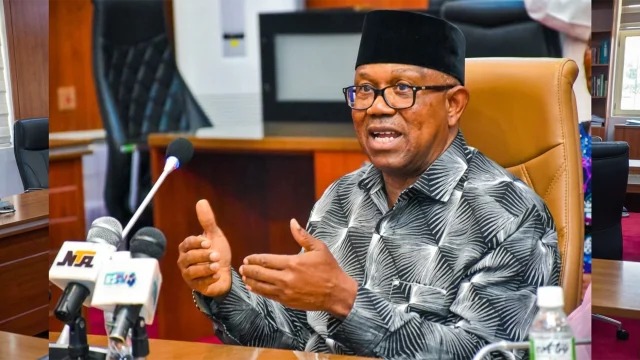
The 2027 presidential candidate of the Nigeria Democratic Congress, Peter Obi, has criticised the administration of President Bola Tinubu over what he described as excessive borrowing, poor fiscal discipline, and lack of accountability in the management of public funds.
Obi alleged that Nigeria’s total public debt has risen to about N200 trillion under the current administration, warning that the country’s rising debt profile poses serious risks to economic stability and the welfare of future generations.
The former Labour Party presidential candidate in the 2023 general election made the remarks in a statement posted on his verified X handle on Tuesday, where he accused the Federal Government of engaging in what he termed “imprudent governance.”
According to Obi, the increase in Nigeria’s debt stock within the last three years far exceeds the borrowing recorded during the administration of former President Muhammadu Buhari.
“President Bola Tinubu’s administration has engaged in remarkably imprudent borrowing, escalating Nigeria’s total debt to approximately N200 trillion,” Obi stated.
“This represents an increase of over N100 trillion within a mere three years, a stark contrast to the roughly N49 trillion accumulated during President Muhammadu Buhari’s eight-year tenure, which would have projected to around N80 trillion.”
He said the rapid increase in public debt had intensified concerns among Nigerians already grappling with economic hardship, inflation, rising unemployment, and the high cost of living.
The former Anambra State governor further criticised what he described as the Federal Government’s failure to provide adequate transparency regarding the utilisation of borrowed funds.
“As millions of Nigerians grapple with the shock of this unsustainable debt accumulation, the situation is exacerbated by the government’s reckless approach to borrowing and a profound absence of accountability and transparency in the utilisation of these funds,” he said.
Obi argued that borrowing, when properly managed and invested in productive sectors, could support national development, but warned that unchecked borrowing without clear accountability mechanisms could plunge the country into deeper financial distress.
He also cited figures from the Budget Office to support his criticism, alleging that the Federal Government exceeded its own borrowing projections for 2025 within the first three quarters of the year.
According to him, the government borrowed N11.89 trillion between January and September 2025, surpassing its planned borrowing target of N10.34 trillion by approximately N1.54 trillion.
The opposition figure questioned the sustainability of the country’s current fiscal trajectory and urged the government to adopt more prudent economic policies focused on production, investment, and efficient management of public resources.
He stressed the need for increased transparency in public finance management, including clearer disclosure on how borrowed funds are allocated and utilised across sectors.
Obi further argued that the nation’s growing debt burden could place enormous pressure on future budgets through rising debt servicing obligations, thereby limiting resources available for infrastructure, healthcare, education, and social development.
He maintained that economic reforms must be accompanied by fiscal discipline and accountability to earn public trust and deliver meaningful benefits to citizens.
The latest criticism comes amid ongoing national debate over the Federal Government’s economic policies, including fuel subsidy removal, foreign exchange reforms, and increased borrowing to finance budget deficits and infrastructure projects.
Nigeria’s debt profile has remained a major issue of public concern in recent years, with economists and financial experts expressing divergent views on the sustainability of the country’s borrowing pattern.
While government officials have repeatedly defended the borrowing strategy as necessary to finance development projects and stabilise the economy, critics argue that rising debt without corresponding growth in productivity and revenue generation could worsen the country’s economic challenges.
The Tinubu administration has consistently maintained that ongoing reforms are designed to reposition the economy for long-term growth and attract investment, despite the short-term hardship experienced by many Nigerians.
However, opposition parties and civil society groups have continued to demand greater transparency, accountability, and more effective measures to cushion the impact of economic reforms on citizens.
Political analysts say Obi’s latest remarks are likely to intensify discussions around economic management and fiscal responsibility as political activities ahead of the 2027 general elections gradually gather momentum.
The debate over public debt, government spending, and economic reforms is expected to remain a dominant issue in national discourse, especially as Nigerians continue to seek relief from rising living costs and economic uncertainty.