By Eke O Ako
A fast‑growing balance sheet Signature Bank Nigeria looks like the new golden child of the Nigerian banking sector – but its numbers raise serious questions about where its revenue and rapid growth are really coming from in a tough, mature market.
Alex C. Otti launched Signature Bank on 21st November 2022 with the bank having no other branches anywhere in the world, apart from its tiny headquarters in a duplex building. Signature started operations in 2022 as a small regional bank after struggling to raise capital to start in 2017, and was only licensed to operate as a small regional bank due to its capital limitations .
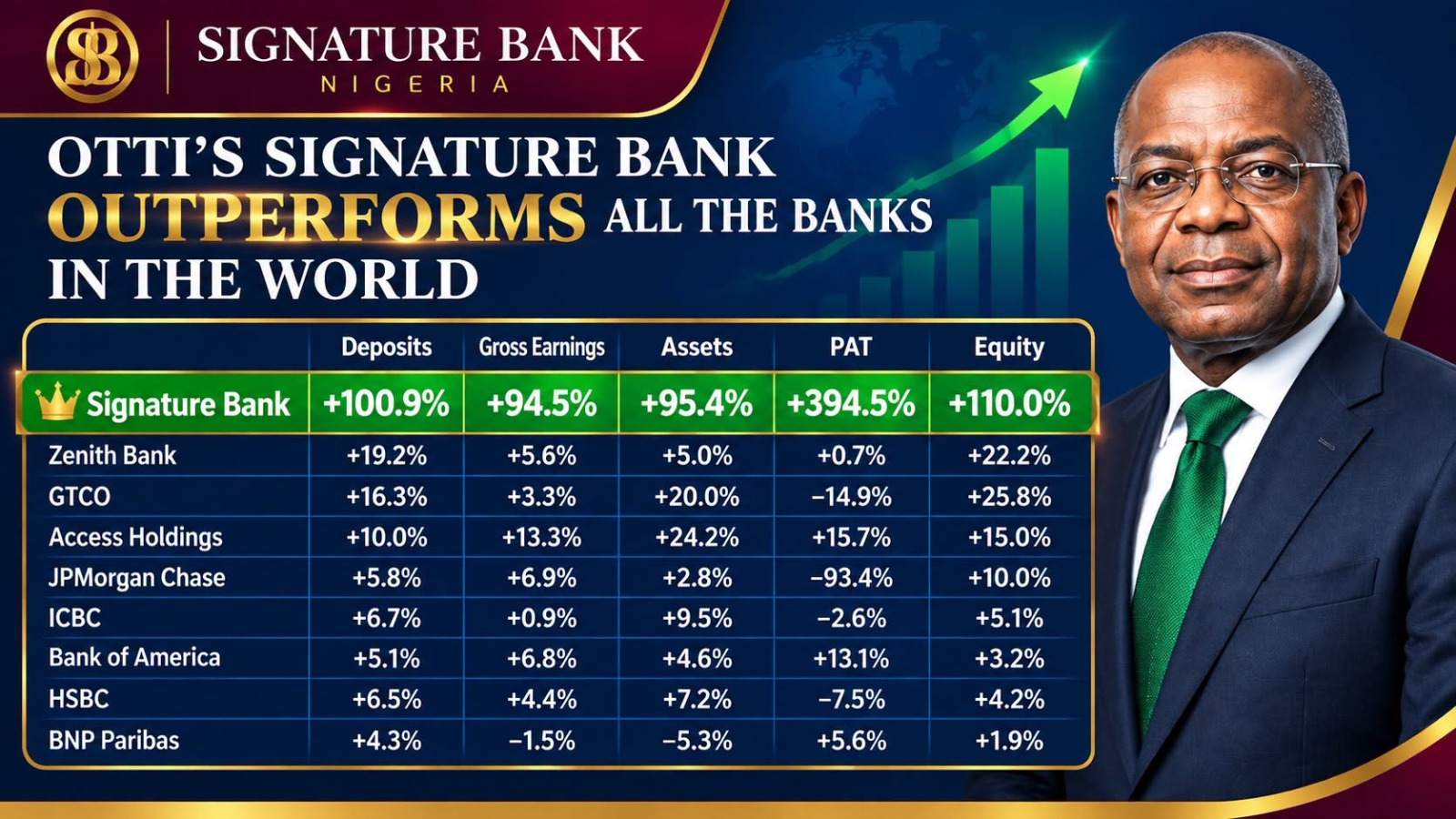
By 2023, its audited results showed total assets of ₦61.22 billion, still tiny compared with Nigeria’s tier‑1 giants. Otti became Abia Governor in May 2023. In 2024, those assets jumped to ₦178.86 billion, with deposits rising from ₦39.20 billion to ₦130.59 billion and gross earnings from about ₦2.69 billion to ₦12.84 billion – a 192% asset increase and roughly 377% revenue leap in one year.
By 2025, press reports put assets at roughly ₦224.7 billion, deposits at ₦170.8 billion, and profit after tax at ₦3.59 billion, giving Signature a growth OF UP TO 400%, and a triple-digit growth across almost every major line in just three years. Compared With Major Global Banks ZENITH BANK: 2024 profit after tax ₦1.03 trillion on ₦3.97 trillion gross earnings, growing profit by about 53% year‑on‑year.
GTCO: 2024 profit before tax around ₦1.27 trillion, roughly double 2023, but still nowhere near the 300–400% jumps reported at Signature. JPMORGAN CHASE: 2024 net income about $58.5 billion, up in the mid‑teens percent, typical of a mature global lender.
The giants are far bigger in absolute size, but Signature Bank’s percentage growth is what stands out. Recapitalisation In March 2026, Signature announced it had raised its capital base to ₦52 billion, slightly above the Central Bank of Nigeria’s ₦50 billion minimum for regional commercial banks, via a rights issue.
That recapitalisation, on top of rapid deposit and asset growth, sets the bank up to chase bigger deals in a very competitive, mature banking market. Behind that story, the company’s own Corporate Affairs Commission (CAC) filing shows that Alex Chioma Otti played a key role in the early stages of the bank.
In the November 2022 certified extract for Signature Bank Limited, he is listed as: A founding director, appointed in January 2022. A direct shareholder with 1 billion ordinary shares, equal to 10% of the initial 10 billion share capital.
A Person with Significant Control, recorded as holding 10% of the shares and 10% of the voting rights, with no indirect holding noted. The same filing shows several corporate investors – Morning Side Capital Partners Limited (35%), Caledonian Properties Nigeria Limited (8.25%), Southglobe Limited (5.5%), Systems Generics International Limited (5.5%), and Orbit Marine and Energy Services Limited (5.5%) – as major shareholders and “persons with significant control.”
Public sources so far do not prove that Otti owns or controls these companies, but given his 10% direct stake and founding‑director role, many Nigerians naturally wonder whether some of these firms might also be linked to him or his business network.
BALHADER INVESTIGATION
An April 2026 investigative report by the Bureau of African Labour, Human and Democratic Rights (BALHADER) digs into Signature Bank’s numbers and its ties to Abia State. Key points from that report: It confirms the 233% deposit surge from ₦39.20 billion (2023) to ₦130.59 billion (2024), with only six branches and 149 staff, calling this “anomalous” compared with typical Nigerian banks.
It notes that Abia State’s Treasury Single Account (TSA) is held at Access Bank, not Signature Bank, but warns that contractor accounts, project escrows and agency sub‑accounts can sit outside TSA, so government‑related money at Signature cannot be ruled out.
It flags a verified structural conflict: Dr. Mutiu Sunmonu simultaneously served as pioneer chairman of Signature Bank and chairman of Julius Berger Nigeria Plc, the firm awarded the ₦36.5 billion Port-Harcourt Township Road Aba contract by Otti’s administration without competitive bidding.
BALHADER stresses that no regulator (EFCC, ICPC, CBN) and no major investigative newsroom has yet probed whether Abia public funds are deposited at Signature Bank. It argues that the absence of investigation is itself a governance problem, not proof that everything is clean.
The everyday question For ordinary readers, the picture now looks like this: A young regional bank goes from ₦61.22 billion in assets (2023) to more than ₦224 billion (2025), with deposits and earnings exploding. The bank outgrows big Nigerian and global names by percentage, even though it remains much smaller in size.
Abia State Governor, Alex C. Otti, who launched the bank just before he became governor, was there at the beginning as a major shareholder and director, while a shared chairman sat on the boards of both Signature Bank and Julius Berger, the beneficiary of a huge no‑bid road contract.
Big Questions That combination of unusually fast growth, recapitalisation, and influential early ownership and board links is why people are asking questions: . If older banks with trillions in assets are growing at 10–50% a year, how is a small regional bank managing almost 200–300% jumps?.
Who are the big customers and deals behind Signature’s sudden rise, and are they ordinary retail and business clients, or a small number of powerful depositors?.
In a mature, competitive banking industry, does Signature Bank’s extraordinary growth come from normal market success, or from highly concentrated, possibly politically connected funding? Ako is a Good Governance Advocate in Abia State.