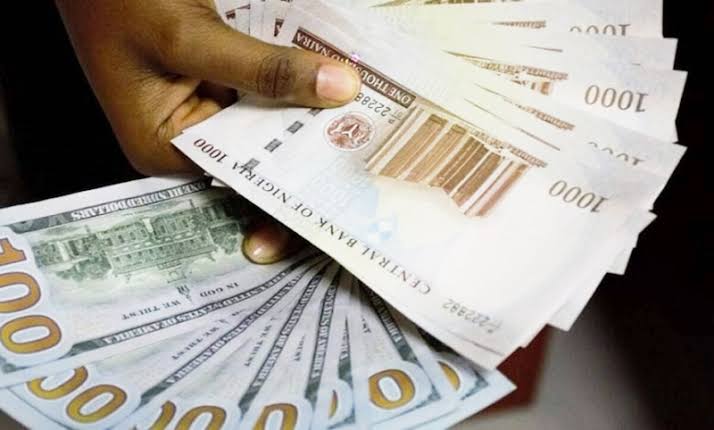
The Nigerian naira opened trading at 9:00 AM WAT on Thursday under sustained demand pressure across both the official Nigerian Foreign Exchange Market (NFEM) and the parallel market, maintaining an exchange rate spread of ₦68 to ₦80 per United States dollar.
Early morning activity across major commercial hubs, including the trading desks of Broad Street, Ikeja, and Marina in Lagos, alongside Wuse Zone 4 in Abuja, showed persistent fourth-quarter corporate and retail demand outstripping immediate dollar supply.
By 10:00 AM WAT on Thursday, the greenback was quoted on the official NFEM benchmark window at between ₦1,350.86 and ₦1,357.84 per dollar, extending the softening trend recorded at Wednesday’s close when NFEM rates hovered near ₦1,353.50 to ₦1,358.34 per dollar.
On the parallel market, street-level Bureau De Change (BDC) operators and informal currency dealers in Lagos and Abuja quoted buying rates between ₦1,411 and ₦1,420 per dollar, while selling rates ranged between ₦1,419 and ₦1,430 per dollar depending on transaction volume and location.
Earlier in the week, between Monday, November 9, and Wednesday, November 11, 2026, the street rate briefly touched a 10-month low of ₦1,430 per dollar, entrenching the wider premium over the official window.
Financial analysts attribute the sustained pressure on the local currency to accelerated end-of-year import restocking, seasonal holiday travel obligations, and foreign portfolio investment outflows amid a firmer U.S. dollar globally.
Market data from FMDQ Exchange and NFEM trading sessions earlier in the week also reflected shifting liquidity levels, with total NFEM turnover standing at $368.80 million on Monday, November 9, including $210.38 million in interbank volume before interbank turnover adjusted to $248.07 million across 144 deals during Tuesday’s session.
Addressing the structural dynamics of the retail foreign exchange segment in Lagos on Monday, November 10, 2026, Dr. Aminu Gwadabe, President of the Association of Bureaux De Change Operators of Nigeria (ABCON), urged the apex bank to resolve retail liquidity bottlenecks, licensing delays, and recapitalisation hurdles affecting licensed operators.
Gwadabe emphasized that integrating BDCs effectively into the official supply chain remains critical to narrowing street-level premiums, noting that Nigeria needs a stronger BDC industry rather than a disappearing one.
At the Central Bank of Nigeria (CBN) headquarters in Abuja, monetary authorities have maintained that the exchange rate remains market-driven while pointing to robust macroeconomic buffers.
CBN Governor Olayemi Cardoso recently reiterated that the bank’s ongoing foreign exchange reforms are anchored on transparency and economic fundamentals, backed by net reserves of roughly $46 billion.
Similarly, CBN Acting Director of Corporate Communications and Investor Relations, Mrs. Hakama Sidi-Ali, has underscored the apex bank’s commitment to market stability, financial integrity, and strict regulatory oversight across both traditional and digital foreign exchange channels.
Despite the short-term demand pressure observed through Thursday morning, Nigeria’s gross external reserves stand at approximately $54.9 billion, comfortably above the CBN’s 2026 full-year target of $51.04 billion, providing the monetary authority with substantial liquidity buffers to support the NFEM window through the remainder of the fourth quarter.