A Word For The Young Man in a Hurry
By Agbeze Ireke Kalu Onuma, AI-KO
In my village, when something undeniably good happens to a man, we do not say he is lucky. We say Chineke mere ya – God did it. Or we say chi ya di mma, his personal god is good. Our tongue does not have a clean, small, isolated word for blind chance because our ancestors did not trust a random universe. A people who have buried children before their time, crossed swollen rivers in wooden canoes, and watched their entire savings burn under a harmattan wind cannot afford the lie that life is a coin toss. We need our suffering to carry weight. We need our victories to be witnessed by a force greater than accident. And yet, there is a category the elders still acknowledge quietly when they speak around the fire.
They call it akara aka, the lines on the palm. It is the destiny assigned to you before you ever drew your first breath. But here is what you must not forget: akara aka is a starting position, not a finish line. It is the seat you are given at the communal table, not the meal you will eventually eat. What you do with that seat, how you sit in it, whether you offer it to a stranger, whether you stand up when an elder enters the room, all of that is not luck. That is character. That is the slow, silent, unphotographed work of becoming a human…
Life has a way of confronting us with mirrors – sometimes gentle, sometimes harsh, sometimes entirely unexpected. These mirrors come in the form of people, events, failures, triumphs, and even the quiet moments when we are forced to sit with ourselves. Over the years, I have come to realize that the most profound lessons rarely arrive wrapped in comfort. They come disguised as mistakes, disappointments, betrayals, embarrassments, and the uncomfortable truths we would rather not face.
They come from watching others stumble, from stumbling ourselves, and from recognizing that the world is not obliged to cushion us from the consequences of our own actions. One such mirror appeared recently in the form of a young man I met over the Easter break. Our acquaintance was brief, but the impression he left on me was anything but fleeting. He had been entrusted with funds for a specific event – a responsibility that required integrity, discipline, and a basic sense of duty. Instead, he embezzled the money. When confronted, he did not express remorse. He did not acknowledge any wrongdoing. He did not even attempt to understand the gravity of what he had done. Instead, he insisted he was simply “unlucky.”
Unlucky. That word hung in the air like a sour note. It was not just the denial of responsibility that struck me, but the complete disconnection from reality that it revealed. He spoke as though life had conspired against him, as though the universe owed him a favourable outcome regardless of his choices. In his mind, the problem was not his decision to betray trust; the problem was that he got caught. That encounter stayed with me. Not because his behaviour was unique – in fact, it was disturbingly familiar – but because it reminded me of how often we, as human beings, hide behind the thin curtain of luck.
We attribute our failures, our lapses, and our outright foolishness to fate, chance, or misfortune. We use luck as a shield to protect our egos from the discomfort of accountability. We invoke it to avoid confronting the truth about who we are and about the choices we make day after day. And so this reflection was born – not merely as a response to that young man, but as a meditation on the many like him scattered across the world, and even on the parts of myself that have, at times, been tempted to blame luck for outcomes I had created with my own two hands.
The first fortune, the one we rarely count, is where many of these illusions begin. You did not choose the village that bore you. You did not choose the language that shaped your earliest thoughts, nor the decade of your birth. By the time you are old enough to make a single real choice, a thousand choices have already been made for you, and their consequences are already woven into your life. I think of this whenever I meet young men in Aba and other places our people congregate today, who believe they built themselves entirely from scratch.
They speak of their hustle, their sleepless nights, their great sacrifices. All of it is real, and all of it deserves respect. But beneath it is a foundation they did not pour. A mother who fried akara by the roadside to pay for their textbooks. An uncle in the village who sent a tuber of yam and a brown envelope when the school fees were short. A father who did not vanish into the city and become a ghost. These are not small things. They are the difference between a man who can walk into any room in Nigeria and speak with a steady voice, and a man who cannot enter the room next door. They are the first strokes of grace that make later striving possible, yet they are easy to forget.
I have also seen the children who started with none of this, children whose first fortune was a curse. Born into compounds where the father was a storm and the mother was a wound. Some of them have risen anyway, and when they rise, people clap and call them lucky. But they know better. They know that what carried them was not luck but a stubborn, burning, almost irrational refusal to be buried by the hand they were dealt. That refusal is the first appearance of strength in a human life, and it is often the only thing standing between a child and the gutter.
Then there is the door that opens without your knocking. This is the luck most people gossip about, the kind that makes for envy and speculation. The contact that comes through a cousin of a cousin. The chairman who happens to be in the meeting when you are presenting. The civil servant who stamps your file because he liked your face. I have seen this luck visit men in Lagos. I have watched it visit me. There was a season when doors opened in a sequence so smooth it felt like a movie. A connection led to a conversation, a conversation led to a contract, a contract led to a platform. None of it was planned.
None of it was earned in the strict sense of the word. But here is what the lucky man rarely tells you: every one of those doors opened onto a room I had already swept and furnished. The luck was the invitation. The preparation was the reason I did not disgrace myself as soon as I crossed the threshold. The ancient Stoic philosopher Epictetus, who was born a slave and became a teacher of emperors, once wrote, “It’s not what happens to you, but how you react to it that matters.” He was pointing directly at this truth: circumstances can be gifts or burdens, but their final meaning is determined by the character of the person who receives them.
I have seen variations of the same pattern play out around me more times than I can count. Someone gets a sudden lift – a connection, a favour, a recommendation, a shortcut that seems to promise a new life. For a while, it works. Doors open. People treat them differently. Their name carries a little borrowed shine. And because the opportunity arrived fully formed, they start to believe the structure beneath them is solid. They stop building their own foundation and start assuming the borrowed one will last forever. But external scaffolding is loyal to no one. A new boss arrives. A sponsor loses influence.
A system shifts. A favour expires. And when the wind changes direction, the person who leaned too heavily on the gift finds themselves exposed. Not ruined, necessarily – just unanchored. They are left holding a title that no longer opens doors, or a memory of a season that felt like momentum but was really just momentum on loan. Watching this taught me something uncomfortable: luck can give you a seat at the table, but it cannot teach you how to stand on your own legs. If you do not use the lucky break to develop actual competence, actual contribution, actual craft, then the moment the external support is withdrawn, you fall back to the level of what you have truly built. And sometimes that level is painfully low.
The people who endure are not the ones who were noticed once; they are the ones who kept working after the noticing faded. They are the ones who treated the opportunity not as a destination but as a window – temporary, fragile, and meant to be used, not lived inside. That is the part many people miss. A gift can open a path, but it cannot walk it for you.
If you do not learn to cook your own food, the day the kitchen door closes, you go hungry. The American essayist and farmer Wendell Berry put it plainly: “The world cannot be discovered by a journey of miles, no matter how long, but only by a spiritual journey, a journey of one inch, very arduous and humbling and joyful, by which we arrive at the ground at our own feet, and learn to be at home.” The luck that lands you in a new place might be the start, but it is the slow, interior journey of getting grounded that turns the place into a home that cannot be taken away.
Consider the woman who runs a modest buka down the street from my office. Her small restaurant survived the fuel price hikes, the scarcity of tomatoes during the border closure, and the months when customers vanished because money was tight everywhere. She did not survive because of luck. She survived because she woke at four every morning to go to the market herself. She learned which supplier would give her credit when cash was low. She remembered the names of her customers, asked after their mothers, and knew who liked extra pepper and who did not. When a government official once stopped at her stall because his car broke down and then praised her egusi soup to his colleagues, customers poured in for a week.
That was luck. But she is still standing five years later because the soup was genuinely worth coming back for, not because a man with a siren mentioned her name. The luck was an announcement. The work was the substance. Had her soup been mediocre, the stampede would have been a one-week wonder, and she would have returned to empty benches. But she had invested years in perfecting her recipes and treating her customers with respect, so the lucky break simply amplified what was already real.
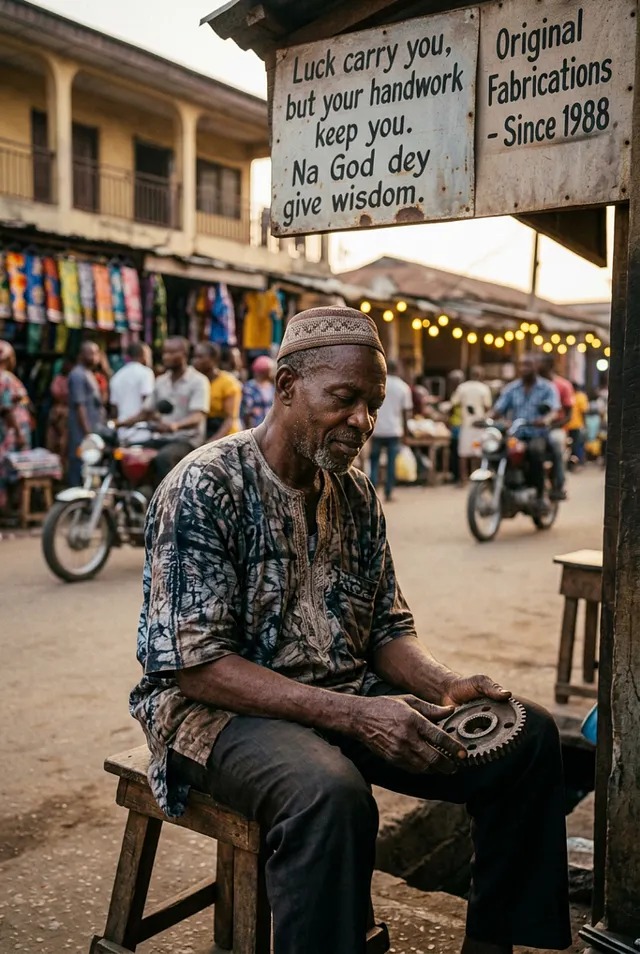
There is a man whose face, posture, and presence have stayed with me for years – a man who, without knowing it, has become a quiet philosopher in my understanding of life. His name is Baba Oni. At sixty-two, he has spent half his life – thirty long, unbroken years – sitting by the corner of a now-busy inner street on Lagos Island, repairing engines, coaxing life out of dead metal, and earning an honest living with hands that have known both grease and grace. He is not a man of dramatic gestures or loud proclamations. He is steady. He is stubborn in the way only disciplined men are stubborn. He is trustworthy in the way only tested men can be trusted.
His apprentices rarely stay after completing their training – the world outside seems faster, shinier, more promising. But he remains, unshaken, unhurried, unbothered by the noise of ambition that has no foundation. What struck me most about him was not his skill – though he is undeniably skilled – but his philosophy, captured in the simple signpost he hung above his workshop: “Luck carry you, but your handwork keep you. Na God dey give wisdom.” In those few words lies a lifetime of truth. A truth many educated people, privileged people, and modern people still struggle to grasp. A truth that the young man who blamed luck for his embezzlement has not yet learned. A truth that life will teach him eventually, whether gently or harshly.
When I think of Baba Oni, I think of a man who has lived long enough to see the street transform – from a quiet corner to a bustling artery of commerce. He has watched buildings rise, businesses collapse, apprentices come and go, fortunes change hands, and trends fade into irrelevance. Yet he remains. Not because he is lucky, but because he is rooted. Because he understands that consistency is a form of intelligence, that work ethic is a form of prayer, that resilience is a form of wisdom.
He does not appear rich, but he is never poor. He does not appear extravagant, but he is never in need. He is not loud, but he is never ignored. He is not famous, but he is deeply respected by those who know the value of a life built on character. In a world obsessed with shortcuts, hacks, and overnight success, men like Baba Oni are reminders that the old truths still stand. That luck may open a door, but it is your hands that keep you inside. That opportunities may come by chance, but sustainability comes by discipline. That God may bless you, but you must steward the blessing.
That life may give you a moment, but you must build the rest. His life interrogates the idea of luck more effectively than any philosophical argument could. Because when you look at him, you see a man who has built a life not by waiting for fortune, but by showing up every day. You see a man who has outlived trends, outlasted shortcuts, and outperformed those who once mocked his simplicity. You see a man who has proven that consistency beats luck, that discipline outlives opportunity, that character outshines talent, and that handwork – real, honest, persistent handwork – is the true currency of survival.
The contrast between him and the young man who blamed luck could not be sharper. One sees luck as a foundation; the other sees it as a spark. One uses luck as an excuse; the other sees it as a gift. One uses luck to avoid responsibility; the other uses responsibility to transcend luck. And this contrast reveals something profound about human nature: our relationship with luck often exposes our relationship with ourselves. People who rely on luck tend to avoid accountability. They see life as something that happens to them, not something they participate in. They see misfortune as persecution rather than consequence.
They see success as entitlement rather than reward. They see responsibility as burden rather than privilege. They see effort as optional rather than essential. And because of this, they remain trapped in cycles of self-inflicted disappointment. But people like Baba Oni understand something deeper: that luck is not a strategy. That luck is not a plan. That luck is not a foundation upon which a meaningful life can be built. They understand that the world does not owe them anything. They understand that dignity comes from contribution, not chance. They understand that the universe responds to patterns, not excuses. They understand that personal responsibility is not a punishment but a path.
When you sit with Baba Oni – as I have – he tells you the history of that small portion of God’s earth with the authority of someone who has lived it. He knows the stories of the buildings, the families, the traders, the apprentices, the street fights, the celebrations, the losses, the transformations. He knows his work with the precision of a surgeon and the humility of a servant.
He knows life not from books, but from experience. And in his quiet way, he embodies a truth that many educated people still struggle to accept: that wisdom is not the same as schooling, and that success is not the same as luck. His signpost says it all: “Luck carry you, but your handwork keep you.” A sentence that should be carved into the consciousness of anyone who hopes to build a life that lasts. Because truly, luck can only take you this far. Beyond that point, it is your hands, your habits, your choices, your character, and your willingness to learn from life’s lessons that carry you the rest of the way.
Yet another mechanic I knew, in a different time and place, learned this lesson the hard way. He was a young man, not yet thirty, with hands that were permanently etched with grease from years of labour in a dusty corner of a motor park. He had an uncanny ability to diagnose an engine by simply listening to it, a gift that seemed almost supernatural. A politician’s convoy once broke down near his shed, and by chance, he was the one available. He fixed a problem that the official mechanics from the government workshop had failed to diagnose. The politician, in a rare moment of genuine gratitude, offered him a job in the civil service. This was the kind of luck men daydream about. He took the job.
Three years later, the politician lost his position, and the new administration swept away all his appointees. The mechanic was left with no workshop, no tools, and a rusty taste of a world he was never trained to navigate. He had abandoned his shed for a salary, and when the salary vanished, the shed was no longer there to return to. Luck had lifted him, but it had not taught him to carry his own ladder. Today, he is back under a different mango tree, starting again with fewer years and heavier debts. His story is a cautionary tale that sits side by side with Baba Oni’s steadfastness, showing that the same stroke of fortune can either anchor a life or unravel it, depending entirely on how the recipient uses the gift.
There is a silence that falls on a person when luck leaves the room. I have felt it myself. You prepared, you prayed, you knocked on every visible door, and yet the door remained shut while it opened for your neighbour who prepared less. In that silence, the easy lie is to call yourself a victim. The harder truth is to ask what you can build with the materials still in your hands. I travelled once to a remote part of the Southeast for a burial and met an elderly farmer whose land was the worst in his village. His soil was rocky, his section was on a slope that erosion was swallowing year by year. His neighbours had flat, fertile plots and richer harvests. That was not his fault. It was the geography of his birth, which is just another name for the luck of the first kind. But this man had studied his land until he understood it intimately.
He planted crops that held the soil together. He dug trenches that redirected the rain. His yield was never the largest, but his land never collapsed. His neighbour, who had the best soil in the village, lost half his harvest in two seasons because he farmed carelessly and refused to learn anything new. The man on the poor land is still farming. The man on the rich land sold his plot to a church and moved to the city. Luck gave one man a head start. Stewardship kept the other man in the race. This is the quiet drama that plays out in a thousand forms every day, and it proves that the starting point is never the whole story.
Real life does not come with a clear division between what you caused and what chose you. The two are woven together like the threads in a market wrapper. The Igbo have a saying: Onye kwe, chi ya ekwe. If a man agrees, his god agrees. It does not mean you can drown and your chi will save you if you simply nod your head. It means your effort and your destiny must lock hands. The chi opens the path, but the feet must walk it. Luck can send you a bus, but it will not teach you to drive. It can hand you a seed, yellow and promising, but it will not clear the land, chase away the birds, or beg the sky for rain. The farmer on the rocky slope understood this. He did not waste time cursing his luck; he got to work understanding his unique conditions. And in doing so, he turned a liability into a lesson that secured his survival.
The myth of luck and the comfort of excuses are tied together like two sides of the same worn coin. Human beings have always been fascinated by luck. We speak of it as though it were a mystical force that determines the trajectory of our lives. We envy those who seem to have it. We pity those who don’t. We pray for it, chase it, and sometimes worship it. But beneath this fascination lies a deeper psychological truth: luck is the easiest explanation for outcomes we do not want to take responsibility for. When we succeed, we attribute it to our hard work, intelligence, or talent. When we fail, we blame luck. It is a convenient narrative. It protects our self-image. It shields us from shame. It allows us to avoid the discomfort of introspection.
But it also traps us in a cycle of stagnation. Because if luck is responsible for our failures, then we have no reason to change. If misfortune is the culprit, then we are absolved of responsibility. If fate is against us, then effort becomes meaningless. This mindset is seductive, but it is also destructive. It prevents growth. It blinds us to our own patterns. It keeps us immature, dependent, and perpetually unprepared for the realities of life. The young man I encountered was not unlucky. He was irresponsible. He was dishonest. He was unprepared for the weight of accountability. But instead of confronting these truths, he chose the comfort of excuses. And in doing so, he robbed himself of the opportunity to grow. That is the tragedy of blaming luck: it keeps us small.
The problem with our worship of luck is not that luck is unreal. It is that waiting for luck makes a man sit in a plastic chair while his life walks past him. A young graduate once told me he was waiting for his breakthrough. I asked him what he was doing while he waited. He was not interning, not volunteering, not apprenticing himself to anyone, not taking an online course. He was simply waiting. He had turned his life into a bus stop. What arrived in that space were not opportunities but years – years he will never recover.
The people I have seen build lasting things in this country did not wait for a minister to remember their last name. They started with what was in their hands. A phone to make calls. A shop on a street with no foot traffic, which they lit with a single yellow bulb and refused to close even when the day’s only customer bought a sachet of pure water. The writer Henry David Thoreau once warned, “The mass of men lead lives of quiet desperation.” That quiet desperation often begins with the belief that a grand moment will come to rearrange everything. When the grand moment does not arrive, desperation sets in. But the alternative is to live a life of quiet construction, building piece by piece so that you are not at the mercy of moments.
I remember a woman who ran a printing and photocopying business in a small university town. The location was poor, the equipment was old, and the students were perpetually broke. She could have folded. Instead, she began staying open until midnight during exam periods, offering typing services, and letting students pay in installments they could manage. She treated every student like a long-term investment. Some graduated, got jobs, and sent their siblings to her. Others became lecturers and brought her departmental printing contracts. Her business grew not because a big break arrived, but because hundreds of small, unnoticed transactions were handled with patience and basic decency. Luck was completely absent from the first five years. The sixth year brought rewards that looked, to an outsider, like a sudden blessing. But the blessing had been slowly constructed, one late night and one flexible payment plan at a time.
The work of staying is not glamorous. There are no awards for waking up and doing the same honest thing for the two hundredth day when the first hundred and ninety-nine brought no applause. There is no viral video for the mother managing a small provision shop in a neighbourhood where people buy Nescafé by the teaspoon. But this is the real foundation of any life that will not collapse when the storm comes. A reputation for reliability. A habit of showing up. The refusal to treat a stroke of fortune as a permanent salary. These are not exciting qualities. They will not earn you a headline. But they will earn you the trust of people who matter, and that trust compounds more reliably than any lottery ticket. As the Bible puts it in Proverbs 12:24, “Diligent hands will rule, but laziness ends in slave labour.” The diligence is not flashy, but over time it builds a kingdom that luck alone can never establish.
Life is not a classroom with a structured curriculum. It is a chaotic, unpredictable, often unforgiving teacher. But it is also fair in its own way. It gives us lessons repeatedly until we learn them. It uses people, events, and experiences as instruments of instruction. And the lessons are always available – if we are willing to pay attention. The first of these is the lesson of responsibility. Responsibility is not glamorous. It is not exciting. It is not something people applaud. But it is the foundation of maturity. It is the quiet, steady force that separates those who build meaningful lives from those who drift aimlessly. Responsibility means acknowledging that your choices have consequences. It means accepting that you are the author of your own story. It means refusing to hide behind excuses. Many people avoid responsibility because it feels heavy.
But the irony is that avoiding responsibility makes life heavier. When you refuse to own your actions, life will force you to face them anyway – often in harsher ways. The young man who blamed luck was not avoiding responsibility for the sake of comfort; he was avoiding it because he had never learned how to carry it. And he is not alone. Many people grow older without growing up. They age physically but remain emotionally and morally adolescent. They want freedom without accountability, success without effort, respect without integrity. But life does not work that way. Life rewards responsibility. Life respects those who respect themselves enough to own their choices.
The second lesson is self-awareness. Self-awareness is one of the most powerful tools a person can possess. It is the ability to see yourself clearly – your strengths, weaknesses, patterns, triggers, and blind spots. It is the courage to confront your own flaws without collapsing into shame or denial. The ancient Greeks inscribed “Know thyself” on the Temple of Apollo at Delphi, and thousands of years later, that command has lost none of its urgency. Most people are not self-aware. They live in narratives that protect their egos rather than reveal the truth. They blame others for their failures. They rewrite events to make themselves the victim. They avoid introspection because it threatens the identity they have constructed. But without self-awareness, growth is impossible. Without self-awareness, you repeat the same mistakes.
Without self-awareness, you sabotage yourself without realizing it. The young man lacked self-awareness. He could not see that his actions reflected his character. He could not see that his choices were shaping his future. He could not see that blaming luck was a form of self-deception. And yet, how many of us have done the same? How many times have we blamed circumstances instead of examining our decisions? How many times have we avoided the mirror because we feared what we might see? Self-awareness is not comfortable, but it is liberating. It frees you from the illusions that keep you stuck. It allows you to grow intentionally. It transforms mistakes into lessons rather than repeated cycles.
The third lesson is character. Character is not built in moments of comfort. It is forged in the fires of adversity, temptation, and choice. It is revealed when no one is watching. It is tested when doing the right thing is inconvenient, costly, or difficult. Luck may open a door for you, but character determines whether you can stay in the room. Many people rise quickly because of luck – connections, timing, opportunities, or circumstances. But without character, they fall just as quickly.
We see this everywhere: in politics, business, entertainment, relationships, and everyday life. People sabotage themselves not because they lack talent, but because they lack character. Character is what sustains success. Character is what earns trust. Character is what builds legacy. The young man had an opportunity – a simple one, but an opportunity nonetheless – to demonstrate character. Instead, he chose the path of least resistance. And life responded accordingly. Aristotle said, “We are what we repeatedly do. Excellence, then, is not an act, but a habit.” Character is the sum of those habits, and it either fortifies a life or leaves it vulnerable to the first strong wind.
The fourth lesson is the lesson of consequences. One of the most important truths about life is that everything has consequences. Every choice. Every action. Every omission. Every lie. Every truth avoided. Every responsibility neglected. Consequences are not punishments; they are simply the natural outcomes of our decisions. They are life’s way of maintaining balance. They are the feedback mechanism that teaches us how to live wisely. When people blame luck, they are trying to escape consequences. But consequences cannot be escaped – only delayed. And the longer they are delayed, the heavier they become.
The young man believed he was unlucky because he faced consequences. But the truth is that he was fortunate. Life gave him a small consequence early, rather than a catastrophic one later. If he learns from it, he will grow. If he doesn’t, life will repeat the lesson – louder, harsher, and more painful. Sir Isaac Newton’s third law of motion states that for every action, there is an equal and opposite reaction. The moral universe operates on a similar principle, even if the reaction is sometimes delayed.
Luck exists. There is no denying that. Some people are born into privilege. Some encounter opportunities others never see. Some experience fortunate timing. Some are in the right place at the right moment. But luck is not a strategy. Luck is not a foundation. Luck is not a substitute for discipline, integrity, or effort. Luck may give you a head start, but it cannot carry you to the finish line.
Luck may open a door, but it cannot keep it open. Luck may give you a chance, but it cannot make you worthy of it. People who rely on luck eventually run out of it. People who rely on character never do. The world is full of talented people who failed because they lacked discipline. It is full of intelligent people who failed because they lacked humility. It is full of privileged people who failed because they lacked gratitude. It is full of lucky people who failed because they lacked responsibility. But it is also full of ordinary people who succeeded because they showed up consistently, learned from their mistakes, and refused to blame luck for their shortcomings.
When fortune leaves, and it often does, you are left alone with whatever you have cultivated inside yourself. If you have cultivated nothing, you are left with an empty room and a ringing silence. If you have cultivated skill, resilience, and a network of people who trust your word, then you have something to rebuild from. I have seen men lose political appointments and vanish into bitterness. I have seen others lose the same appointments and return to their law chambers, their farms, their consulting firms, their classrooms. The difference was not the size of the loss. It was the substance of the person enduring it.
One saw the position as his identity. The other saw it as an interval. When the music stopped, the first man had no dance of his own to perform. The second man simply returned to his own song. There is a question the old ones ask a child who boasts too early: “I ma ka esi e ji ututu amara ehihe?” Do you know how to use the morning to judge the afternoon? A lucky morning is a gift. It is warm, it is bright, and it makes everything seem possible. But the afternoon will test you. The sun will climb higher, the money may not arrive, the friends may thin out, the approval may turn to silence. The man who has trained only for mornings will collapse by two o’clock. The man who has trained for the whole day will be planting while the morning man is still celebrating.
Let me tell you about a man in my village. He was a trader who imported containers of leather goods. For years, he was the standard. He built a mansion on the main road, bought cars for his kinsmen, and became a titled man. He was often called lucky, and perhaps in the beginning, timing had favoured him. But he refused to diversify, refused to listen to the small voices warning him that the market was shifting. He dismissed every piece of counsel as the jealousy of small people.
When the policies changed, when the container business turned vicious, he fell. He fell so hard that the mansion is now an empty shell with rusting gates. He sits in a rented two-room apartment in the state capital, still talking of the good years, still waiting for luck to return and restore his name. Waiting is easier than learning. It is also a form of slow death. Now consider the tailor who occupies a tiny shop on a street you would not enter unless someone directed you there. He learned his craft the hard way, through an apprenticeship that lasted six years. He does not have a single signboard.
His shop is hot and cramped. But the suits he cuts fit so precisely that judges and bank managers seek him out by referral. He is not rich by the standard of the container merchant. But he has never been broke. He owns his shop. His children are in school. His reputation is a safe he carries inside his chest, his age mates respect him, and no government can devalue its currency. Luck did not build his business. The steady hand did. The refusal to let out a garment that was not correct did. The long, boring, repetitive discipline of being excellent in a hidden room built a life that no market crash can dismantle overnight.
What you must understand is that the harvest never comes from the single spectacular rain. It comes from the daily, boring irrigation. The rain is a good drama, and we love drama. But a farmer who depends on drama will starve. The farmer who digs a well survives the drought. If you are waiting for a dramatic rain, for the one appointment, the one contract, the one viral moment that will rearrange your destiny, you are gambling with your years. Build the well. Lay the pipes. Do the unphotographed work. Then, when the rain finally comes, you will have something to catch it in. If the rain never comes, you will have water anyway.
This is what was meant by an old man with hands full of splinters who once mended an oar for me years ago in a coastal town far from here. He could have told me to buy a new one. Instead, he said a new oar has no history. It has not learned the water. The broken one had memory in its grain. Luck is a new oar, fresh and smooth and untested. It looks beautiful. But it is the oar that has fought the current, that has been sanded by salt and strain, that can be trusted when the sea turns hostile. The life that has passed through difficulty carries a knowledge that easy fortune cannot counterfeit. Do not despise your scars. They are proof of tuition paid.
There are pains luck cannot protect you from. In a hospital ward some years ago, I sat with a woman whose body was being slowly dismantled by an illness that arrived without warning. Before the sickness, there was no sense of injustice. She had a good job, a family, a future that seemed secured. The illness was not a punishment. It was biology. A random cell dividing in the dark. In those final months, talk of luck or its absence became meaningless. What remained was agency over the soul. How she met the morning. What tone she chose for her last words. The deliberate way she distributed her wrappers, her jewellery, and her final messages.
Luck could not enter that room. Only character could sit in the chair beside the bed. Some distances cannot be crossed by any amount of striving, but grace remains possible until the very last step. Viktor Frankl, a psychiatrist who survived the Nazi concentration camps, wrote, “Everything can be taken from a man but one thing: the last of the human freedoms – to choose one’s attitude in any given set of circumstances, to choose one’s own way.” That freedom is not luck. It is the quiet, determined fruit of a life that has learned to stand on something deeper than circumstance.
So when the appetite for miracles becomes too loud, step outside your gate and look at the mango tree. It does not pray for fruit. It absorbs water, reaches toward light, and deepens its roots in the dry months when no one applauds. The fruit arrives when it arrives. If the season is bad, the tree does not collapse into self-pity. It waits and thickens its trunk. The tree knows what the anxious young man scrolling through his phone does not know: that there is a rhythm deeper than the noise, and that fitting yourself to that rhythm is more important than chasing every passing breeze. The Psalmist captured a similar image when he wrote of the man who delights in the law of the Lord: “He is like a tree planted by streams of water, which yields its fruit in season and whose leaf does not wither.” The flourishing is not a result of frantic grasping but of deep, patient rootedness.
The hard truth is that you are responsible for your life. Not luck. Not fate. Not circumstances. Not other people. Not the universe. You. Your choices. Your habits. Your mindset. Your character. Your willingness to learn. Your ability to grow. Your courage to face yourself. Life is not always fair, but it is always honest. It gives you what you earn, what you tolerate, what you attract, and what you allow. It responds to your patterns, not your excuses. The young man blamed luck because he could not face himself.
But life will not adjust itself to accommodate his denial. It will continue to present him with the consequences of his choices until he learns the lesson. And the same is true for all of us. One of the most difficult journeys a person can take is the journey inward. It requires honesty, courage, and humility. It requires the willingness to confront uncomfortable truths. It requires the ability to sit with shame without letting it define you.
But it is also the most rewarding journey. Because on the other side of self-confrontation lies self-mastery. On the other side of discomfort lies growth. On the other side of truth lies freedom. When we stop blaming luck, we begin to see ourselves clearly. When we stop making excuses, we begin to grow. When we stop avoiding responsibility, we begin to mature. The young man’s story is not unique. It is a reflection of a widespread human tendency to avoid accountability. But it is also an invitation – a reminder that we can choose differently. We can choose to take responsibility. We can choose to learn from our mistakes. We can choose to build character. We can choose to grow.
Every person we meet is a lesson. Every situation we encounter is a teacher. Every experience we live through is a chapter in our education. Life is constantly speaking – through people, through events, through consequences, through opportunities, through failures. But we only benefit from these lessons if we are willing to listen. The young man taught me something – not about him, but about humanity. He reminded me of how easy it is to slip into denial. He reminded me of how tempting it is to blame luck. He reminded me of how important it is to examine myself. Because the truth is, I have been that young man at times. We all have. We have all blamed circumstances instead of choices. We have all avoided responsibility. We have all made excuses. We have all been disconnected from reality at some point. But growth begins when we recognize these tendencies and choose to rise above them.
If luck is unreliable, then what should we rely on? The answer is simple, but not easy: responsibility, self-awareness, discipline, integrity, humility, consistency, and character. These are the qualities that build a meaningful life. These are the qualities that sustain success. These are the qualities that earn trust. These are the qualities that create legacy. Luck may give you a moment, but character gives you a lifetime. If you find yourself with a piece of luck, receive it with thanks. Give thanks to the God your ancestors acknowledged. Share the blessing. Let your celebration be brief and your reinvestment swift.
A gift is not a foundation. Do not build your house on it. And if you find yourself in a season where luck has seemingly packed its bags and travelled to another man’s village, do not imagine you have been singled out for suffering. This is the normal curriculum of life. This is the period where you develop the only things that can never be stolen from you: your skill, your character, your steady hand, and your refusal to quit while you still have breath. These are not consolation prizes for the unlucky. They are the architecture of a life that can survive good times without becoming soft and bad times without becoming bitter.
In the end, life is not a game of chance. It is a journey of choices. Luck may influence the beginning, but it does not determine the end. Luck may give you opportunities, but it cannot make you worthy of them. Luck may open doors, but it cannot keep them open. What carries you forward – what sustains you, shapes you, and defines you – is your character, your responsibility, your willingness to learn, and your courage to face yourself. The young man who blamed luck will continue to encounter the same lessons until he chooses to grow. And so will we. Because life is patient, but it is also persistent.
It will keep teaching us until we learn. Luck is real, but it has a short reach. It can take you from the back of the hall to the front chair. It can put a microphone in your hand. It cannot write the speech. It cannot make your voice steady. It cannot fill the room a second time. After a certain point, just beyond the bright entrance, the noise fades, the spotlight swings away to find a fresher face, and you are left in the long corridor of your actual life. What you do there, what you build in the silence, whether you keep walking when no one is watching, that belongs entirely to you. Luck can only take you this far. The rest is yours to walk, and the walking is the point.