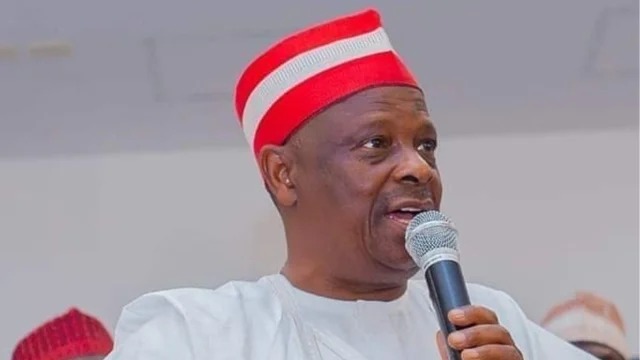
Former Kano State Governor and vice-presidential candidate of the Nigeria Democratic Congress, Rabiu Kwankwaso, has called for an urgent and comprehensive overhaul of Nigeria’s security architecture, warning that the country is gradually sliding deeper into chaos despite enormous government spending on security operations.
Kwankwaso made the call in a statement shared on his X handle on Tuesday, where he expressed grave concern over the worsening security situation across several parts of the country.
The former governor lamented that violent crimes such as banditry, kidnapping, terrorism, communal clashes and armed robbery had become recurring realities in many states, leaving citizens trapped in fear and uncertainty.
According to him, the growing insecurity has reached alarming levels, with many Nigerians no longer feeling safe in their homes, on highways or even within their communities.
“I have noted with grave concern the escalating wave of insecurity that has engulfed our beloved nation. Once again, Nigeria is bleeding profusely,” Kwankwaso said.
He stated that despite repeated assurances from authorities and huge allocations to the security sector over the years, attacks by criminal groups had continued to spread across different regions of the country.
Kwankwaso specifically mentioned states such as Zamfara, Borno, Sokoto, Katsina, Kwara and Oyo as some of the areas severely affected by persistent violence and criminal activities.
According to him, residents in many of these states now live under constant fear of attacks, abductions and killings, while businesses and economic activities continue to suffer due to insecurity.
The former governor lamented that many Nigerians could no longer “sleep with both eyes closed,” a situation he described as unacceptable for a country aspiring to economic growth and stability.
He warned that if urgent steps were not taken to address the deteriorating security situation, the consequences could become more devastating for national unity, economic development and public confidence in government institutions.
Kwankwaso stressed that the challenge facing Nigeria was no longer one that could be solved through temporary measures or political rhetoric, insisting that the country required a strategic and sincere restructuring of its security framework.
He argued that security agencies needed better coordination, improved intelligence gathering, modern equipment and stronger accountability mechanisms to effectively tackle emerging threats.
The former governor also called for greater investment in community-based policing and grassroots intelligence systems, saying local communities often possess critical information capable of preventing attacks if properly engaged.
According to him, the current centralised approach to security management has not produced the expected results, especially in remote areas where criminal groups continue to operate freely.
Kwankwaso further urged the Federal Government to pay closer attention to the welfare and morale of security personnel, noting that many officers serving in dangerous environments lacked adequate support and motivation.
He said security operatives must be properly trained, equipped and motivated to confront increasingly sophisticated criminal networks operating across the country.
The former governor also linked rising insecurity to worsening economic hardship, unemployment and poverty, warning that the growing number of idle youths created opportunities for criminal recruitment.
He therefore called for urgent socio-economic reforms capable of addressing inequality, joblessness and lack of opportunities among young Nigerians.
Kwankwaso maintained that tackling insecurity required a combination of military action, economic intervention, social justice and political sincerity.
He urged political leaders across party lines to stop politicising security issues and instead unite in the national interest to find lasting solutions to the crisis.
According to him, insecurity should not be treated as a partisan issue because the consequences affect all Nigerians regardless of political affiliation, ethnicity or religion.
He also sympathised with families who had lost loved ones to attacks in different parts of the country and prayed for the quick recovery of victims injured during violent incidents.
The former governor appealed to the Federal Government to demonstrate stronger commitment and urgency in protecting lives and property, which he described as the primary responsibility of any government.
Security challenges have continued to dominate national discourse in recent years, with several states battling various forms of violent crimes ranging from insurgency in the North-East to banditry in the North-West, kidnapping in the North-Central and armed attacks in parts of the South.
Recent incidents in several communities across the country have further intensified concerns over the effectiveness of existing security strategies and the capacity of law enforcement agencies to respond swiftly to emergencies.
Analysts believe Kwankwaso’s comments reflect growing public frustration over the persistent insecurity affecting both rural and urban communities despite repeated promises by authorities to restore peace and stability.
Many Nigerians have also continued to call for reforms in the security sector, including improved intelligence sharing, decentralised policing structures and stronger collaboration between federal and state authorities.
Kwankwaso concluded by urging Nigerians not to lose hope despite the prevailing challenges, while calling on leaders at all levels to place the safety and wellbeing of citizens above political interests.
He said restoring peace and public confidence must become an urgent national priority if Nigeria hopes to achieve meaningful progress and stability in the years ahead.