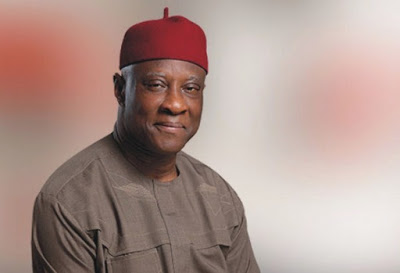
Former Minister of Interior and Managing Director of Integrated Oil and Gas Limited, Captain Emmanuel Iheanacho has urged maritime journalists in Nigeria to invest deeply in knowledge so as to enable them to understand shipping economics, study regulation, learn the language of trade, interrogate data, verify facts and protect credibility.
Iheanacho who gave this counsel while delivering a paper titled, “The Role of the Media in Sustainable Maritime Development in Nigeria”, during an event to celebrate past Presidents of the Maritime Reporters’ Association of Nigeria, MARAN in Lagos on Friday, reminded the media professionals that theirs is not merely a reporting profession but a strategic national assignment, hence the need for them to be on top of their game in reporting the sector.
Iheanacho who was represented at the event by the Principal Partner of Akabogu & Associates, Dr. Emeka Akabogu SAN, argued that where the media is responsible, informed, and courageous, industries progress faster adding that where reporting is careless, shallow, or easily swayed, progress becomes harder.
He insisted that Nigeria needs a maritime media that is fearless but fair; critical but constructive; independent but informed; energetic but disciplined.”
Continuing, he said, “I am particularly pleased to speak to you not only as a guest, but as someone whose life has been deeply intertwined with the Nigerian maritime industry for close to five decades.
“Over those years, I have had the privilege of serving in different capacities as an operator in the private sector, as a promoter of shipping and maritime enterprise, as chairman of industry associations and collaborative initiatives, and at another stage, as a Minister of the Federal Republic.
“Those experiences have given me a unique vantage point. I have seen how responsible journalism can support reform, encourage investment, correct misinformation, and build confidence.
“I have also seen how incomplete facts, sensationalism, insufficient technical understanding, or avoidable haste can damage reputations, distort policy debates, and slow progress.
“It is from that practical perspective, not theory alone, that I speak today on ‘The Role of the Media in Sustainable Maritime Development in Nigeria.”
Acknowledging that Nigeria’s maritime sector sits at the intersection of trade, energy, logistics, food security, industrialisation, and regional competitiveness, he charged the journalists saying, “Your words can attract confidence or discourage it, your questions can trigger reform or expose complacency, your analysis can clarify choices or deepen confusion.
“Therefore, invest deeply in knowledge. Understand shipping economics. Study regulation. Learn the language of trade. Interrogate data. Verify facts. Protect credibility. The more technically competent maritime journalism becomes, the more powerful its contribution to development”, he declared.
The former Minister who practically listed four primary functions of the media to include: agenda setting, accountability, public education and stakeholder mobilization, however, called on the journalists to live up to expectations by constantly ensuring that they follow issues beyond the headline and accompany policy until results are delivered.
On accountability, he urged media practitioners to always ensure that they play the watchdog role by exposing administrative bottlenecks, corruption risks, policy contradictions, operational inefficiencies and delays that impose costs on businesses and consumers alike.
“During periods of reform, responsible reporting can also help the public distinguish genuine progress from mere announcements”, he added.
Highlighting why public education is one of the noblest functions of maritime journalism, Iheanacho explained that shipping, marine insurance, vessel finance, customs systems, port concessioning, cabotage, freight logistics, international conventions are specialised subjects, yet they affect ordinary Nigerians every day through prices, jobs, trade flows, and national competitiveness.
He however, pointed out that more needs to be done saying, “We need: simpler explanations of policy reforms, more data-driven reporting, wider coverage of inland waterways and coastal economies, greater promotion of maritime education and skills development as well as more rigorous accountability from persons in position of government authority to track policy, budget and outcomes. Nigeria cannot build a strong blue economy with a poorly informed public.”
On stakeholder mobilization, he charged the media to provide a platform where government, private investors, regulators, operators and indeed, all stakeholders move in alignment.
“The media has helped bring regulators and operators into dialogue, amplify urgent policy concerns, encourage transparency in reforms, build confidence around investment opportunities and ensure that important conversations are not hidden from the public.
“In several instances, issues that might have remained trapped within committee rooms gained traction because journalists carried them into the national conversation. Yet mobilisation can be stronger still.
“Too often, conferences end with excellent speeches but limited follow-through. The media can help by tracking commitments, revisiting promises, and sustaining momentum after the applause has ended”, Iheanacho submitted.
Speaking on the reason for the gathering, the retired Merchant Navy Captain commended MARAN for sustaining a tradition of professional engagement in a sector that is both vital to the economy and often insufficiently understood by the wider public.
“To celebrate your past presidents is to celebrate stewardship, sacrifice, and continuity. Leadership in journalism, especially sector journalism is not easy. It demands courage, persistence, judgement, and often the willingness to stand alone in defence of facts.
“As we honour the past presidents of MARAN tonight, we honour those who helped build that tradition. May the next generation build it even stronger. And may all of us – operators, regulators, policymakers, and journalists work together to create a maritime sector that is efficient, transparent, globally competitive, and sustainable for generations to come”, he said.
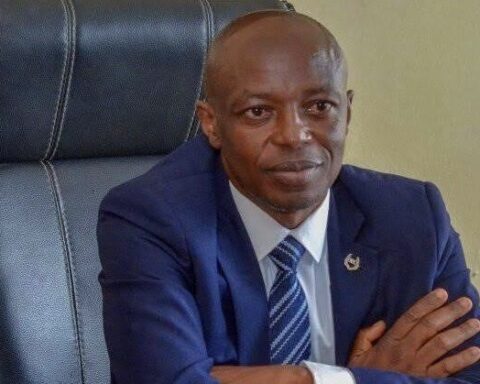
Dr. Emeka Akabogu SAN, Principal Partner, Akabogu & Associates and representative of former Minister of Interior, Capt. Emmanuel Iheanacho at the MARAN event on Friday.