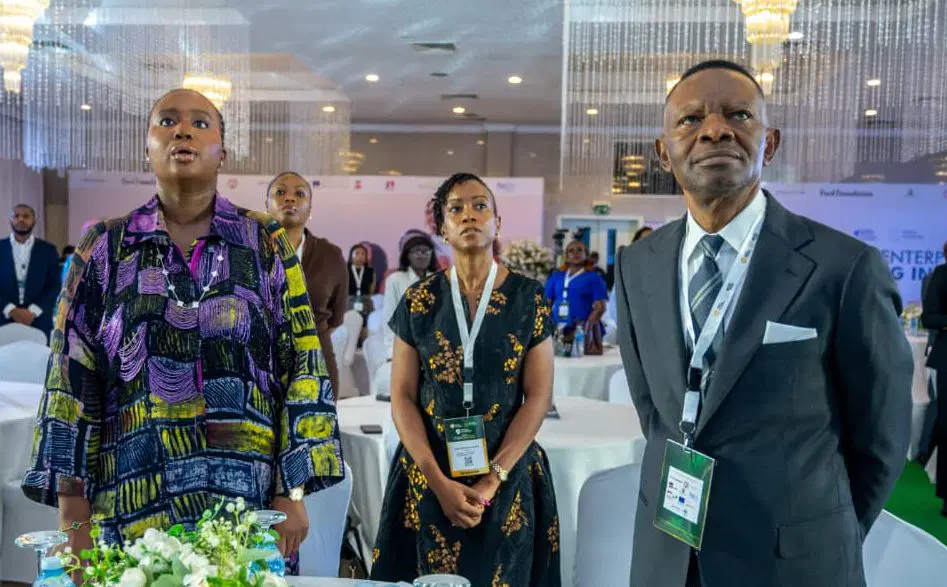
The Impact Investors Foundation (IIF) has intensified efforts to unlock domestic institutional capital for Nigeria’s impact economy, convening policymakers, regulators, fund managers, and entrepreneurs in Lagos to dismantle structural bottlenecks hindering inclusive growth.
Speaking at the opening of the 9th Annual Convening on Impact Investing (ACII), which commenced at 8:00 AM on Wednesday, November 25, 2026, and runs through Thursday, November 26, 2026, at the Civic Centre, Victoria Island, Lagos, stakeholders identified weak policy implementation, poor capital allocation, and limited investment pathways as primary barriers preventing long-term local funds from reaching high-impact businesses.
The two-day forum, themed “Unlocking Institutional Capital for Nigeria’s Impact Economy,” spotlights the stark disconnect between Nigeria’s growing domestic capital pools and the acute financing deficit facing Micro, Small, and Medium Enterprises (MSMEs).
Delivering remarks at the forum, Oare Ehiemua-Ochui, Chief Executive Officer of the Impact Investors Foundation, noted that while Nigeria’s pension industry manages a record ₦31.8 trillion as of August 2026, covering over 11.3 million contributors, MSMEs across the country continue to grapple with an estimated $160 billion funding gap, according to African Development Bank (AfDB) figures.
“That is not a shortage of money. It is a shortage of structure and shared confidence,” Ehiemua-Ochui said, explaining that institutional investors are not hesitant because impact is unattractive, but rather because they hold other people’s retirement savings in trust and are right to exercise caution. Reflecting on the evolution of the ecosystem over the past decade, she added that while impact investing in Nigeria was a conversation among a few pioneers nine years ago, it has matured into a viable market whose next chapter will be written by domestic institutions.
According to her, the foundation’s immediate ambition is to turn the momentum in the room into tangible capital that reaches entrepreneurs with bold ideas, factories ready to scale, and communities waiting for opportunity. To bridge this trust and structural deficit, IIF is actively collaborating with government institutions, regulators, and development partners to establish a National Impact Investing Policy and Regulatory Framework.
As part of its broader push to expand blended finance mechanisms, Ehiemua-Ochui disclosed that the Nigeria Wholesale Impact Investment Fund (WIIF) SME Fund Accelerator, which launched earlier in November 2026, is currently supporting 22 indigenous fund managers across 14 states to build capacity, de-risk untested opportunities, and improve their institutional readiness. Beyond financial structuring, the foundation is advocating for stronger links between academia and enterprise.
Ehiemua-Ochui urged universities and research institutions across the country to serve as stronger pipelines for commercially viable businesses, backed by technical and financial frameworks capable of scaling homegrown innovations.
Meanwhile, the convening’s technical sessions, featuring ecosystem leaders such as Adesuwa Okunbo-Rhodes, Founder and Managing Partner of Aruwa Capital Management, integrated gender-lens investment metrics, angel investing workshops co-hosted with the Lagos Angel Network and Impact Hub, and curated deal rooms designed to connect investment-ready SMEs directly with institutional asset owners.
The two-day gathering will culminate on Thursday evening with the IIF Annual Dinner and Awards, honouring organisations and individuals driving measurable social and environmental outcomes across the Social Enterprise and Impact Investor categories, alongside the prestigious Innocent Chukwuma Award for Social Impact.
Concluding its call to action, the foundation urged regulators, pension fund administrators, and policymakers to move beyond dialogue and implement actionable reforms, emphasising that Nigeria’s economic progress must be measured not merely by Gross Domestic Product (GDP) growth, but by tangible improvements in citizens’ livelihoods.