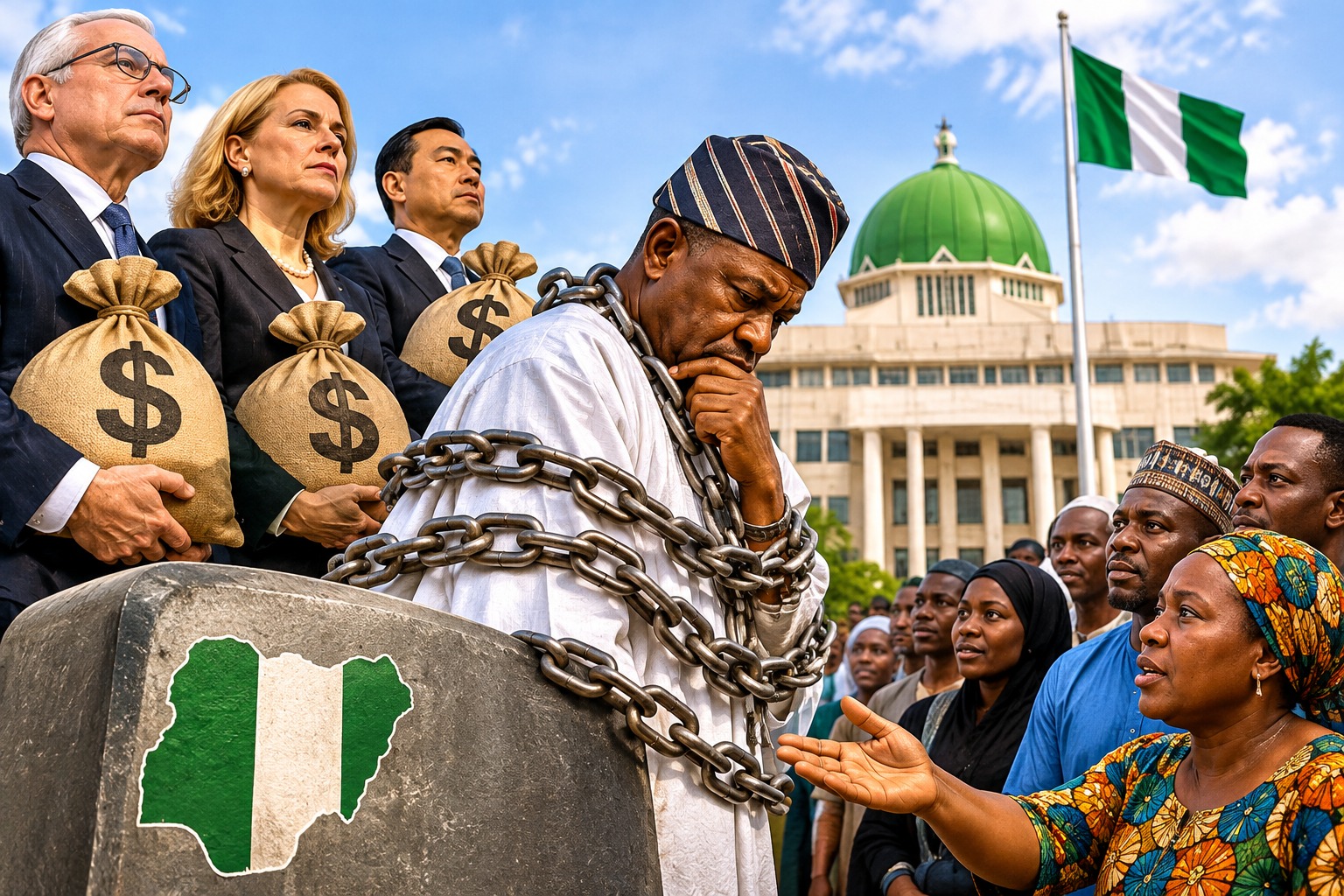
Why Nigeria’s reset must begin not with the next loan, but with restoring the bargain between the state and the people who fund it.
By Charles Obiajulu Ugwu
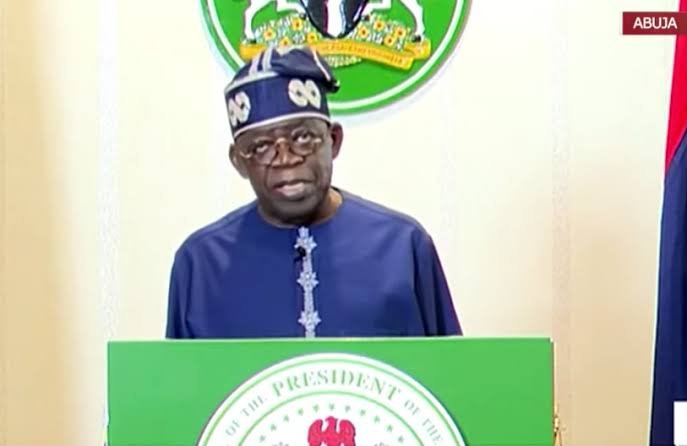
On 27 October 2026, a letter from the President was read on the floor of the Senate. It asked the National Assembly to approve a supplementary external borrowing plan of $20,517,755,901 and €1,045,083,643 for 2026 and 2027, about $21.7 billion in all, for infrastructure, agriculture, health, education, water, security and employment. It arrived barely fifteen months after the same Assembly approved a $21.5 billion plan for 2025 and 2026, and months after a separate request for $6 billion to support the 2026 budget.
The national argument that followed was predictable within hours. The government spoke of an infrastructure gap and concessional rates. Its critics spoke of a debt trap. Almost everyone, on both sides, agreed that the cost of governance must come down. Each of these positions holds a piece of the truth. Together they form a ritual Nigeria has performed for two decades, and the ritual has changed nothing.
This essay argues that the real fracture lies elsewhere. A state that cannot collect from its own citizens, and borrows abroad to fill the gap, slowly changes the people it answers to. Its first loyalty moves from the taxpayer to the creditor. Interest is paid before teachers. The lender’s covenant is read more carefully than the citizen’s complaint. Nigeria is drifting, loan by loan, into being governed by its creditors.
The reset, then, does not begin with whether to borrow. It begins with restoring the bargain between the state and the people who fund it: what I will call fiscal consent. Cutting the cost of government matters, but not for the reason usually given. Its value is not that it pays the debt. It cannot. Its value is that it is the price a state must pay to be trusted with its citizens’ money again.
The misdiagnosis
Three scripts dominate every Nigerian debt debate, and each one allows its speaker to avoid the harder question.
The first is the official script: our debt-to-GDP ratio is low. It is. The IMF projects it at about 32 percent in 2026, well below the thresholds that usually alarm lenders. But a ratio of debt to the size of the economy says little about a government’s ability to pay. A state does not repay creditors with GDP.
It repays them with revenue, and Nigeria’s revenue is among the thinnest of any large economy, at roughly 9 to 10 percent of GDP. Debt-to-GDP is the comfortable number. Interest-to-revenue is the honest one, and the IMF puts it at 53.7 percent for 2026, up from 40.8 percent in 2024.
The second is the opposition script: debt is the disease, and corruption its cause. This is half right, which makes it dangerous. Borrowing is not in itself a moral failure. Every serious economy that built modern infrastructure borrowed to do it. The question has never been whether to borrow, but whether the borrower can show, in public and in detail, what the money became. A debate framed as “debt good” against “debt bad” lets both sides avoid that question.
The third script belongs to almost everyone: cut the cost of governance. It is the most popular and the most misunderstood. It is usually offered as if trimming salaries, convoys and allowances would close the fiscal gap. As I will demonstrate in the course of this essay, the arithmetic does not allow it. Yet the instinct behind it is correct, for a reason the script rarely names.
What the three scripts share is a focus on the size of the debt rather than the relationship it reflects. Debt is a symptom. The underlying condition is a broken loop between what citizens contribute, what they can see, and what the state is compelled to explain. Until that loop is repaired, every new loan, whatever its interest rate, deepens the condition it is meant to cure.
The creditor constituency
States become accountable to whoever funds them. Where governments live on broad taxation, citizens learn to ask what their money bought, and governments learn they must answer. Where governments live on rents that require no consent, oil being the classic case, that pressure weakens. Nigeria’s political history since the 1970s is in large part the story of a state that grew rich without needing its citizens’ permission.
External borrowing is the new rent. It allows the state to spend what it has not collected and has not justified to anyone at home. And unlike oil, it comes with a master. A government that finances close to half its budget by borrowing does not answer first to the trader in Onitsha or the farmer in Funtua.
It answers first to the bondholder and the multilateral lender, whose interest falls due on a fixed date whatever happens to the teacher’s salary. In January 2025, according to the Central Bank’s own data, the federal government paid ₦696.27 billion in debt service against retained revenue of ₦483.47 billion (Gov Business Journal). For that month, every naira the state kept went to its creditors, and more had to be found.
This is the shift the debate keeps missing. The danger of the $21.7 billion is not only fiscal. It is constitutional in the plain sense of the word: it changes who constitutes the state’s real audience.
The irony is that Nigerians do not lack the habit of accountability. They practise it every week. In markets, motor parks and offices across the country, people run rotating savings circles: esusu among the Yoruba, isusu among the Igbo, adashe among the Hausa. Every member sees each contribution. Everyone knows the order in which the pot will be collected. A member who takes the pot and stops contributing is named and quickly finds that no circle will admit them again. These circles move large sums on trust alone, and the trust holds because the pot is visible.
The same citizens who run these circles with discipline cannot see their state’s pot. They do not know what came in this month, what went out, to whom, or what a loan from 2018 became. The problem is not that Nigerians fail to understand fiscal accountability. It is that their state has opted out of the accountability they practise every day.
A reset worthy of the word must therefore do something more ambitious than cut costs or refuse loans. It must make the national pot as visible as the market pot, so that citizens can once again stand in the place creditors now occupy.
The arithmetic of honesty
Any serious argument for resetting Nigeria must begin by being honest about numbers, including the numbers that are inconvenient to reformers.
The revenue picture is stark. Between January and October 2026, the federation collected ₦26.14 trillion against a prorated target of ₦46.87 trillion, a shortfall of 44 percent, in a year when conflict in the Middle East pushed oil prices sharply higher (TechEconomy). The year before was worse. The then Finance Minister told senators that revenue projected at about ₦40 trillion for 2025 came in at roughly ₦10 trillion in actual federal cash (BusinessDay). A country that misses its revenue targets this badly in a favourable oil year does not have a forecasting problem. It has a structural one.
Against that revenue, the 2026 budget set aside ₦15.52 trillion for debt service and planned a deficit of ₦23.85 trillion (TechEconomy). Public debt stood at ₦166.79 trillion by June 2026, up from ₦159.35 trillion three months earlier (The News Chronicle).
Now set the cost of the governing institutions against that debt service bill.
Item, 2026
Allocation
Share of ₦15.52tn debt service
National Assembly personnel (source)
₦344.85 billion
about 2.2%
Presidency, National Assembly and Judiciary combined (soluape)
about ₦1.04 trillion
under 7%
If the Presidency, the National Assembly and the Judiciary were abolished outright, the savings would cover less than one month of debt service. Cost of governance cannot pay Nigeria’s debts. Reformers who promise otherwise will be exposed by the first budget they are allowed to write.
Why, then, does the instinct matter so much? Because the cost of governance is not mainly a fiscal variable. It is a signal, and signals decide behaviour. No citizen will willingly pay more tax while watching the 2026 budget allocate ₦11.23 billion for vehicles, more than double the previous year (Guardian). No investor reads a national development plan with confidence while capital budgets are routinely carried into the following year, as the 2025 capital budget was carried to June 2026 (Guardian).
Restraint at the top does not close the gap. It earns the permission to close it. The real fiscal levers, broader taxation, honest oil revenue, and spending that becomes assets, are all politically impossible without that permission. Cost of governance is the down payment on fiscal consent.
The overhead state
Nigeria’s bloated public sector is usually described as waste, as if it were an accident of poor management. That description is too kind. The bloat is a system. It performs a function, and the function explains why it survives every attempt to cut it.
Consider the agencies. In 2012 the Oronsaye panel counted 541 federal parastatals, commissions and agencies and recommended deep consolidation. One later count, drawn from the Federal Civil Service, puts the number at 1,316 (Nairametrics). In February 2024 the Federal Executive Council approved aspects of the report: 30 agencies to be merged, 9 absorbed into others and 4 relocated (Nairametrics). A year later, citizens were still asking what had actually happened, and the government had not said (Guardian).
The pattern is not mysterious. Each agency is a board to be appointed, a headquarters to be built, a budget line to be defended, and a constituency to be served. In a federation held together by careful balancing among regions, faiths and factions, agencies are one of the main currencies of inclusion. Abolishing one is not an efficiency measure. It is a political subtraction from someone. That is why reports are adopted with fanfare and implemented in silence, and why new agencies are created faster than old ones are merged.
The same logic governs the cost of the legislature. Public anger can move the numbers, but only briefly. After an outcry in 2011, the National Assembly’s budget dropped to ₦111 billion; it rose to ₦150 billion the following year (The Nigeria Lawyer), and its personnel line alone now stands at ₦344.85 billion. Constituency projects let legislators perform executive functions with public money, which blurs the very line oversight depends on.
The states repeat the pattern, often more sharply. In the first quarter of 2026, Enugu spent just 2.4 percent of a capital budget of about ₦1.3 trillion, Ekiti 8.7 percent and Bayelsa 11.7 percent, while recurrent spending ran far faster (BusinessDay). Budgets grow bigger while delivery stays slow, because the recurrent machine is fed first.
Call this the overhead state: a state whose first claim on every naira is its own maintenance, and whose development spending is whatever survives that claim. An overhead state can borrow, but it cannot borrow well. Loans pass through the same machinery, and the machinery takes its share in delay, padding and abandonment before any road is finished.
This is why the usual reform, a committee followed by a list of mergers, fails. You cannot cut a distribution system with a memo. You have to change the rules that make it pay.
Instruments of reset
If the disease is a broken consent loop, the cure is a set of rules that make the state’s money visible, its borrowing conditional and its overhead temporary. Seven instruments follow. None depends on finding better people. Each changes what the existing system rewards.
1. The receipted loan
No external loan should be approved without a public dossier: the project, its cost, the lender, the rate, the tenor, the expected return, the drawdown schedule, and who will maintain the asset when it is built. The government says over $7.9 billion of the new plan comes from development partners at an average of 2.1 percent, led by $5 billion from the World Bank (allAfrica). Good. Then publish the same detail for the remaining $13.8 billion, whose terms have not been disclosed. Concessional money should pass quickly. Money whose terms cannot be shown should not pass at all.
2. The national pot
Publish a ledger of every federal loan since 2015: amount, purpose, disbursement, what was built and its present condition. Pair it with a live public record of monthly federation revenue and spending. This is the esusu principle at national scale. Where a loan cannot be traced to an asset, the Auditor-General should refer it onward, and the finding should be published whether or not anyone is charged.
3. The debt brake
Amend the Fiscal Responsibility Act so that when interest payments exceed a fixed share of revenue, new borrowing is automatically limited to refinancing and concessional loans. Debt-to-GDP should no longer be the governing test. The brake should be tied to the number that measures the burden: what share of each naira collected goes to creditors.
4. The sunset state
Every federal agency should carry a statutory expiry date and be required to justify its renewal before a published review. Agency budgets should be built from zero each cycle instead of rolled forward. This turns the burden of proof around. Today an agency survives unless someone defeats it. Under a sunset rule, it ends unless someone defends it in public.
5. The lean legislature compact
The aim is to reduce what the legislature costs without reducing what it can do. A weak legislature is cheaper and worse, because it leaves the executive unchecked. The compact would publish the National Assembly’s budget line by line each year, make the Revenue Mobilisation Allocation and Fiscal Commission the only authority over legislators’ total pay and allowances, abolish constituency projects, cap aides and support staff, and open a costed national debate on part-time or single-chamber options. That last step needs constitutional amendment. The others do not.
6. Finish first, then build
No new major project should begin while comparable approved projects lie abandoned. Existing ports, airports and idle federal properties should be leased to competent operators and the proceeds used for new building. Pension funds and domestic infrastructure funds can finance projects that earn naira returns, without exchange-rate risk. Public-private partnerships should transfer real risk to the private partner, not hide sovereign guarantees behind a new label. Maintenance should outrank ribbon-cutting.
7. A broader base, not higher rates
Revenue must rise, but through a wider base. That means honest oil accounts, with theft reduced and NNPC remittances fully transparent; publication of every tax waiver and incentive with a cost-benefit test; serious property taxation at state level; and fully digital collection. Each of these becomes easier once citizens can see the pot. That is the point of the sequence.
Horizon
What changes
First 100 days
No new commercial external borrowing; dossiers published for every pending loan; full status report on agency mergers; moratorium on vehicles and office renovations
Year 1
Debt brake legislated; constituency projects abolished; payroll verified biometrically; sunset law passed; tax waivers published
Years 2 to 3
Constitutional review of the legislature’s form and cost; local government financial autonomy; asset leasing programme; tax-to-GDP raised toward 15 percent
The civil service belongs inside this sequence, not ahead of it. Mass layoffs in a weak economy would deepen hardship and invite resistance strong enough to sink everything else. Payroll verification, functional review, voluntary exit and redeployment toward revenue, audit and project supervision will achieve more, and will last.
Answering the serious objections
An argument that cannot face its strongest critics is not worth publishing. Five objections I anticipate from this essay deserve a direct answer.
“The infrastructure gap is real, and waiting is costly.” It is. The African Development Bank has estimated Nigeria’s infrastructure gap at about $100 billion (Finance in Africa), and the President has tied the new borrowing to a $1 trillion economy by 2030 (The News Chronicle). He is right that borrowing should be judged by the value it creates.
That is precisely the case for the receipted loan. This essay does not oppose concessional money at 2.1 percent. It opposes money whose value cannot be shown.
“Cutting spending in a weak economy will make it weaker.” It can, which is why the reset targets overhead, not investment, and why it rejects mass layoffs. Moving naira from vehicles and renovations to finished roads and working power lines is not austerity. It is a change of address for the same money.
“Debt is still moderate by international standards.” Measured against the economy, yes. Measured against what the state actually collects, no. A household with a modest mortgage relative to the value of its house is still in trouble if more than half its income goes on interest.
“Cutting the legislature’s cost will weaken democracy.” It would, if done carelessly. The compact proposed here separates cost from power. A legislature freed of constituency projects is in a stronger position to scrutinise the executive, not a weaker one, because it no longer shares in what it is meant to oversee.
“Constitutional reform is slow and fragile.” True. That is why five of the seven instruments need only ordinary legislation or executive will. The national pot, the receipted loan, the debt brake, the sunset rule and the finish-first principle can all begin before any constitutional amendment is debated.
The generational ledger
Every loan is a message sent forward in time. It tells a child born this year that part of her future earnings has already been promised to someone she will never meet, for something she may never see. That is not wrong in itself. Generations have always borrowed for their children, and the children have thanked them when the bridge still stood. What a generation owes the next is not freedom from debt. It is a receipt.
Nigeria has borrowed for a long time without issuing receipts. The cost of that habit is no longer measured only in naira. It is measured in the slow migration of the state’s attention from its citizens to its creditors, and in the cynicism of a public that no longer believes a loan will become anything at all.
The Senate’s Committee on Local and Foreign Debts now holds the October request. The question before it is usually framed as yes or no. That is the wrong question. The right one is whether the National Assembly will approve this borrowing on terms that make the state answerable again: every loan with its dossier, every naira in the national pot, every agency on a clock, and the legislature itself under the same light it is asked to shine on others.
The market women who run their esusu circles with nothing but a notebook and a shared memory have already shown what accountability looks like in Nigeria. It is not a foreign import awaiting a donor programme. It is a local practice waiting for the state to join it.
Borrow, if Nigeria must. But borrow in daylight.
About the Author
Charles is an Economist and a contrarian thinker writing from Lagos