Hopes of a breakthrough in Nigeria’s troubled university system were rekindled on Tuesday as the Federal Government resumed negotiations with the Joint Action Committee (JAC) of non-teaching staff unions, following a deadlocked meeting that had earlier stalled efforts to end the ongoing strike.
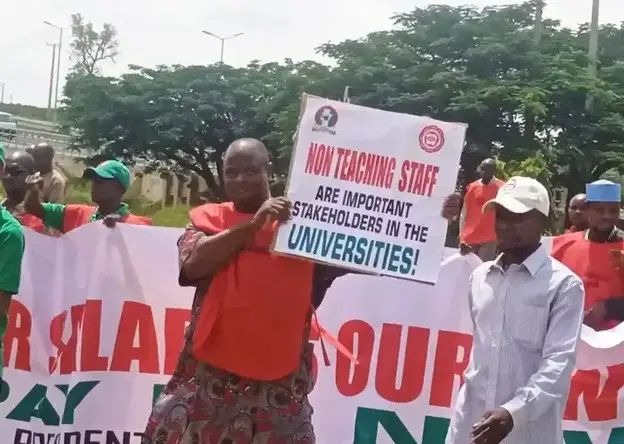
The industrial action, which has disrupted administrative activities across public universities, is being driven by two major unions, the Senior Staff Association of Nigerian Universities (SSANU) and the Non-Academic Staff Union of Educational and Associated Institutions (NASU). Both bodies commenced an indefinite strike on April 30 after the expiration of a one-month ultimatum issued to the government.
At the heart of the dispute lies the long-standing issue of the renegotiation of the 2009 agreement between the unions and the government, an agreement that union leaders say has suffered years of neglect, partial implementation, and unfulfilled promises.
Monday’s meeting, convened by the Minister of Education, Tunji Alausa, ended without a resolution, highlighting the complexity of the issues at stake. Representatives from both sides reportedly engaged in extensive deliberations, but were unable to reach consensus on key demands, prompting the adjournment of talks until Tuesday at 3 p.m.
Sources familiar with the negotiations described the atmosphere as “tense but constructive,” noting that while both parties expressed willingness to find common ground, significant gaps remain, particularly on funding commitments, salary adjustments, and the broader framework for reviewing the 2009 agreement.
For SSANU and NASU, the strike is not just about wages but about recognition and fairness within the university system. Union leaders have repeatedly argued that non-academic staff play a critical role in the smooth functioning of institutions, from administrative support to technical services, and deserve equitable treatment alongside academic staff.
“The system cannot function without us,” a union representative said after Monday’s meeting. “We are not asking for special treatment; we are asking for justice and the implementation of agreements already reached.”
On the government’s side, officials have acknowledged the legitimacy of some of the concerns but pointed to fiscal constraints and competing national priorities as major challenges. Insiders say the government is attempting to strike a balance between addressing union demands and maintaining budgetary discipline.
The ongoing strike has already begun to take a toll on university operations. While lectures in some institutions continue, administrative processes, including student registration, documentation, and facility management, have been significantly affected. Students, many of whom are still recovering from previous disruptions in the academic calendar, now face renewed uncertainty.
Parents and education stakeholders have also voiced concern, urging both parties to reach a compromise quickly to avoid a prolonged shutdown of critical university services.
Analysts warn that the situation reflects a deeper, systemic issue within Nigeria’s higher education sector, one marked by recurring disputes, delayed negotiations, and a lack of sustained policy implementation.
“The 2009 agreement has become a recurring flashpoint because it was never fully resolved,” an education policy expert noted. “Until there is a comprehensive and realistic framework for implementation, these cycles of strikes and negotiations will continue.”
As talks resume, expectations are cautiously high. The decision to reconvene suggests that both the government and the unions recognize the urgency of the situation and the need to prevent further escalation.
However, whether today’s meeting will produce a breakthrough remains uncertain.
For thousands of university workers, the outcome of the negotiations will determine not just the future of the strike, but also their confidence in the government’s commitment to honoring agreements. For students and the broader public, it is yet another test of Nigeria’s ability to manage labor relations in a sector that is vital to national development.
As the clock ticks toward the 3 p.m. meeting, all eyes are on the negotiating table, where compromise, if achieved, could bring relief to a system once again on the brink.