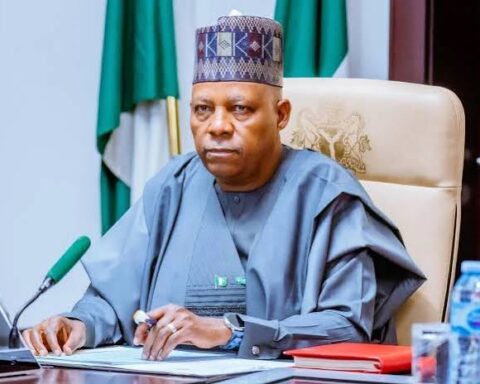
Civil society experts have backed President Bola Tinubu’s position that weak grassroots governance contributes to insecurity, saying genuine local government autonomy is critical to improving security and accelerating development.
The experts spoke in separate interviews with the News Agency of Nigeria (NAN) in Kaduna while reacting to the President’s recent remarks linking insecurity to the collapse of effective local government administration.
President Tinubu had said that the failure of grassroots governance had significantly contributed to Nigeria’s security challenges, stressing that effective local government administration remained central to national development.
The fourth National President of the Campaign for Democracy (CD), Comrade Bako Usman, said the absence of full local government autonomy had weakened service delivery and delayed responses to security threats in many communities.
According to him, local governments are constitutionally the closest tier of government to the people and should be empowered to respond swiftly to local challenges.
“When local governments cannot directly receive and utilise their funds, they cannot respond quickly to local needs, including community policing, vigilance services, healthcare, road infrastructure and education.
“Many local government chairmen have limited powers to recruit, deploy or adequately fund local security outfits because approvals often come from state authorities.
“This weakens early warning systems and creates governance gaps that criminal elements often exploit”.
Usman noted that communities without visible government presence often became vulnerable to banditry, kidnapping and other forms of criminality.
He added that while financial autonomy was necessary, it must be accompanied by transparency, accountability and active citizens’ participation.
“Autonomy without accountability will fail, just as accountability without capacity will also fail.
“Give local governments the resources, the powers, the skills and public scrutiny, and hold them accountable for measurable results,” he said.
He also advocated regular publication of local government budgets, allocations and expenditure reports through public notice boards, radio, television and official websites to enhance public confidence.
Usman identified poor primary healthcare services, inadequate staffing, shortage of essential medicines, declining educational infrastructure, poor rural roads, inadequate water supply and weak agricultural support as some of the consequences of ineffective grassroots governance in many states.
Also speaking, the Executive Director of Civic Impact for Sustainable Development Foundation, Yusuf Goje, said there was a direct relationship between weak local governance and insecurity.
According to him, local governments play critical roles in community participation, conflict prevention, human capital development and intelligence gathering.
“When governance is weak at the grassroots, communities become breeding grounds for unemployed, uneducated and frustrated youths who are easily recruited into criminal activities.
“Most insecurity begins with unresolved local conflicts, poverty and poor governance. Unfortunately, state and federal governments are often too far away to detect these early warning signs,” he said.
Goje said although local government autonomy was not a complete solution to insecurity, it would significantly address many of its underlying drivers through improved governance and service delivery.
He also expressed concern over poor human development indicators in many rural communities.
He cited rising numbers of out-of-school children, high maternal and child mortality, poor access to quality healthcare, youth unemployment and declining agricultural productivity as evidence of governance deficits at the grassroots.
“Visit many primary healthcare centres and basic education schools in rural communities and you will understand why development remains slow.
“Poor service delivery creates frustration, deepens poverty and provides fertile ground for insecurity,” he said.
Goje, however, stressed that granting local governments greater financial independence should be accompanied by stronger accountability mechanisms.
He urged communities to actively monitor public spending by tracking budgets, procurement processes and project implementation.
According to him, transparency should extend beyond budget publication to include procurement information, contract details and project specifications.
He also called for increased capacity building for citizens and civil society organisations to strengthen public oversight of local government finances.
The development expert further recommended reforms in public financial management, improved budgeting systems, stronger monitoring and evaluation frameworks, better working conditions for local government workers and the preparation of long-term local government development plans.
He said such reforms would ensure value for money, strengthen service delivery and restore public confidence in grassroots governance.
The experts expressed optimism that strengthening local government autonomy alongside transparency, accountability and citizen participation would improve security, deepen development and enhance the quality of life in rural communities.
Efforts to get officials of Kaduna State chapters of the Association of All Local Government of Nigeria (ALGON) and Nigeria Union Local Government Employees (NULGE) to speak on their experience of local governments in the state did not yield results.