A Commentary on the Submerging of Lagos
Agbeze Ireke Kalu Onuma, AI-KO
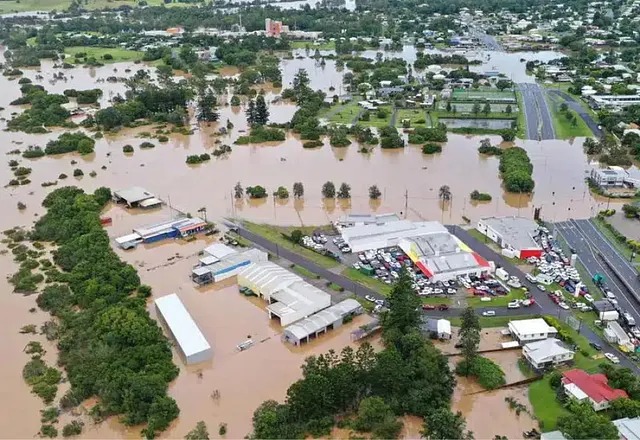
June 30, July 1 and 2 2026 was the precise moment when rain ceased to be a blessing and becomes a formal accusation. It arrived somewhere between the first grey clouds gathering over the lagoon and the moment a mother, ankle-deep in her own parlour, begins moving photographs and certificates to the highest shelf she owns. Watching the footage that has become our grim national liturgy – cars floating like discarded toys through Gbagada, homes swallowed in the concrete stretches of Lekki, children ferried to school in canoes past their own front gates in Agungi – the primary emotion is not merely frustration. It is a deep, heavy, existential pain. It is the fear of an impending erasure, the sense that a city is being slowly, patiently, unmade by the very water it was built beside.
When water rises to the window frames of a modern metropolis, the mind naturally seeks a historical or spiritual anchor to make sense of the chaos. It is impossible to look at these submerged streets without hearing the faint, ancient echo of Noah’s generation. We romanticise that biblical narrative, viewing it through the safe distance of Sunday-school illustrations – the gentle animals, the rainbow, the tidy ending. But the reality of Noah’s time was…
Noah’s ark, we forget, was not built in secret. It was a massive, wooden monument to an impending reality, raised in full view of a bustling, cynical public over decades. Every strike of his hammer was a physical warning, a structural sermon declaring that the current arrangement of the world was unsustainable. The tragedy of that generation was not a lack of information but a lack of discernment. They looked at the dry ground, calculated the immediate sky, and concluded that tomorrow would look exactly like yesterday. They mistook the patience of God for the permanence of the earth.
In Matthew 24, Jesus spoke of the end of an era, warning of a time when the very rhythm of the earth would fracture. He spoke of famines, pestilences, and earthquakes in various places, describing them not as isolated catastrophes but as “the beginning of sorrows” – or, closer to the original Greek odin, the first contractions of birth pangs. A birth pang is unlike a random ache; it is progressive, it intensifies in frequency and severity, and it signals that a radical, irreversible change is already underway.
The striking feature of His prediction is not merely the occurrence of natural disaster, but the apathy and distraction of the populace right up until the moment of crisis. “For as in the days that were before the flood,” He warned, “they were eating and drinking, marrying and giving in marriage, until the day that Noah entered into the ark, and knew not until the flood came, and took them all away.” They were not ignorant of Noah’s project; they simply refused to connect the warning to their own reality. They normalised the anomaly.
Herein lies the painful parallel with contemporary Lagos. We are fulfilling these words not merely because the clouds are emptying themselves with unprecedented fury, but because our collective posture is identical to that ancient pre-flood world. We see the warnings. We read the seasonal meteorological predictions. And still we continue with an aggressive, short-sighted normal: we build estates on known wetlands, we reclaim the lagoon with a frantic, speculative energy, and we raise coastal towers without an equal devotion to the drains beneath them.
We are “eating and drinking” in the form of real estate booms and off-plan launches, entirely oblivious to the structural debt we are accumulating with every sand-filled swamp. We have normalised the submerging of our own streets, treating the destruction of homes and the loss of livelihoods as a routine seasonal tax paid for the privilege of living in a coastal megacity, rather than as an existential signpost that our way of building – and our way of living – is fundamentally broken.
This spiritual numbness has a name in scripture. Jesus warned that in the last days, “because iniquity shall abound, the love of many shall wax cold.” In a socio-ecological context, this coldness manifests as a complete disregard for the common good. The wealthy build higher fences, buy larger pumping machines, and elevate their own compounds, indifferent to where the displaced water ultimately flows. The poor, denied reliable waste collection for weeks on end, empty their refuse into the nearest open drain, unconcerned with the downstream catastrophe. This fragmentation of empathy is the ultimate spiritual failure. We believe we can engineer a private salvation inside a city undergoing collective judgement. The structural failure of an urban landscape mirrors the spiritual apathy of its people: when the physical drains are blocked by refuse, it is because the collective conscience has long been clogged by indifference.
To watch a luxurious vehicle float, engine dead, down a flooded Lagos street is to witness a stark, visual exegesis of Christ’s warning. It is the sudden, violent devaluation of human ambition. In a matter of minutes, wealth that took a lifetime to accumulate, property bought with frantic energy and borrowed money, is rendered useless by a few inches of brown water. Our bad city planning is not merely a failure of the Ministry of Physical Planning; it is the externalisation of a mindset that lives only for the immediate present, ignoring the long-term covenant between a people and the land they inhabit. We build without a tomorrow in mind, and therefore we are left entirely defenceless when the long-warned tomorrow arrives. The water that fills the streets of Lagos is a mirror held up to our souls. It reveals a people rich in ambition but bankrupt in preparation – spiritually asleep in a city that is physically drowning.
But the pain of watching these videos is compounded by a second, more earthly truth: our utter lack of engineering preparation for the city we have chosen to build. Lagos is a coastal megacity, a low-lying basin in constant negotiation with the Atlantic Ocean and a vast, restless lagoon. This geography demands the most rigorous, uncompromising, forward-thinking urban engineering on the African continent. Instead, what we see year after year is a tragic mismatch between the grandeur of our skyscrapers and the primitive state of our gutters – channels designed decades ago for a fraction of the population now expected to carry the waste and stormwater of more than twenty million people. When the sky opens for a few continuous hours, the entire illusion of our commercial sophistication is washed away, exposing a fragile, waterlogged core.
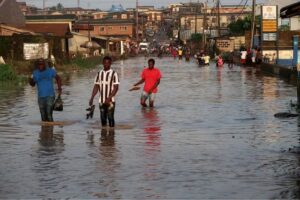
The particular tragedy of the Lekki peninsula and its surrounding environs lies in its very geography. This corridor is a low-lying barrier island, an intricate, fragile ribbon of land sandwiched between the Atlantic Ocean and the Lagos Lagoon. Historically, it was a vast network of wetlands, mangrove swamps, and natural floodplains, designed by nature itself to absorb excess water like a great sponge. Urban development has proceeded here with an almost wilful blindness to that topography. Speculative real estate has aggressively sand-filled these critical wetlands, replacing porous earth with millions of square metres of impermeable concrete, so that water which once seeped harmlessly into the soil now has nowhere to go but up, into living rooms, into shops, into the beds of sleeping children.
The 2026 flooding in Ajiran laid this bare: officials inspecting the community discovered that its main discharge channel into the lagoon had been deliberately blocked by a land-owning family, starving the entire neighbourhood of its only route of escape for stormwater. As the state’s Commissioner for the Environment and Water Resources, Tokunbo Wahab, put it after the inspection, “we discovered that the outlet into the lagoon had been deliberately blocked; without opening that channel, the water cannot leave the area,” a confession that this was not an act of God but an act of greed.
This is the hydrological trap that now defines Lagos: when exceptional, high-intensity rainfall coincides with a high Atlantic tide, the lagoon itself swells, and the city’s drainage channels – built to discharge stormwater by gravity – simply cannot empty into a lagoon that has nowhere to receive them. The water backs up through the grid, spilling out onto the streets until the tide recedes and nature, in its own time, allows the city to breathe again. This is precisely the mechanism the Lagos State Government has cited in the flooding that recently swallowed Victoria Island, Lekki, Ikoyi, Maryland, Ikeja, Ikorodu, Ajah, Gbagada, Mushin, and Mafoluku (as reported by Vanguard), and again in the persistent, almost ritual drowning of Ajiran, Agungi, and Ikota, where major drainage infrastructure completed more than two years ago has still failed to spare residents (Tribune Online).
The government, for its part, insists the warnings were given. In presenting the state’s 2026 Seasonal Climate Prediction, officials had already projected above-normal rainfall for the year, with annual precipitation expected to range between 1,650 and 3,030 millimetres, and had urged residents to prepare for intense downpours (Premium Times). Governor Babajide Sanwo-Olu has since approved the dredging and maintenance of twenty-eight additional primary channels across the state, and more than one thousand offenders have been prosecuted over the past year for environmental infractions tied to drainage obstruction (Daily Post).
Bulldozers have moved through Mehabond Estate and Megamond Estate in Ikota, tearing down structures raised illegally on canal rights-of-way and on a stretch of the Ikota River that was reclaimed for development without so much as an Environmental Impact Assessment (Nigeria Housing Market). These are not small gestures. But they arrive, as they always do, as autopsy rather than prevention – after the water has already claimed its due, after the videos have already travelled, after the grief has already settled into the walls of a hundred homes.
And so the same tired argument recurs each rainy season, government and citizen trading blame across a widening gulf of mutual exhaustion. Officials insist that residents worsen their own fate by dumping refuse into canals and building on floodplains; they point to weeks of missed waste collection as license for indiscriminate dumping, and to “irresponsible land-owning families” as the true villains of Ajiran’s perennial flooding (The Guardian Nigeria). Citizens, wading through the ruins of their own daily routines, ask why drainage infrastructure completed years ago still fails them, why the Private Sector Participation waste operators vanish for a month at a time, why the burden of a state’s failed enforcement always seems to land hardest on those with the least capacity to absorb it. Both accusations are true, and their truth changes nothing, because a city cannot legislate its way out of a design flaw with press statements alone.
The current approach – seasonal desilting, reactive demolitions, inspections conducted only after the water has already reached the ceiling fans – is merely treating the symptoms of a terminal disease. If Lagos is to survive as a sustainable coastal hub rather than a cautionary tale, it requires a radical departure from conventional engineering, a wholesale reimagining of how a delta city relates to the water that both sustains and threatens it.
Lagos cannot continue to rely solely on concrete gutters to channel stormwater away, because concrete does not absorb; it merely relocates the problem downstream to whoever lives closest to the lagoon. The urban design philosophy must shift decisively toward absorption and retention – what planners elsewhere call the “sponge city” model. The state must aggressively acquire land along the Lekki-Epe corridor specifically to create deep, open-air retention lakes and artificial wetlands capable of holding millions of cubic metres of stormwater during peak deluges, rather than surrendering every remaining wetland to the highest bidder. Building regulations must mandate that new estate roads, parking lots, and walkways use permeable paving that lets surface water infiltrate the ground, instead of the solid asphalt that now seals the earth like a drum skin over a swelling river.
Because gravity drainage collapses entirely during high tides, Lagos must transition toward an engineered, mechanically managed water system, in the manner of other low-lying delta cities that have made peace with their geography rather than denying it. This means massive automated tidal gates at the major outfall channels where they meet the lagoon, built to prevent lagoon water from surging backward into the drainage network precisely when the city needs it most. It means high-capacity pumping stations behind those gates, engineered to force stormwater out into the lagoon by machine when nature’s gravity refuses to cooperate. Amsterdam did not out-pray its geography; it out-engineered it. Lagos, sitting on a comparably fragile shelf of reclaimed and semi-reclaimed land, cannot expect gravity and goodwill to do the work of pumps and gates.
None of this will matter without the courage of enforcement that treats a canal right-of-way as more sacred than a Certificate of Occupancy. An Environmental Impact Assessment cannot continue to be treated as a bureaucratic rubber stamp, secured after the fact, once the concrete has already been poured over a wetland. The state must enforce a total, unambiguous moratorium on the sand-filling of all remaining coastal wetlands and natural valleys, designating them as protected ecological zones with the same seriousness given to oil blocks.
The critical primary channels – the System 1 drainage alignment on the mainland, the major outfalls linking the island to the lagoon – must be permanently cleared, widened, and deep-dredged, bounded by buffers that no developer, however politically favoured, is permitted to breach. Land ownership, as the Lagos commissioner himself has now conceded in the case of Ajiran, does not confer the right to strangle a drainage channel that serves thousands of neighbours downstream.
To watch Lagos drown year after year is to realise that the flood is not confined to the asphalt outside. It becomes an internal drowning – a flooding of the mind with questions about how long a people can survive on resilience alone, and how much longer we can afford to ignore the literal and prophetic signs written into the rising waters. If the birth pangs described in Matthew 24 are intensifying – and the rain of this year is not the rain of the last, rising faster, staying longer, penetrating deeper into streets once considered safe – then our current state of urban and spiritual unreadiness suggests we are entirely unequipped for the delivery that is coming.
The water that fills Ajiran, Agungi, Gbagada, and Iwaya does not discriminate between the luxury villas of the wealthy and the makeshift shanties of the poor; it fills every vacuum left by our collective failure, every wetland we sold for a song, every drain we treated as a bin, every warning we mistook for background noise. It is, in the end, both a divine reminder of our vulnerability and a very human monument to bad governance and civic neglect – two floods arriving as one, indistinguishable in the brown water lapping at a nation’s ankles, waiting to see whether we will finally build the ark before the rain, or continue, like the generation before us, eating and drinking until the water takes us by surprise.