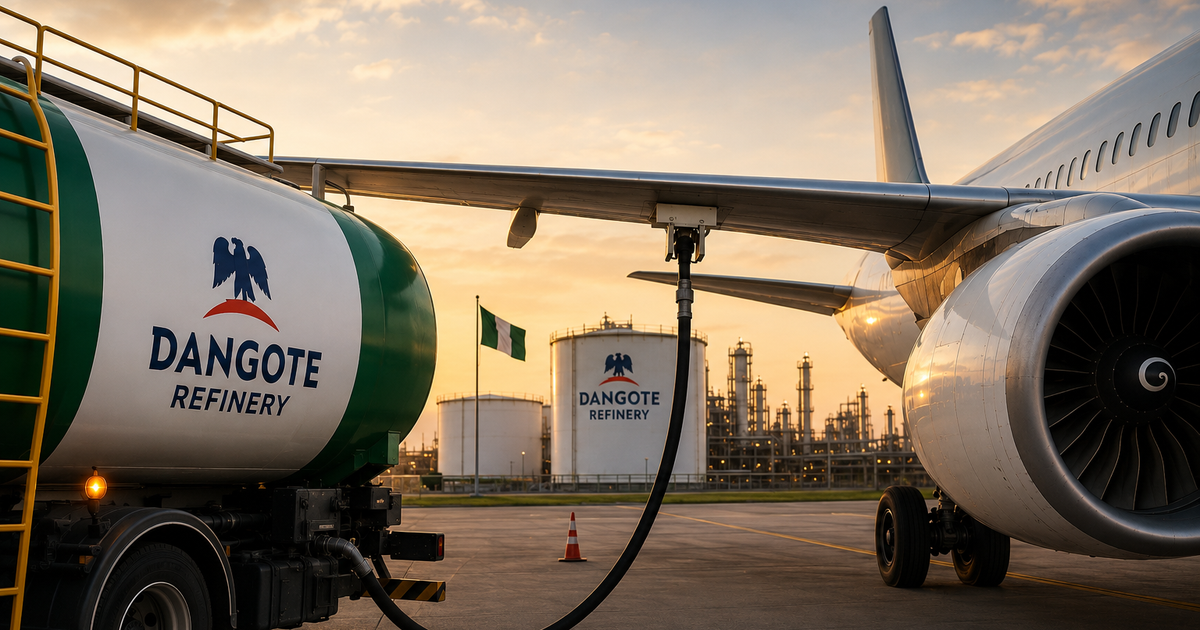
Nigeria’s Dangote Petroleum Refinery has officially surpassed the United States to become Europe’s largest external supplier of jet fuel, exporting an estimated 466,000 metric tonnes of aviation fuel to the continent.
The massive cargo, shipped, carries an estimated value of N757.25 billion ($553 million). This milestone marks the highest volume of Nigerian aviation fuel sold into Europe since the country transitioned into a net exporter of the product following the refinery’s commencement of operations.
According to a market report from S&P Global Commodity Insights, Nigerian jet fuel flows to Europe doubled month-on-month, climbing from 232,000 metric tonnes in May to 466,000 metric tonnes.
The volume translates to roughly 582.5 million litres of jet fuel, valued using a domestic reference price of N1,300 per litre. While Nigeria’s exports surged, US aviation fuel shipments to Europe fell steadily from a record 818,000 metric tonnes in April, to 560,000 tonnes in May, and down to 399,000 metric tonnes, allowing Nigeria to claim the top spot.
The sudden influx of Nigerian fuel arrives as the European aviation fuel market faces a significant pivot. Driven by high local production and massive external inflows from both Dangote and the US, Europe’s jet fuel market has shifted from acute tightness to an oversupply.
”Jet is oversupplied because of high local refinery production; refineries pushed back maintenance to make the most of the high prices,” a European fuel trader noted in the S&P Global report. “The US and Dangote also shipped large volumes.”
As a result of this market saturation and weaker-than-expected summer aviation demand, prices have eased considerably. The Northwest Europe jet CIF cargo benchmark fell sharply from its peak during the height of Middle East hostilities to end the month at $981.75 a metric tonne.
The historic June performance underscores Nigeria’s rapid transformation from a historical mega-importer of petroleum products into a dominant global refining hub.
Backed by growing capacity and strategic geographical positioning, the Lekki-based mega-refinery continues to reshape international fuel trade flows well beyond the African continent.