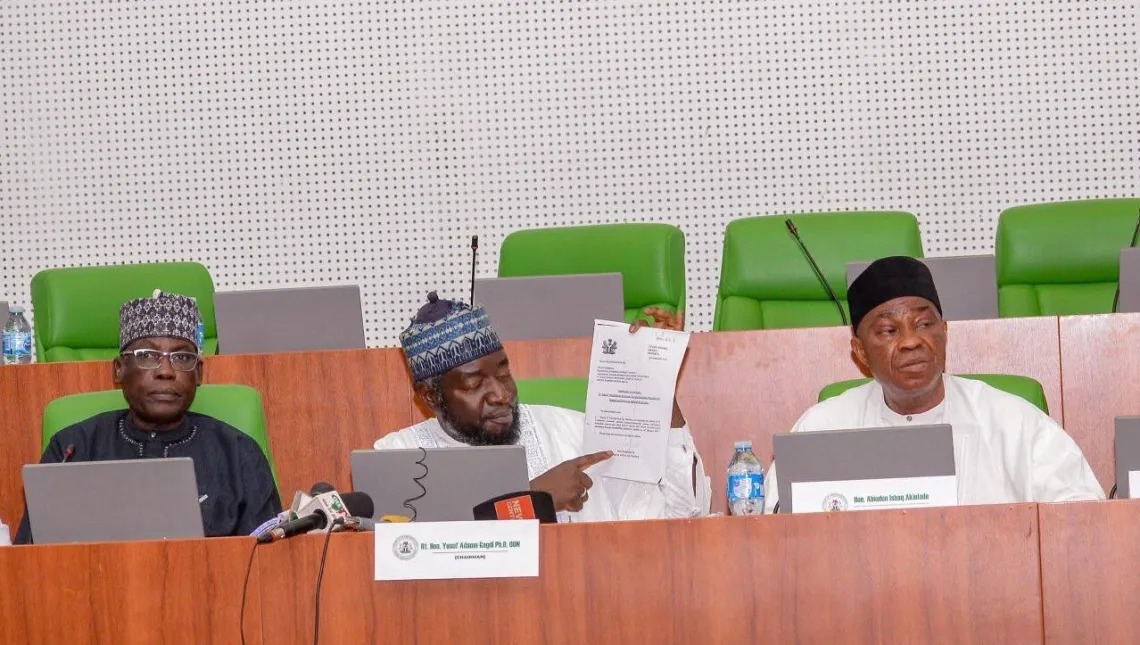
The House of Representatives Ad-hoc Committee investigating the alleged illegal establishment and activities of the Presidential Foreign Investment Promotion Council (PFIPC) heard testimony on Tuesday, August 4, 2026, regarding a massive contract scam operating at the highest levels of government administration.
Appearing before the legislative panel at the National Assembly Complex in Abuja, the Managing Director of Divine Dopacy Nigeria Limited, Mr. Gbenga Collins, detailed how he was allegedly defrauded of N400 million by Prince Adeniyi Adeyemi, who fraudulently paraded himself as the Director-General of the non-existent PFIPC as well as the Presidential Economic Advisory Council (PEAC).
According to Mr. Collins, his ordeal began after meeting Adeyemi in December 2024 during a civic function in their hometown of Ogbomoso, Oyo State. In early 2025, Adeyemi invited him to Abuja to discuss potential government procurement opportunities.
Upon his arrival at the Nnamdi Azikiwe International Airport, Collins was picked up by an official convoy, including a Lexus SUV bearing official Federal Government license plates, and escorted directly to an office suite operated by Adeyemi within the Federal Secretariat complex in Abuja. Surrounding the purported Director-General were armed security personnel and various visitors presenting as high-ranking dignitaries.
”When I arrived at the airport, he sent an official car to come and pick me up and take me to his office at the Federal Secretariat… The trappings of government authority, official vehicles, and location within the Federal Secretariat fully convinced me that I was dealing with a legitimate federal agency,” Collins testified.
Collins testified that Adeyemi presented him with an offer to renovate and furnish an official residence allegedly allocated to him in Abuja as the head of the agency. Following a physical inspection of the residence alongside Adeyemi’s staff and security detail, Collins was issued an official contract award letter, a scope of work, and an agreement in April 2025.
To show proof of financial capability and fast-track contract mobilisation fees, Adeyemi demanded a deposit of N400 million. Between May 16 and July 29, 2025, Collins transferred the funds in five separate instalments sourced from business partners and associates:
N380 million was transferred into a Guaranty Trust Bank account under the name World Entrepreneurs Limited and N20 million was deposited into an Access Bank account belonging to Sunshine Confectionery and Catering Services.
Despite assurances that mobilization for the refurbishment project would begin in August 2025, Adeyemi repeatedly postponed execution citing security delays, before eventually cutting off all communication by late 2025.
Realizing he had been defrauded after consulting legal counsel in Abuja, Collins submitted a formal petition to the Economic and Financial Crimes Commission (EFCC) on November 13, 2025.
During the hearing, the Chairman of the Ad-hoc Committee, Hon. Yusuf Gagdi (APC, Plateau State), questioned whether the payment constituted an attempted bribe for contract procurement. Collins firmly denied the characterization, explaining the funds were solicited and paid strictly as mandatory financial commitment fees required by the purported government council to mobilize resources.
Hon. Gagdi reassured the public and victims that the legislative panel will interrogate Adeyemi in coordination with security agencies, while ensuring anti-graft investigations are not compromised.
Following disclosures regarding the use of official state vehicle credentials, the House committee also issued a formal summons to the Corps Marshal of the Federal Road Safety Corps (FRSC) to explain how fraudulent operators secured government registration plates for private vehicles.