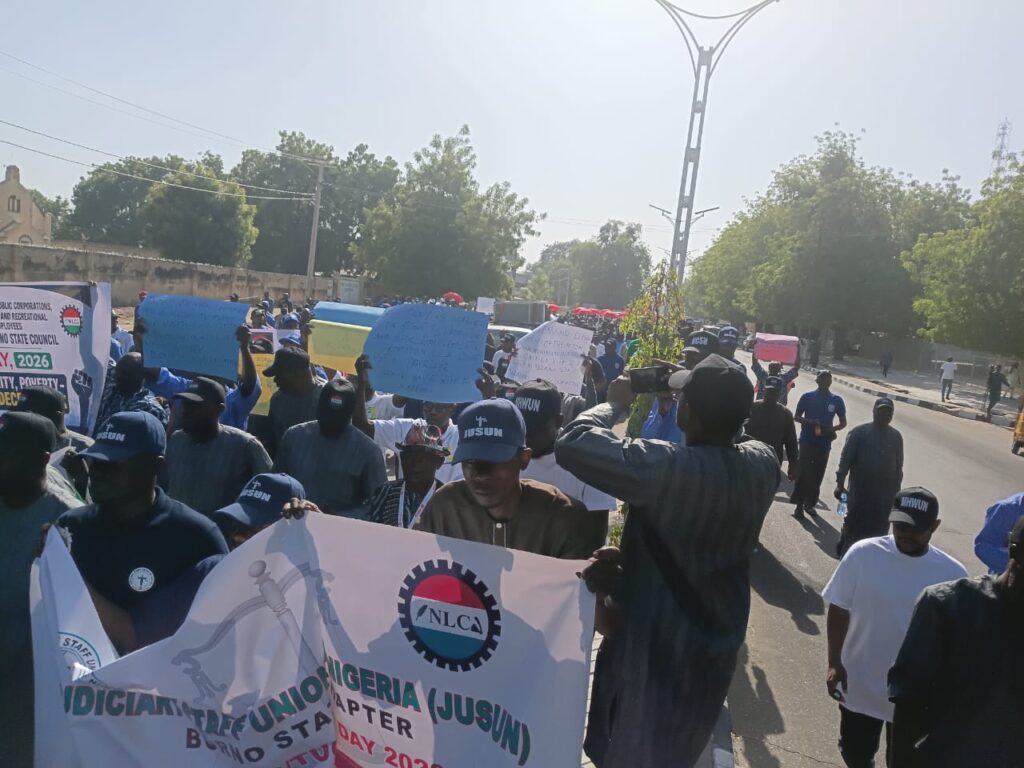
Local government workers across Borno State took to the streets of Maiduguri on Friday in a protest over the non-implementation of the ₦70,000 minimum wage, turning what is traditionally a day of celebration into a demonstration of frustration and unmet expectations.
The protest, organised by the Nigeria Labour Congress and the Trade Union Congress, formed part of activities marking International Workers’ Day. Rather than gathering in ceremonial venues, workers marched through major roads, chanting solidarity songs and holding placards that highlighted their grievances.
At the heart of the protest was the demand for the full implementation of the new minimum wage, which the workers say remains largely unfulfilled at the local government level in Borno State. Many of the demonstrators expressed anger that despite rising living costs, their earnings have not been adjusted to reflect the new wage structure.
Addressing journalists during the protest, the state chairman of the NLC, Yusuf Inuwa, said the decision to protest on Workers’ Day was deliberate, aimed at drawing attention to the harsh realities faced by workers.
“You may like to know why we are celebrating our Workers’ Day on the street today,” Inuwa said. “We all know the situation we find ourselves in this country. Nigerian workers are the poorest citizens in this country. Therefore, we chose to celebrate our Workers’ Day on the street.”
His remarks captured the mood of the protesters, many of whom said they could no longer cope with the widening gap between income and expenses. According to them, inflation, high transportation costs, and rising food prices have made it increasingly difficult to meet basic needs.
Inuwa stressed that local government workers are among the most vulnerable in the current economic climate, noting that they often receive lower wages compared to their counterparts in state and federal institutions, yet face the same rising cost of living.
“Local government staff are the most affected,” he added. “They are at the grassroots, closer to the people, but ironically, they are the ones suffering the most.”
The protest remained largely peaceful, with security personnel monitoring the situation to ensure order. However, the message from the workers was clear: symbolic celebrations are no longer enough without tangible improvements in their welfare.
Some workers who spoke during the protest described the situation as “unsustainable,” calling on the state government to act swiftly to implement the approved wage structure. They warned that continued delays could lead to more widespread industrial action.
Labour leaders also used the occasion to call for broader reforms beyond wage adjustments, including improved working conditions, timely salary payments, and better support systems for workers at all levels of government.
The demonstration in Maiduguri reflects a wider national conversation about workers’ welfare, particularly as many states grapple with the financial implications of implementing the new minimum wage. While some states have begun partial compliance, others face challenges related to revenue and budget constraints.
For the workers in Borno, however, the issue is immediate and personal. As they marched through the streets on a day meant to celebrate their contributions, their voices carried a unified demand, for fairness, dignity, and a wage that can sustain a decent standard of living.
As the echoes of their chants faded into the evening, the spotlight remained on the authorities, with expectations high that the concerns raised will translate into concrete action. For these workers, the hope is that future Workers’ Day celebrations will return to being moments of pride rather than protests for survival.