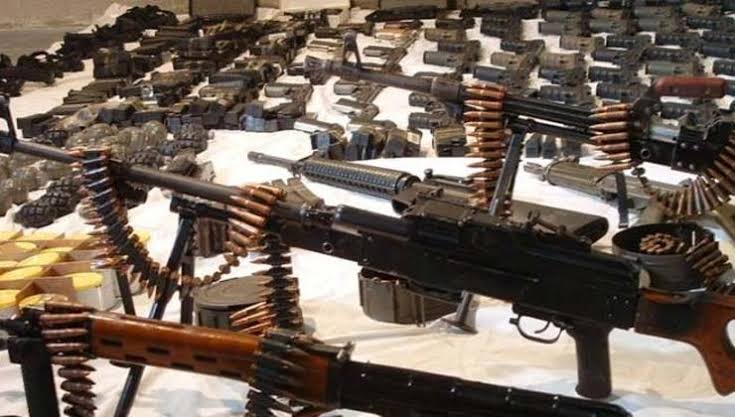
As Nigeria moves into the critical pre-election year of 2026, the “war” on gun proliferation has shifted from reactive recovery to a structured, institutionalized crackdown. With the 2027 general elections on the horizon, the federal government is treating illegal arms as a direct threat to the democratic process.
A major change occurred following the signing of the National Centre for the Control of Small Arms and Light Weapons (NCCSALW) Bill into law.
For the first time, the NCCSALW has full prosecutorial backing, allowing it to move beyond just collecting weapons to actively dismantling the cartels and “political sponsors” behind the shipments.
In late 2025, President Tinubu ordered the redeployment of over 11,500 police officers from VIP protection duties to frontline security in “insecure areas,” aimed at drying up the black market for weapons used in local skirmishes.
In late January 2026, the Nigeria Customs Service (PTML Command) handed over a significant cache of pistols, rifles, and thousands of rounds of ammunition to the NCCSALW. These were intercepted from imported vehicles—a common method for smuggling high-grade small arms.
Operations like “Operation SAFE HAVEN” have continued to yield results. In late 2025, over 200 weapons and 1,800 rounds of ammunition were recovered in the North-Central zone alone, signaling a tightening net around local militias.
Customs revenue at key ports has risen (surpassing ₦44 billion in Jan 2026), which officials attribute to more rigorous inspections and the deployment of new cargo scanners specifically designed to detect concealed arms.
A massive effort is underway to digitize all firearm records. This is designed to ensure that “lost” service weapons or licensed guns that end up at political rallies can be traced back to their original owners.
Nigeria is currently leading ECOWAS-level talks to harmonize arms control across the Gulf of Guinea, aiming to plug the “porous border” problem where weapons from the Sahel leak into Nigerian election zones.
Recent high-profile security standoffs (such as the attempted arrest of former Governor Nasir El-Rufai in Abuja in February 2026) suggest that the security architecture is becoming more aggressive in policing political actors who are perceived as potential destabilizers.
A “silent” threat is the rise of sophisticated local gunsmiths in the Southeast and North-Central regions who produce weapons that never pass through a port or border.
INEC recently proposed a staggering ₦873 billion budget for the 2027 elections, with a massive chunk dedicated to security logistics—a reflection of how expensive it has become to protect the polls from armed disruption.
The focus has shifted from “recovering guns” to “arresting the money.” Security agencies are now tracking the financial flows used by “political thugs” to acquire weapons, treating gun proliferation as a financial crime as much as a physical one.