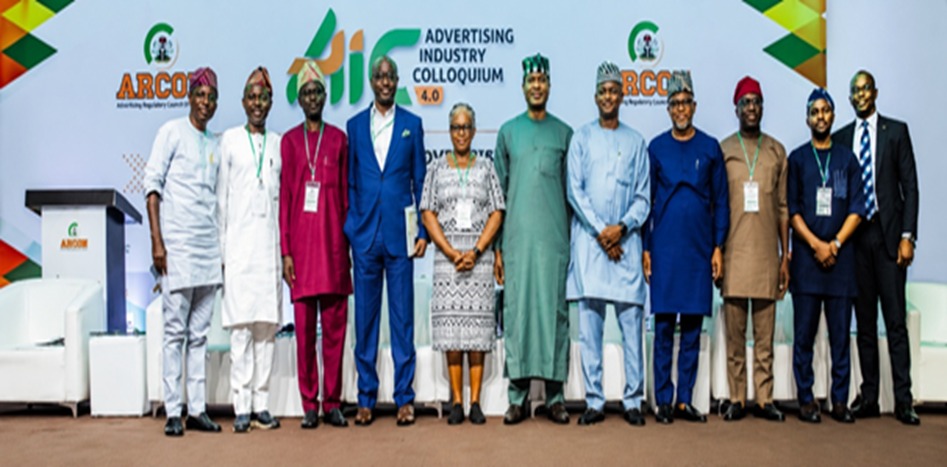
Minister says advertising now shapes culture, democracy and economic growth as ARCON calls for a new regulatory compact built on platforms, people and collaboration.
Nigeria’s advertising industry is undergoing one of its most profound philosophical shifts in decades, with regulators and government leaders increasingly positioning marketing communications not merely as a commercial activity but as strategic infrastructure for the country’s digital economy.
That message emerged forcefully at the Fourth Advertising Industry Colloquium (AIC 4.0) organised by the Advertising Regulatory Council of Nigeria (ARCON), where policymakers, regulators, academics and industry executives gathered to examine the future of advertising under the theme, “The Future of Advertising: The Role of Platforms, People and Regulation.”
Addressing delegates, the Minister of Information and National Orientation, Mohammed Idris, argued that advertising has evolved beyond its traditional role of promoting products and services into a strategic national asset that influences culture, shapes public perception, supports democratic participation and drives economic growth.
“Advertising has evolved far beyond selling products,” the Minister said. “It now influences culture, shapes public perception, drives economic activity, promotes national identity and supports democratic participation.”
He noted that rapid advances in artificial intelligence, digital platforms, big data and immersive technologies are transforming how brands communicate with consumers, requiring regulation that evolves alongside innovation without constraining creativity.
The Minister described digital platforms as both an opportunity and a governance challenge, observing that while they have democratised communication, they have also intensified concerns around misinformation, privacy, harmful content, data protection and market fairness. He argued that innovation must therefore be accompanied by responsible governance capable of protecting consumers while encouraging enterprise.
He also maintained that technology would never replace the uniquely human qualities that define effective communication.
“Artificial Intelligence may generate content, but authentic storytelling, cultural understanding, emotional intelligence and professional judgment remain uniquely human,” he said, adding that Nigeria must continue investing in digital literacy, innovation and creative entrepreneurship if its young population is to compete globally.
Opening the colloquium, ARCON Director-General Dr. Olalekan Fadolapo described the gathering as an important platform for bringing together regulators, practitioners, academia and emerging professionals to collectively shape the future of Nigeria’s advertising ecosystem. According to him, no single stakeholder can determine the future of advertising alone.
“The future of advertising cannot be shaped by one stakeholder alone. It requires collaboration that inspires innovation, stakeholders who drive creativity and ethical practice, and a regulatory framework that promotes trust, protects consumers and supports sustainable industry growth,” he said.
Dr. Fadolapo said the rapid transformation of communication technologies makes responsible innovation, professional excellence and adaptive regulation more important than ever before. He expressed confidence that dialogue between industry practitioners, regulators and academia would strengthen partnerships, encourage fresh thinking and position Nigeria’s advertising industry to compete more effectively in an increasingly digital global economy.
The Minister also reaffirmed the Federal Government’s commitment to strengthening Nigeria’s digital economy through broadband expansion, digital infrastructure and investment-friendly policies designed to create opportunities for advertisers, content creators and digital entrepreneurs. He further called for ethical frameworks capable of protecting intellectual property while encouraging responsible AI innovation.
BrandiQ Analysis
The official theme of AIC 4.0 was Platforms, People and Regulation. The underlying conversation, however, was about something considerably larger: governance.
For decades, advertising regulation in Nigeria focused primarily on reviewing advertisements before publication and enforcing compliance after campaigns were released. The speeches delivered at AIC 4.0 suggest that ARCON increasingly views its mandate differently. The regulator is gradually moving from supervising advertising outputs towards governing the broader communication ecosystem within which advertising now operates.
That distinction matters because advertising itself has fundamentally changed. Brands no longer communicate only through television, radio and newspapers. They increasingly operate through algorithm-driven social media platforms, generative AI systems, creator economies, retail media networks and automated advertising exchanges. Regulation therefore can no longer concentrate solely on creative content; it must also address data governance, algorithmic accountability, intellectual property, platform responsibility and digital trust.
Equally significant was the Minister’s insistence that advertising now influences national identity and democratic participation. This reflects an emerging recognition that communication industries are becoming strategic national assets comparable to financial infrastructure or telecommunications networks. Countries that fail to govern them effectively risk losing not merely advertising revenues but influence over culture, information flows and digital sovereignty.
The Director-General’s emphasis on collaboration reinforces this transition. Rather than positioning ARCON solely as an enforcement agency, his remarks suggest an ambition to become an institutional coordinator capable of bringing together regulators, agencies, advertisers, technology companies and academia to develop adaptive regulatory frameworks. In an era when AI evolves faster than legislation, collaborative governance may prove more effective than command-and-control regulation.
Perhaps the most important insight from the colloquium is that Nigeria’s advertising industry is beginning to confront questions that transcend advertising itself. How should artificial intelligence reshape creativity? Who owns AI-generated intellectual property? How should platforms be governed? How can regulators preserve innovation while protecting public trust? These are no longer abstract debates confined to Silicon Valley or Brussels; they are becoming central questions for Africa’s largest communications market.
BrandiQ Verdict
AIC 4.0 may eventually be remembered not for discussing artificial intelligence, but for redefining the role of advertising itself.
The colloquium signalled an emerging consensus that advertising is no longer simply a commercial function. It is becoming part of Nigeria’s digital governance architecture – one that shapes economic competitiveness, cultural identity, technological innovation and public trust.
That shift carries profound implications for agencies, brands, media organisations and regulators alike. Success in the next decade will depend less on producing more advertising and more on governing a rapidly evolving communications ecosystem where platforms, algorithms, creators and consumers increasingly determine how influence is created and exercised.
If ARCON succeeds in translating the philosophy articulated at AIC 4.0 into practical policy, Nigeria could move beyond regulating advertisements to helping define one of Africa’s first comprehensive governance models for the AI-driven marketing communications economy. That would represent a far more enduring legacy than any single conference theme.