Naming Nigeria’s Power Structure Before We Speak of Transformation
By Charles Obiajulu Ugwu -PhD
Nigeria has refused, for so long, to ask itself the one question that matters. The silence has hardened into a feature of the republic. It is not the question of who governs us, which we ask noisily every four years. It is the deeper question of who owns us, who decides on our behalf without our consent, and why the rest of us have come to treat that arrangement as the weather rather than as a policy.
When a small confederacy of extractive and distributive interests, working in quiet concert with a thin stratum of inheritors and gatekeepers, controls nearly the entire ownership and benefit flow of a country of over two hundred million people, the right word for that condition is not inequality. Inequality is what happens inside a functioning polity. What we have is older and more total. It is capture. And capture that has outlived regimes, constitutions, military adventures, and every wave of reform is no longer an aberration. It is the operating system.
Capture that has outlived every constitution and every reform is no longer an aberration. It is the operating system.
The Refusal to Name
Every country that has remade itself began with an act of naming. The Meiji reformers named the limits of the shogunate before they dismantled it. Postwar Germany named the cartel structure of the Weimar economy before it restructured it. Singapore named the patronage economy it inherited from late colonial Malaya before it built around it. Nigeria has done the opposite. We have built an entire reform vocabulary around euphemism. We speak of corruption when we mean capture. We speak of weak institutions when we mean institutions working exactly as designed for those who designed them. We speak of insecurity when we mean the withdrawal of a social contract by those who never signed it.
The cost of this refusal is that every conversation about transformation begins one floor above the foundation. We debate fuel subsidies without asking who owns the downstream. We debate electricity tariffs without asking who structured the privatisation. We debate revenue allocation without asking whose hands receive it after the federation account. We debate national unity without asking whether the present configuration permits anyone outside the inner ring to feel like a citizen rather than a tenant. Until the structure is named, every reform becomes a ratification. Every policy paper becomes a polite letter to the captors, asking them to be a little kinder in the next budget cycle. Every election becomes a rotation among the licensed.
Until the structure is named, every reform becomes a ratification.
The Anatomy of the Few
It would be an evasion to speak of the few as a single cabal in one room. They are a layered set of interlocking interests that have learned to share the table. There is the extractive tier, whose power flows from rent on what the land yields, whether crude, solid minerals, customs, or the licensing of access to any of these. There is the distributive tier, whose power flows from the choreography of public expenditure, contracts, allocations, waivers, and the strategic placement of family and clients across the procurement chain. And there is the stratum class, the inheritors of social and ceremonial authority, whose power flows from the ability to confer legitimacy on the first two, to bless their movements, to absorb their children, and to police the cultural perimeter against any insurgent imagination.
These three tiers quarrel and occasionally betray one another in public. But on the central question, whether the ownership of Nigeria should ever be opened to genuine contest, they have maintained an iron consensus for more than six decades. That consensus is the real constitution of the country. The document we call the constitution is, at best, a polite footnote to it.
The Domestication of Dissent
Capture would have collapsed under its own weight long ago were it not for a parallel achievement that receives too little attention. The captors have not merely accumulated power. They have steadily domesticated the institutions that exist to challenge power. The Academic Staff Union of Universities, once capable of grinding a federal government to a halt and forcing it to renegotiate the terms of public education, now strikes on a predictable calendar, exhausts itself, and returns to classrooms whose conditions worsen with each cycle. Student unionism, which produced some of the country’s bravest civic voices in the 1980s, has been reduced in many universities to a managed appendage of vice-chancellor’s offices, where the leadership is curated, the budgets are tethered, and the militancy is performance.
Civil society has fared no better. The most vocal coalitions are studied, mapped, and quietly resourced or quietly starved depending on which option costs the state less. Labour federations sit at tripartite tables whose outcomes are written before the meetings begin. Religious bodies that once spoke prophetically now lobby for tax waivers and protocol seats. The press, brave in pockets, has been disciplined by ownership structures that route its survival through the same interests it is meant to scrutinise.
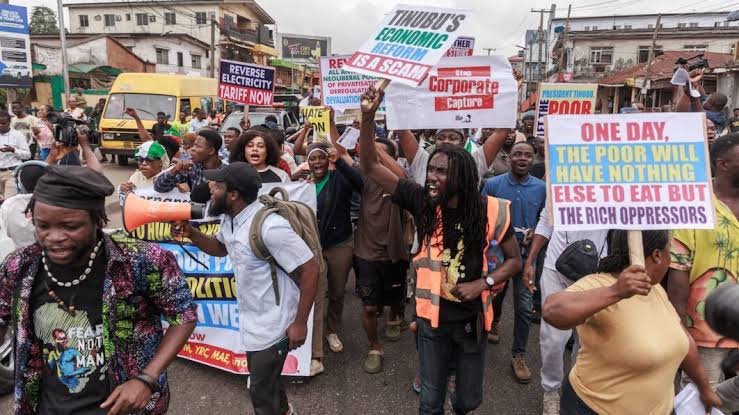
The captors treat these voices the way a large estate treats its tenants. They are heard, they are accommodated for show, and they are dismissed. Their bargaining power is read accurately as beggarly, their threats as theatre, their consequences as containable. A union that can be outlasted is not a threat. A coalition that can be defunded is not a threat. A protest that can be permitted, mapped, and dispersed is not a threat. Over time, the institutions of dissent have learned this assessment of themselves and internalised it. The most dangerous form of subjugation is not the one imposed by the captor. It is the one rehearsed by the captured until it becomes their working theory of what is possible.
The most dangerous form of subjugation is not the one imposed by the captor. It is the one rehearsed by the captured until it becomes their working theory of what is possible.
This is why the few sleep soundly. They have not silenced dissent. They have trained it. They have taught it the choreography of complaint without consequence, the ritual of demand without leverage, the season of agitation that ends, reliably, in resumption.
The Surrender of the Many
If capture were only a story of the few, it would be a simpler problem. Capture is sustained by surrender, and the surrender of the Nigerian majority is the part of the diagnosis we have been least willing to face. It is not a surrender of cowardice. The Nigerian majority is among the most resilient populations on earth. It is a surrender of imagination. The captured order has taught the rest of the country to mistake survival for citizenship, hustle for participation, and the occasional crumb for proof of belonging.
Listen to how Nigerians speak about the country in private. The vocabulary is the vocabulary of tenants. We say the government, not our government. We say they took the money, not they took our money. We say one day Nigeria will be better, as if Nigeria were a distant cousin whose fortunes we follow from a respectful distance rather than the collective body of which we are constitutive. Even our protests, in their bravest moments, ask for relief from the captors rather than for the dissolution of the structure that produced them.
Consider what a tenancy actually is. The tenant pays, maintains the premises, and improves the property at his own expense. He raises his children there, buries his dead within reach of it, and grows old inside it. None of this converts him into an owner. The landlord may admire his industry, may even reduce his rent in a generous year, but the title remains where it was. Nigeria has produced a republic of lifelong tenants on land their grandfathers helped to build. The rent is paid in taxes, in lost youth, in interred ambition, in the quiet emigration of the best minds. The title is held elsewhere, and no improvement the tenant makes alters that fact.
Nigeria has produced a republic of lifelong tenants on land their grandfathers helped to build.
Part or Appendage
The question any serious Nigerian must now place on the national table is not how to make the captured order more efficient or more presentable to foreign capital. The question is whether the present ownership and power structure can produce a country in which the ordinary citizen feels like a part rather than an appendage. A part is a constitutive member, whose presence or absence alters the whole. An appendage is something attached to the body for the convenience of the body, removable without consequence to anything that matters.
The honest answer is that the present structure was not designed to produce parts. It was designed to produce appendages. Its incentives reward those who organise the population as a labour pool, a vote bank, a consumer market, and a security buffer for the inner ring. It punishes any politics, any economics, any cultural movement that tries to convert appendages into parts. This is why every genuine reformer in our history has been absorbed, neutralised, or quietly outlasted. The system does not fear them. It waits for them.
The Work of a Real Beginning
A real beginning would not look like another reform agenda. It would look like a national audit of ownership, conducted by a body whose mandate is to render visible what the country has spent sixty years rendering invisible. Who owns the land. Who owns the licences. Who owns the contracts. Who owns the seats. Who inherited what, from whom, and on what terms. Until that map exists and is placed before the Nigerian public, every conversation about restructuring, devolution, true federalism, or new constitutions is a conversation about furniture in a house whose deeds we have never seen.
A real beginning would also require the majority to do its own internal work, which is harder than any external reform. It would require Nigerians to stop performing the citizenship of appendages, to reclaim the language of ownership in ordinary speech, in civic associations, in faith communities, in professional bodies, in the way we raise our children to understand the country. The captors have no incentive to hand over a country whose people have already conceded it. The first transfer that must happen is internal.
The first transfer that must happen is internal.
A Country Worth Belonging To
Nigeria’s longing for transformation is real, and it is one of the most persistent civic emotions in the world. Sixty years of disappointment have not extinguished it. That fact alone should tell us the raw material for a different country is still here. What is missing is not energy, not talent, not capital, not even ideas. What is missing is the willingness to name the structure that stands between us and ourselves, and to refuse the comfort of conversations that leave that structure untouched.
A country in which the few own almost everything and the many own almost nothing is not, in any morally serious sense, a country. It is an arrangement. Arrangements can be renegotiated. They can also be allowed to harden until they become indistinguishable from fate. The choice between those two outcomes is the only choice that matters in Nigeria today. Every other debate is downstream of it.
The question is no longer whether we can transform Nigeria. The question is whether we are prepared to belong to it on terms that make transformation possible. Until we answer that question honestly, and act on the answer, we will remain citizens of a republic that has not yet agreed to have us.
About the Author
Charles is a contrarian thinker writing from Lagos