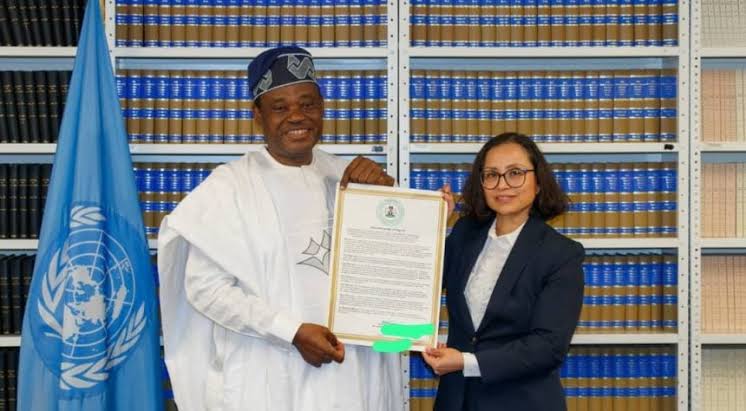
Nigeria has officially deposited its instrument of ratification for the United Nations Agreement on the Conservation and Sustainable Use of Marine Biological Diversity of Areas Beyond National Jurisdiction (BBNJ), becoming the 108th state party to the landmark global accord. The ratification instrument, signed by President Bola Ahmed Tinubu on Tuesday, November 24, 2026, was formally presented later that day at the United Nations Headquarters in New York.
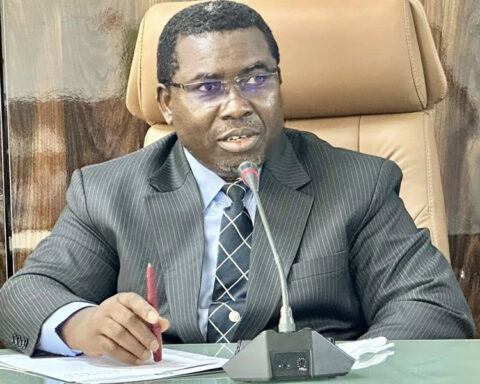
Nigeria’s Permanent Representative to the United Nations, Ambassador Jimoh Ibrahim, handed over the document to Evelyn Sánchez, Officer-in-Charge of the UN Treaty Section. The milestone was publicly announced via a statement issued from the United Nations Mission House in New York on Wednesday, November 25, 2026, at 11:36 AM. Speaking after the deposition ceremony in New York, Ambassador Ibrahim noted that the ratification underscores President Tinubu’s strategic push to diversify Nigeria’s economy through sustainable maritime development.
“The whole idea is President Tinubu’s desire to develop the blue ocean economy,” Ibrahim stated. “We have to buy geophysical equipment to be able to know what is in all this sea, and then we can appropriately tackle those resources. I think that’s the future; that’s the wealth of tomorrow.”
He highlighted that the Tinubu administration has already laid substantial institutional groundwork for the sector through the creation of the Federal Ministry of Marine and Blue Economy, headed by Minister Adegboyega Oyetola, alongside the adoption of a National Blue Economy Policy and a dedicated implementation roadmap.
According to government figures, the ministry generated ₦1.83 trillion in revenue in 2025, marking a 160 percent surge from ₦700.79 billion in 2023, and is projected to hit ₦2 trillion in annual revenue by 2027. Ibrahim added that Nigeria’s broader maritime strategy integrates this treaty with the country’s extended continental shelf, an additional 16,300 square kilometres of seabed beyond the 200-nautical-mile limit approved by the UN, which holds significant potential for hydrocarbons, solid minerals, and marine species.
While clarifying that the BBNJ Agreement does not automatically extend Nigeria’s territorial waters or geographical boundaries, Ambassador Ibrahim emphasized that full party status grants the nation a vital seat at the table in governing international waters. Under the treaty, Nigeria plans to champion equitable benefit-sharing by advocating for the fair distribution of proceeds derived from marine genetic resources and digital sequence information.
The delegation will also prioritize securing capacity-building initiatives and marine science technology transfers for African and developing nations, while pushing for the operationalization of a well-funded Special Fund with predictable resources to support treaty implementation. Nigeria initially signed the BBNJ Agreement on May 3, 2024, represented at the time by Ambassador Adamu I. Lamuwa, following its adoption by the UN in June 2023, before the treaty formally entered into global force on January 17, 2026.
With Tuesday’s ratification, Nigeria transitions from a signatory to a full voting party ahead of the inaugural Conference of the Parties (COP1) to the BBNJ Agreement, scheduled to take place in the United States from January 11 to 22, 2027. Ambassador Ibrahim urged remaining African nations to expedite their ratification processes so the African Group can present a united front at the upcoming summit.