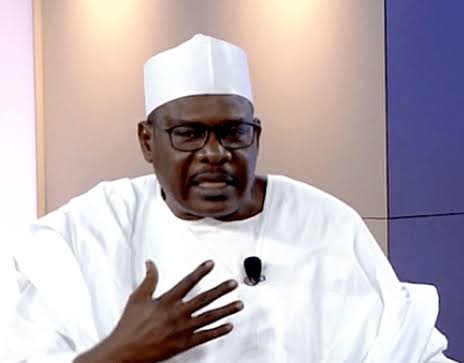
The Senator representing Borno South Senatorial District, Ali Ndume (APC), on Wednesday, November 18, 2026, made a candid admission of personal culpability in Nigeria’s political and governance challenges, declaring that successive administrations have operated as a “government of some people, by some people and for some people”.
Speaking during an evening appearance on Prime Time, a current affairs programme broadcast on ARISE News Television, the former Senate Chief Whip stated that he could not absolve himself from the shortcomings of the country’s political class. Ndume expressed deep regret over his entry into partisan politics, likening the Nigerian political landscape to an incurable affliction.
”I am part of the failure; I cannot deny that,” Ndume said during the broadcast. “I am not going to claim to be the best or better than anybody. But if I had known that this is how this politics is going to turn out to be, I wouldn’t have joined it. You can compare politics to AIDS. Once you catch it, you can’t say you don’t have AIDS. I’m telling you. It’s a dangerous game, especially in Nigeria. You can’t get cured.”
Addressing the state of the nation ahead of the January 16, 2027, general elections, the Borno South lawmaker argued that public administration has been hijacked by narrow interests rather than serving the generality of Nigerians.
He noted that the exclusionary nature of power did not originate with the current administration of President Bola Tinubu, but had become entrenched across previous governments.
”It’s true that government of the day has been a government of some people, by some people and for some people,” Ndume stated. “If it were a government of all, this complaint and all that would not be happening. It did not start with this government. It started with the previous government. It has become a practice that you must be within the cycle. Even within the cycle, there are cabals running the government.”
During the interview, Ndume also decried the accumulation of unexplained wealth by public office holders, whom he described as “kleptocrats”, and lamented the growing culture of impunity surrounding official corruption.
Ndume’s televised remarks followed deliberations at the Senate Chamber of the National Assembly Complex in Abuja, where lawmakers debated rising political intolerance and attacks on political actors.
During plenary, Ndume seconded a motion sponsored by Senator Abdul Ningi (ADC, Bauchi Central) calling for the investigation and prosecution of perpetrators and sponsors of electoral violence.
The motion highlighted recent attacks involving prominent political figures, including President Bola Tinubu, former Vice-President Atiku Abubakar, and the 2023 Labour Party presidential candidate, Peter Obi, across Abuja, Edo, Delta, and Sokoto states.
Following the debate, the Red Chamber, presided over by Senate President Godswill Akpabio, urged the Independent National Electoral Commission (INEC) to enforce provisions of the Electoral Act 2026 to disqualify candidates linked to violent thuggery.
Reflecting on the Senate resolutions during his ARISE News appearance, Ndume condemned state governors who deny opposition parties access to public facilities such as stadia and hotels, describing such tactics as “cheap things” that heighten political tension.
He further accused desperate politicians of weaponising poverty by recruiting underprivileged youths and underage children as political thugs, warning that hunger and unresolved grievances could trigger widespread civil unrest similar to uprisings witnessed in Bangladesh and the Middle East.
”When people easily take the law into their own hands to express their hunger and use whatever is available that can be regarded as a weapon or tool, then it becomes a dangerous thing,” Ndume warned, urging parents, community leaders, and security agencies to curb the recruitment of youths for political violence before the 2027 polls.