Agbeze Ireke Kalu Onuma, AI-KO
Sixty-one days from tonight, Nigerians will be asked to choose a president, and the outcome that ought to be impossible is, at this hour, the likeliest.
A government that has presided over the sharpest cost-of-living crisis in a generation, that cannot guarantee the farmer his field or the traveller his road, and that has turned hardship into the daily grammar of every household from Sokoto to Calabar, is on course to be returned to office. It is not on course because it is loved. It is not on course because it is trusted, or because a weary country has found in it the keeper of a promise kept. It is on course because the people who say they will replace it cannot agree on which of them should.
That is the whole of the matter, and everything else is commentary. The election falls on Saturday, 16 January 2027, a date the Independent National Electoral Commission fixed when the Electoral Act 2026 brought forward a poll first announced for February. The ballot will carry Bola Tinubu for the ruling All Progressives Congress; Atiku Abubakar for the African Democratic Congress; Peter Obi for the Nigeria Democratic Congress, with Rabiu Kwankwaso as his running mate; Seyi Makinde, the Governor of Oyo State, for the Allied Peoples Movement; and Donald Duke for the Peoples Redemption Party. Four of those five stand, in some fashion, against the incumbent. Not one of the four has yet done the single thing that the arithmetic demands of at least one of them.
Begin with the arithmetic, because arithmetic does not flatter and does not take sides. In February 2023, Bola Tinubu was declared winner with 8,794,726 votes, which was 36.61 per cent of the 24,025,940 valid votes counted. Atiku Abubakar polled 6,984,520. Peter Obi polled 6,101,533. Rabiu Kwankwaso polled 1,496,687. Add Atiku and Obi together and the sum is 13,086,053, which is 54.5 per cent of the valid votes and 4,291,327 more than the man who was sworn in. Add Kwankwaso and the opposition total rises to 14,582,740, which is 60.7 per cent, and the margin over the winner rises to 5,788,014. Nigeria is a country where a president can be returned with barely more than a third of the ballots, and where more than three-fifths of those who voted in the last contest voted against him.
Nor is that the whole of the lesson. Of 93,469,008 registered voters, only 24,965,218 cast a ballot in 2023, a turnout of 26.71 per cent, the lowest in the history of the Fourth Republic. Put it the other way and it reads worse: nearly seventy-three of every hundred registered Nigerians stayed home. The incumbent does not need to persuade a majority. He needs only to keep his opponents divided and the country discouraged, and then to let the arithmetic finish what the division began. In the weeks that remain, the question that matters is whether the opposition will do for itself what it has so far declined to do.
In December 1992, Kenya held the first multi-party presidential election of the post-Kenyatta era, and the country that voted wanted Daniel arap Moi gone. He had ruled since Jomo Kenyatta’s death in 1978, and the country had grown weary of him. The opposition was larger than the ruling party in every way that mattered except the one that decides elections: it had three leaders and one chair. Kenneth Matiba of FORD-Asili, Mwai Kibaki of the Democratic Party and Jaramogi Oginga Odinga of FORD-Kenya each believed the country had been waiting for him in particular. Matiba polled 1,404,266 votes, Kibaki 1,050,617 and Oginga Odinga 944,197. Together they gathered 3,399,080 votes. Moi, with 1,962,866, which was 36.35 per cent, kept the presidency.
The Christian Science Monitor, taking the measure of that result a week into the new year, assigned the cause in seven words: “Personal ambition and mistrust caused that split.” It had said much the same before the vote, when it described an opposition weakened and divided by personal ambitions and penetrated by the government. Five years later Moi won again, with about 40 per cent of the vote, over four opposition candidates who divided the other 57. A man who could not have won a straight contest against a united opposition ruled Kenya for a decade after he should have left, and he did so with the willing help of the men who wished him gone.
I begin there because Nigeria stands today where Kenya stood in 1992, with an advantage Kenya did not have: Nigeria can read the ending in advance. The story I have just told was not a tragedy of power. It was a tragedy of pride, and pride is a decision that a man makes with open eyes and a calendar in front of him.
An incumbent supplies the strength. The opposition, if it chooses, supplies the division.
I have spent a good part of this year reading the opinion columns, the poll releases, the rally reports, the court notices and the press statements, as anybody must who wishes to understand the season. Nothing in them alters the picture. If anything, the noise has made the picture clearer, because noise is what a political system produces when it has nothing to say.
I began to sketch this essay on 25 October, when the election was eighty-three days away. It has taken me longer than the calendar allowed. Other assignments pulled at my time, and the subject itself would not hold still: every few days a court, a coalition, a defection or a press statement altered the ground, and I found myself doubling back to see whether what I had written still stood. Few essays have had to be written against a politics that moved this fast, and that is part of what I want the reader to take from it. The country is not waiting for anyone’s argument to be finished.
Consider the polls. A movement calling itself Tinubu Must Go ran a twenty-four-hour online poll on 24 and 25 September, drew 109,799 respondents, and reported that 73.6 per cent had chosen the Atiku–Amaechi ticket against 22.3 per cent for Obi and Kwankwaso. A fortnight earlier, the Oxford-Metro Analytics National Trust Poll had reported Tinubu leading in twenty states and the Federal Capital Territory, with Obi and Atiku each topping the table in eight states, and Tinubu ahead of Obi nationally by a margin of just 1,067 responses. One poll finds the incumbent a conqueror; another finds Atiku a colossus. The two cannot both be right, and each is best read as a record of who was willing to answer the pollster. I do not rest my argument on either. I rest it on the numbers that the Nigerian people have already supplied, in a polling booth, under the eyes of the commission, in the last election they were allowed to count.
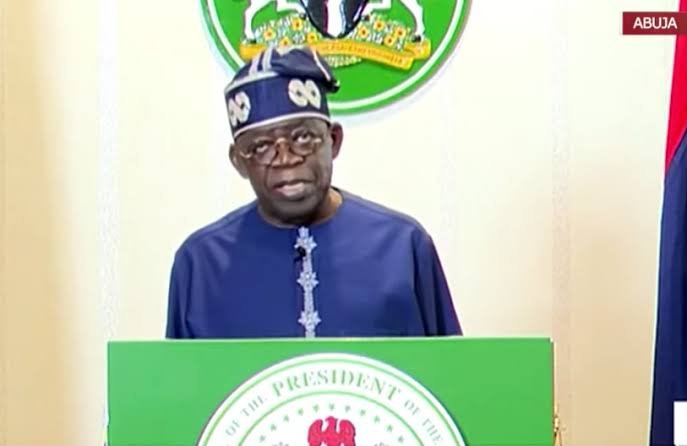
What the polls and the sentiment do agree on, and what every reporter in the country can confirm from the street, is that the incumbent’s popularity does not resemble his power. The state is behind him: the governors who left their parties to join his, the machinery of the commission whose neutrality its own chairman, Professor Joash Amupitan, has had to defend, and the federal purse. Nyesom Wike, whose revolt of five PDP governors in 2023 wounded Atiku’s campaign, is now announced as the man to lead the president’s re-election campaign in the Federal Capital Territory and Rivers State. A government that strong does not need to be liked. It needs only to be unopposed, and it has been fortunate in its opposition.
The man at the centre of this essay is not a villain. I say that deliberately and at the start, because the argument is about consequence, not about character, and an argument about consequence is weakened the moment it is dressed up as an indictment of a man’s soul.
Atiku Abubakar was born in Jada, in what is now Adamawa State, on 25 November 1946. On 25 November he will be eighty. He began as an officer of the Nigeria Customs Service, a post he left to enter business and then politics, and his political formation took place under Shehu Musa Yar’Adua, whose Peoples Front of Nigeria was denied registration by the military and whose followers were folded into the Social Democratic Party. When the military disqualified Yar’Adua from the party’s presidential primary in 1992, his organisation pushed Atiku forward in his place. In the 1993 primary he came third, behind Chief M.K.O. Abiola and Baba Gana Kingibe. Abiola went on to win the election of 12 June, which the military annulled. Atiku was in his mid-forties then, and his instinct that politics was a serious vocation was no illusion.
He was elected Governor of Adamawa State in 1999 and was lifted from that office before he could take it, when Olusegun Obasanjo chose him as running mate. Together they won, and for eight years, until 2007, he was vice-president of a country that had just come out of military rule. He has a record to defend and a record to be proud of. He founded the American University of Nigeria in Yola. He has argued, from the platform and in print, for the restructuring of the Nigerian federation, and has stayed on that argument long enough for it to stop being fashionable and become again necessary. His defenders say, with truth, that no Nigerian has done more to hold together the northern and southern halves of an opposition. Paul Ibe, his spokesman, has noted on Trust TV that, whatever the number of times he has sought the nomination, Atiku has stood on the ballot of a general election only three times before 2027: in 2007, in 2019 and in 2023.
Now set that record beside the other record, the one that is also true. In 2006 he fell out with Obasanjo over the succession, opposed the third-term project that would have kept his principal in office, and left the Peoples Democratic Party for the Action Congress. He came third in the 2007 presidential election behind Umaru Yar’Adua and Muhammadu Buhari. He later returned to the PDP, and in January 2011 he challenged President Goodluck Jonathan for the party’s ticket and lost the primary.
On 2 February 2014 he left the PDP once more, this time as a founding member of the All Progressives Congress, the merger of opposition parties that was to rescue the country from Jonathan. At the December 2014 primary at the Teslim Balogun Stadium in Surulere he came third, behind Buhari and Kwankwaso. He stayed nearly four years inside the party that he helped to build, and left it on 24 November 2017, returning to the PDP on 3 December. He won its ticket for 2019 and lost to Buhari, by about 15.2 million votes to about 11.3 million. He won it again for 2023 and lost to Tinubu. In 2025 he left the PDP a third time, for the ADC.
I do not recite that list to mock a man for changing parties. Parties in Nigeria are vehicles and every politician has stepped off one. I recite it because the pattern is the point. Each departure came at the same junction, at the moment a door shut on the one ambition around which the rest of the career has been arranged. Atiku himself provided the sentence that sums up his place in the story. Speaking in January of this year, at a gathering with Obi, he said, “Many of us helped form the APC”, and then he told the country that the rescue promised by that merger had failed. He was right. The APC he and others helped to build is the government he now seeks to remove, and the machinery that carried Buhari in 2015 and Tinubu in 2023 is part of his own work. It is a rare thing in politics to be both the builder of a house and the man who must be rescued from it.
His age matters for a reason that has nothing to do with vigour. The age of a politician is a clock that runs inside his decisions, and the clock tells him something that no adviser dares say aloud: that there will be no later.
Atiku has said as much himself. In April this year, interviewed on Arise Television, he was asked whether turning eighty by the next election raised the stakes for him. He answered, as the Premium Times reported it, “I believe that will be my last outing.” Four months later, put the same question by the BBC in Hausa, he replied with a question of his own: “Do I look like an 80-year-old man?”
And in the same round of interviews he declared the president, who by every public record was born in 1952 and is seventy-four, to be ninety, and said that he had the proof. The Presidency, after the April interview, had already announced that the ambition of the former vice-president was “dead on arrival”. That is the register in which the leading men of the Nigerian republic have chosen to conduct a debate over the future of a country of more than two hundred million people: whose birth certificate is the more suspect, whose face the less eighty.
The commentators saw it coming long before the candidates did, and I was among them. On 1 February 2025, in the Combing the Dust series, I published “Atiku Abubakar: A Spent Force in Nigerian Politics and the Urgent Need for a New Opposition Leadership”. It was prompted by a commentary from my friend Emeka Alex Duru on Atiku’s warning that the ruling party was working towards a one-party state, and it asked a harder question than the warning did: whether the man sounding the alarm was still the right voice to lead the opposition.
My argument was that Atiku’s continued involvement in active politics was detrimental to the opposition’s chances of presenting a viable alternative to the APC, and that his energy would serve the country better in grooming younger and more dynamic leaders. Three months later, Azu Ishiekwene, writing in the Premium Times, put his case in the headline: “Atiku, not Tinubu, is the wrecking ball”, and argued that the PDP would receive a fresh start when its principal obstacle stepped aside. In the Vanguard this April, Olu Fasan gave his column the title “Atiku only cares about running, not winning”, while granting, fairly, that health matters more than age and that Atiku, at nearly eighty, looks a good deal healthier than the president. The months since have not softened my argument. They have sharpened it.
I make no claim to prophecy. I make a claim about incentive. A young politician who loses a primary has a future, and a future disciplines. An old politician who loses has a legacy, and a legacy is a different instrument: it asks for one more try, one more alliance, one more courthouse, because the alternative is to be remembered as the man who came close. Atiku has sought the presidency, by his own account and by the record, since 1993. To anyone who has watched him closely the thirty-three years are not a failing; they are a form of consistency. The tragedy is that every other loyalty, to party, to coalition, to the people who gave him their ballots, has proved negotiable against that single constancy.
A young man who loses has a future, and a future disciplines him. An old man who loses has a legacy, and a legacy asks only for one more try.
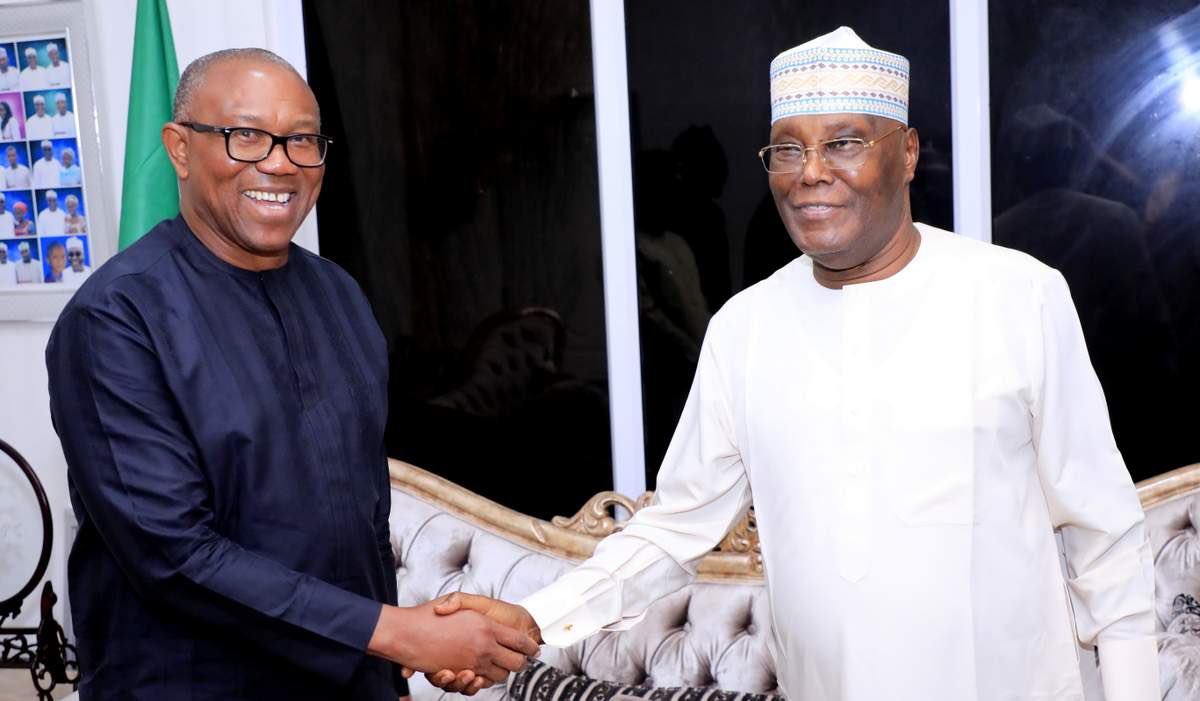
The man who is now asked to yield was once Peter Obi’s principal and, for a season, his companion on the road. On 13 October 2018, Atiku named Obi, the former Governor of Anambra State, as his running mate on the PDP ticket for the 2019 election, and for four months the two men walked the length of the country together. They lost to Muhammadu Buhari. Obi absorbed the defeat, went home, and in 2022 became the unlikely vessel for something Nigeria had not seen in the Fourth Republic: a presidential candidacy carried, in large part, not by a party machine or a governor’s purse, but by a generation of young voters who had never before believed that a ballot could be a weapon.
In February 2023 that candidacy polled 6,101,533 votes. It carried eleven states and the Federal Capital Territory, including Lagos, the home ground of the man who was declared the winner. It did this under the banner of a party with little national machinery behind it. No third-force candidate in the Fourth Republic had come so far, so quickly, with so little. Whatever one makes of the man, the figure is a fact of the country’s electoral geography.
When in 2025 the opposition decided, after years of watching itself be divided and ruled, to unite behind a single platform, the African Democratic Congress, the arithmetic drew Obi and Atiku back into the same room. On 25 September 2025 the party’s leaders’ caucus, meeting in Abuja under the chairmanship of David Mark, with Atiku, Rotimi Amaechi and Nasir El-Rufai in attendance, resolved that the presidential hopefuls, Atiku, Obi and Amaechi among them, would back whoever emerged as the candidate. It is the sentence on which all the later arguments depend, and it deserves to be remembered. In March 2026 Obi formally registered with the ADC. In April, Atiku was asked on Arise Television whether he would step aside should Obi win the party’s primary, and he answered that he would yield to whoever won, Obi included, since a contender is a contender. He framed the matter as a question of process: consensus or election, one or the other.
Read that pledge carefully, because it has been much quoted and little examined. It was a promise to yield to the winner of a primary. It was not a promise to yield to the arithmetic. And a primary, in the Nigerian setting, is not a contest of ideas but a contest of delegates, and delegates are a function of money, machinery and the control of the party’s structure. Obi understood this. Babachir Lawal, the former Secretary to the Government of the Federation under Buhari, who says he was a participant in every ADC meeting and who played a part in bringing both Obi and Kwankwaso to the party, told Arise Television in September that Obi had favoured a consensus candidate because he believed a contested primary would favour whoever had the greater resources and influence, and that, when no consensus was reached, both he and Kwankwaso became convinced the process was tilted towards Atiku. Kwankwaso, in Lawal’s account, had feared from the start that with Atiku in the party nothing good would come out of it.
He promised to yield to the winner of a primary. He never promised to yield to the arithmetic.
On Sunday, 3 May 2026, Obi announced his departure from the ADC and, with Kwankwaso, joined the Nigeria Democratic Congress. In a statement on his account he spoke of a “toxic” political environment and systemic dysfunction, and he took care to say that he was not leaving because of ill-treatment by David Mark or by “my leader and elder brother, Alhaji Atiku Abubakar”. Kwankwaso, interviewed on Arise Television, said they had left “not because we are fighting with Atiku or anybody there”, and listed three unresolved problems inside the coalition that could prevent the party from fielding candidates. Reports in the Daily Sun, carried elsewhere, added the zoning question: Obi had pressed, in coalition meetings, for the party’s presidential ticket to be zoned to the South, and Atiku’s camp had firmly refused.
The ADC held its primary on 25 May. Atiku emerged as the candidate, with Rotimi Amaechi as running mate. On 30 May the NDC confirmed Obi as its flag-bearer, and he announced Kwankwaso at his side. And so the single platform that had been built to prevent exactly this division produced it within the year, and the country, which had been promised one door, found itself in front of three.
I want to be fair to what happened, because fairness is the only footing on which this argument can stand. Obi, too, has declined to step down. When the G-100 coalition of political groups pressed all three principal candidates in September to make way for a consensus choice, Atiku, Obi and Makinde each rejected the idea of stepping aside. The NDC has kept its own preference in view, and its chieftain Ladipo Johnson speaks of Obi and Kwankwaso as “my two principals”.
That is a proposition, and no more than a proposition, and it is the mirror image of what Atiku’s camp says. The difference between the two refusals is not that one man is virtuous and the other vain. The difference is arithmetical and generational. Obi is sixty-five. He has an unfinished career and a movement that is still growing. Atiku is about to be eighty and has told the country that this is his last outing. A man with a future can lose and return. A man with a final outing cannot. A young movement can wait for its hour. An elder statesman cannot, and for that reason he needs the movement more than he will say.
I have been asked, in the last few weeks, by people who share my conviction that the incumbent should go, a question that I have wrestled with and for which I have no evidence: is Atiku, in the end, working for Tinubu?
I have no facts. None. I have not seen a document, heard a recording, been told by a source who would put his name to it. A feeling is not a fact, and I will not dress one in the other’s clothes. A writer who accuses without evidence takes from his own argument everything it has earned, and gives the accused a refuge. If I were of a different temperament, I might allow the feeling to harden into a charge. I am not, and the argument does not need it.
It does not need it because the consequence is the same whether the intention is hostile or merely vain. Max Weber, lecturing to students in Munich in 1919 on politics as a vocation, drew the distinction that every politician ought to carry in his pocket: the ethic of conviction, which asks whether an act is sincere, and the ethic of responsibility, which asks what the act will do. A man may sincerely believe that he alone can lead the opposition, that the northern vote is his, that the young are a fashion and the elders are the permanent reality, and he may hold that belief honestly and still be the cause of the incumbent’s return. Weber’s line, that politics is a “strong and slow boring of hard boards”, ends with an obligation: it takes passion and a sense of proportion. Atiku has the passion. The proportion is what the season demands of him, and what it has not yet received.
So the question that matters is not whether he intends to help Tinubu. It is whether he can look at the consequences of what he is doing, in the light of the numbers of 2023 and the ruins of 1992 in Kenya, and still call it a campaign. What does he lose by adopting Peter Obi? He loses a prize he has not won in thirty-three years of trying. He loses a party’s flag, which a court in Abuja has, in any case, thrown into doubt. And he loses the audience at which he is, by his own account, performing for the last time. What does he gain? He gains the only thing that the arithmetic can still give him: to be the man whose decision took away the incumbent’s second term. There is no other office in Nigerian politics that a man of eighty can hold which would count for more.
What does Atiku lose by standing down? A flag, a title and an audience. What does the country lose if he does not? Another four years it cannot spare.
The essay that I published on 1 February 2025 began with a column by a friend. Emeka Alex Duru’s piece in the Vanguard took Atiku’s warning about a one-party state and asked what it could mean, and his answer began in 2006, in the crisis-ridden Alliance for Democracy, when Bola Tinubu and his allies chose to leave a collapsing party and build the Action Congress. The alarm, as Duru read it, can only be understood against what Nigerian democracy would have become had they stayed: a republic in which one party faced no opposition worth the name. Duru also noted the irony that the tactics Atiku now condemns were in use in the Peoples Democratic Party in the years when he sat at its high table.
I want to take Duru’s date and push it somewhere he did not take it. The Action Congress that he credits was the vehicle in which, on 20 December 2006, the sitting Vice-President of Nigeria was chosen as its presidential candidate, and he went there, as News24 reported at the time, after President Obasanjo blocked him from running on the ruling party’s ticket. The opposition as a public good and the opposition as a refuge for a man whose own house had closed its door met in the same room, in the same year, and they have been meeting inside him ever since.
Within weeks of the April 2007 election, Sahara Reporters wrote, citing anonymous sources whose account I give for what it is and no more, that the partnership with Tinubu was already fraying over whether to resist the result. Whatever the truth of that report, the larger fact stands. The two men who now stand at opposite ends of Nigerian politics began as partners in a party built to be an alternative to the one that dominated the republic. The history that Duru recovers is not only a charge against the PDP. It is a mirror, and it is held up to everyone who walked through that door.
This argument has insisted from its first pages that it concerns consequence and not character, and that remains true. But consequences have a source, and the source here is a mind, and a mind is worth understanding before it is judged. The political history tells us what Atiku has done. It does not tell us why a man who has lost so often, and who has told the country that this is his last outing, finds the act of yielding so nearly impossible. The answer lies in five things that Nigerian commentary has hardly touched, because they belong less to politics than to the oldest habits of the human mind.
The first is the nature of his defeats. Consider the sequence. Third in the 1993 primary. Third in the 2007 election. Defeated in the 2011 primary by an incumbent. Third again in the 2014 primary of the party that he helped to found. Beaten by about four million votes in 2019, and by about 1.8 million in 2023, in an election that he has described as the worst that INEC has ever conducted, as he told the Inter-Party Advisory Council. Now look at how such a sequence is lived from the inside. A man who believes that the last prize was taken from him by a rigged count does not experience 2023 as a defeat. He experiences it as a near-miss. And the near-miss is the most dangerous outcome that any contest can produce.
In a laboratory at the University of Cambridge, Luke Clark and his colleagues put volunteers in front of a slot machine and watched their brains. When the symbols stopped one position short of the jackpot, the volunteers reported the result as unpleasant, and yet the reward circuitry that responds to a win lit up as it does for a win, and their wish to play again grew. The effect appeared only when the player had a say in arranging the gamble himself. Set that beside a man who has chosen his own party, his own running mate, his own moment and his own war chest, six times over, and the picture changes. His persistence is not stubbornness in the ordinary sense. It is what the brain does with an almost, a feeling that arrives dressed as information, saying that the next attempt is the one, when it is only noise from the machine.
A near-miss feels like a message from the future. It is only noise from the machine.
The second thing is the ledger. Every politician loses, but not every politician converts each loss into a claim. Follow the sequence once more, this time as a creditor would. In 1999 Obasanjo lifted him out of a governorship that he had just won, and the debt began there. In 2006 the same man blocked his succession. In 2011 a sitting president beat him to the ticket. In 2015 the party that he had helped to build handed its flag to another man. In 2019 and 2023 the votes went elsewhere. Each of these is, in the mind of the man to whom it happened, an entry on the side of what the republic owes him, and the sum has grown over thirty-three years until it is large enough to be a reason for living.
This is why the request that he step aside lands on him differently from the way that it lands on a younger man. He is not asked to give up a prize. He is asked to close the ledger, to accept that the account will never be settled and that the debt which he has carried since 1993 is to be written off by him, personally, in public, at eighty. A man can forgive a debtor. It is far harder to forgive a ledger, because the ledger is what he has been living on.
The third is a quarrel about age that has been conducted in the wrong key. When Atiku was asked by the BBC whether turning eighty affected his chances, he answered by asking whether he looked eighty, and in the same round of interviews he told the country that the president is ninety. Listen to the grammar. A man who is at ease with his years does not count another man’s. The loudest claim about someone else’s age is almost always a private calculation about one’s own, and the accusation that Tinubu is ninety is the same sentence as the question about his own face, spoken from the other side of the mirror.
The loudest claim about another man’s age is almost always a private calculation about one’s own.
There is a more uncomfortable mirror. In March this year, as Tinubu’s government was said to be pressing opposition figures to cross over or be crushed, Atiku said, in a statement reported by The Frontier, “A confident leader welcomes competition.” The sentence goes on to say what the opposite of confidence is, and I leave it where he put it. In the same season he questioned the moral basis of a system in which one man bends the whole political structure to his personal ambition. Those are good sentences. They have no addressee clause. They apply to any leader in Nigeria who finds a rival’s candidacy intolerable, and they apply, with the force of his own authorship, to a candidate who has been asked to welcome the competition of Peter Obi and has so far preferred the company of his own certainty.
The fourth thing is the one that I have not seen in any column, and it explains more than the other three together. Atiku is not one man. Over thirty years his career has attached to itself a company of aides, delegates, former ministers, financiers and dependants, and the careers of a great many of them are tied to his candidacy. The retirement of such a man is not private. It is the dismissal of everybody who depends on him, and the patron’s particular cruelty is that he is not allowed to be tired. When people ask him to step down they believe they are asking for a gesture. He hears the request as an instruction to betray those who have followed him, and no decent man betrays his followers in one sentence.
That is the reason why a request addressed to his pride will fail, and why the request that I make later in this essay is addressed instead to his obligations. If the cost of yielding is the abandonment of his people, then the way to bring him to it is to make the yielding the means by which they are carried, and not left behind.
The fifth is the simplest of the five, and it is a compliment to him. A man who has been about to be president since 1993 has lived inside that sentence for thirty-three years. It is his address, his profession and his name. At eighty the distinction between candidate and nothing at all is not an abstraction, and he would not be human if he did not hold on to the one word that still describes him. This is what the age, the ledger and the network have in common: they all make “candidate” the only identity that is left standing, and so a request to stop is heard as a request to cease.
I have spent a life among people who think about endings differently, and I offer their thought to him without pretending that it is mine alone. In the thinking of my own people, and in that of many others, the dead are not all equal. A man does not become an ancestor by the offices that he held. He becomes one by the manner of his leaving. Those who end well are called upon by the living, and those who end badly are feared, or forgotten. The idea is not Igbo. It is among the oldest in the world, and it runs from republican Rome to the village square. It holds that the final act of a life is not the last chapter but the one that the others are read through.
A candidate is remembered for what he asked. An ancestor is remembered for what he gave.
It follows that Atiku can still run for an office more durable than the presidency, and the election for it does not need a primary. The office of the ancestor is filled by one thing only, which is the quality of the ending. He has six defeats behind him that the country will remember as the story of a man who wanted something very much. He has one choice before him that could make them read as the long preparation of a man who knew, at the end, what to do with his wanting.
On Thursday, 5 November, with the campaign in full swing, Justice Peter Odo Lifu of the Federal High Court in Abuja delivered a judgment that rearranged the ground beneath the opposition. In a suit brought by Nafiu Bala Gombe, a former deputy national chairman of the ADC for the North-East, the court held that the emergence of David Mark, Rauf Aregbesola and other officers as the national leadership of the party was unlawful, and it set aside the decisions taken under that leadership from 29 July 2025. Those decisions included the congresses and the convention that produced Atiku Abubakar as the party’s presidential candidate. The ruling came barely a day after Atiku addressed a rally in Sokoto.
What the judgment does, in its specific orders, is a matter on which honest people differ. The ADC’s lawyer, Kalu Kalu, insists that it does not name Atiku or expressly cancel his nomination. Dino Melaye says the same. Fact Check Africa, examining Melaye’s claim, separated two questions: whether Atiku is named in the judgment, and whether its orders could affect the process that produced him. As The Nigeria Lawyer reported, the court directs the commission to recognise Gombe as the only elected member of the party’s National Working Committee entitled to supervise its affairs, sets aside the resolutions that made David Mark and Rauf Aregbesola members of it, and does not expressly order the removal of any nominee. The ADC received the certified judgment on 11 November. The commission’s legal department is reviewing it. An appeal has been filed and applications for a stay are pending, though two ADC officials confirmed that no stay has yet been obtained. Atiku has called the judgment an attempt to destabilise the party and undermine his ambition, and has vowed that neither pressure nor litigation will make him withdraw.
I take no view on the law, and am in no position to. The Court of Appeal will say what the judgment means and whether it stands. But no one who believes in the opposition’s cause can pretend that a nominee whose candidacy is in litigation sixty-one days before polling is an asset. The question has been raised, whatever its answer. The commission’s own chairman, who has had to deny allegations that the body is sympathetic to the ruling party, says it is constitutionally bound to abide by whatever final judgment the courts deliver on the eligibility of the former vice-president. If the judgment stands and is applied, the ADC’s vote is stranded, in a country where the polling-agent upload deadline falls on 10 December, and votes cast in January for a nominee the courts have set aside will count for nothing. If it is reversed, the country will have spent its last weeks before the election arguing about a courtroom rather than about its future. In neither case does the opposition gain.
The calendar has meanwhile closed the easy exits. Under the Electoral Act 2026, a candidate’s signed withdrawal must reach INEC through the party at least ninety days before the poll. For a January election that deadline fell on 18 October, and it has passed. Substitution is permitted only on death or withdrawal and requires another primary. A merger of parties requires nine months’ notice and the commission’s approval. Nobody, in other words, can be removed from the ballot by a handshake in the corridor, and nobody can be added. What remains is the instrument that has always been available to politicians of conscience: the endorsement, in which a candidate directs his supporters to another without taking his party’s name from the ballot. That is the only exit left, and it requires nothing from any court or commission. It requires a man to say a sentence.
Nobody can be removed from the ballot by a handshake in the corridor. A sentence, however, can still change the outcome.
None of this is a defence of the incumbent, and it would be a dishonest essay that made the opposition’s folly look like the government’s virtue. The case against a second Tinubu term does not depend on exaggeration. It can be made from the government’s own figures.
Inflation, which reached 34.8 per cent in December 2024, was 15.69 per cent in April 2026, according to the Minister of Information, who cited the fall as proof that inflation had more than halved. The Centre for the Promotion of Private Enterprise, assessing the first three years, said the reforms had stabilised a fragile economy but that Nigerians had yet to feel the benefit.
The Guardian noted that the figure fell after the rebasing of the price index in 2025, which moved the base year from 2009 to 2024. Foreign reserves climbed above fifty billion dollars by February, a verified backlog of seven billion dollars in foreign-exchange obligations was cleared, and the government reports growth of 3.4 per cent in the first quarter of 2026. These are real achievements and I will not deny them. But the naira, which stood at 460 to the dollar when the president took office, has settled at more than 1,500, and a litre of petrol that cost 185 naira now costs above 900.
The Bertelsmann Transformation Index report for 2026 records sluggish growth, steeply higher prices and an insecurity that has kept spreading, while judging Tinubu a more decisive president than his predecessor. The former president of the Chartered Institute of Bankers of Nigeria, Okechukwu Unegbu, gave the administration a score of 20 per cent on the economy. Others scored it higher. All agreed that the reforms averted a fiscal collapse and that Nigerians face worsening hardship.
Then there is the other ledger. Amnesty International reported that at least 10,217 people were killed in attacks by gunmen in the first two years of this administration. That figure is not a statistic. It is ten thousand funerals, and behind them the abandoned farms and the unplanted seasons that run through the food-price figures. A government that cannot keep its people alive on their own land has little standing to ask for four more years. It is a government that, on its own evidence, should be tested at the polls and should lose.
And yet I say it again: it may win, and the reason for that is not its record.
A government is not returned because its record is good. It is returned because the alternative arrives at the polling booth in pieces.
There are issues in this campaign. It would be unfair to say there are none. Atiku has challenged the electricity record of the Tinubu government and proposed to replace the tariff-band system. Governor Makinde has presented a “Reset Nigeria” agenda on security, education and the management of the economy. Obi’s slogan, that a new Nigeria is possible, has the advantage of being a claim that can be tested. But these are fragments. They do not set the weather of the season.
The weather of the season is made of an argument over whose age is the more suspect, a court judgment that nobody can agree on the meaning of, a governor’s defection, an allegation by Rotimi Amaechi that the Economic and Financial Crimes Commission is plotting his arrest, a quarrel over the ticket, a quarrel over the primary, a summit scheduled for next Monday. It is noise, and noise in an election is never neutral. Noise protects the incumbent, because a voter who cannot tell which opposition leader is arguing for what will decide, reasonably, that he cannot tell the difference between them, and that the devil he knows is, at least, the one in office.
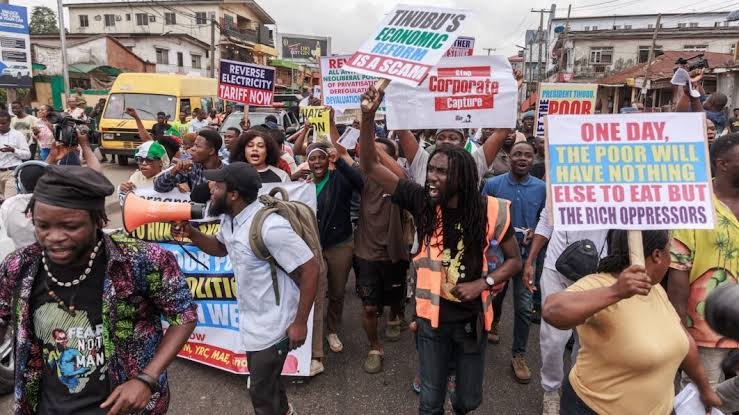
The young know this better than anybody. Nigeria has a youthful electorate, and in 2023 the young were the engine of the one genuine insurgency the Fourth Republic has seen. They are also the people who stayed away in the largest numbers when it counted. A turnout of 26.71 per cent, down eight points from 2019, means that nearly three in four registered Nigerians looked at the choices on the ballot and decided that the ballot had nothing to say to them. For the young in particular, neither Tinubu nor Atiku belongs to the conversation.
One governed through the sharpest cost-of-living crisis of their adult lives. The other has been in national politics since before most of them were born. When one man is seventy-four by the register and the other turns eighty on 25 November, the young do not hear a debate about the future. They hear two men who were grown when their parents were children, asking for the keys to a country the young will have to live in for another fifty years.
It would be a grave misreading to say that the young have lost interest in their country. They have lost interest in the people who ask for their votes. That is a different diagnosis, and a more dangerous one, because it points to a withdrawal of consent rather than a lapse of attention. A candidate who can restore that consent is the one thing the opposition still has in its power to offer, and its answer to date has been to offer them three tickets and a court case.
I know the objection of Atiku’s supporters, because I have heard it in a dozen forms: that he is the man with the northern vote, that without him the opposition has no base in the one region that decides presidential elections, and that the sensible thing is therefore for the others to yield to him. In April he put the point himself, asking who, among the current leaders of the North, had more votes than he had, and describing Kwankwaso’s popularity as restricted to Kano State.
The claim deserves a serious answer, and the answer is in his own record. In 2019, running with Peter Obi, Atiku polled about 11.3 million votes. In 2023, running with Ifeanyi Okowa, he polled 6,984,520. His vote fell by more than four million in four years, and turnout fell by eight points. Some of those votes went to the abstention that follows disappointment. Many went to the competitor who drew the young and southern parts of the coalition that had stood with him in 2019: his own former running mate.
The northern vote is not a possession. It is a territory with three candidates, in which Kwankwaso, who carried Kano in 2023, is now on the ticket with Obi, in which Makinde, one of the five governors who withheld their support from Atiku in 2023, has entered the race under his own banner, and in which the incumbent, if the Oxford-Metro poll is to be believed at all, is gaining ground in the very states that voted for Atiku last time. A candidate with a strong base in a region does not need to count his voters in speeches. He needs them to turn out.
I am not saying Atiku has no support. A man who has been vice-president of the republic, who has carried the flag of a major party twice, who has built and funded a political network over three decades, retains something. The Premium Times, asking this month whether there is an Atiku factor in the election, began its answer by crediting his political weight. I agree with that. A man may be heavy and still not be able to rise. The weight is real. It is a weight, not a lift.
What would it mean for Nigeria if the incumbent were returned by default? The question is not about a man or a party. It is about what the country would learn from the experience.
It would learn that a president can win a second term with the support of little more than a third of those who vote and a tenth of those who might. In 2023, the 8,794,726 votes that elected Tinubu were 10.08 per cent of all eligible voters, a figure so low that no honest democrat can regard it as a mandate. A second default victory, on the same or a lower share, would not repair that figure. It would entrench it. The lesson young Nigerians would carry out of the election would be that votes do not matter, that blocs do, and that the persons who hold the blocs are the persons who decide.
It would learn, secondly, what the opposition itself has been warning against. In November 2023, speaking to the Inter-Party Advisory Council, Atiku said, “our democracy is fast becoming a one-party system.” He was right then, and a re-elected incumbent facing a divided opposition with the governors, the machinery and the purse behind him would move the country a great step closer to it. It is a bitter irony that the man who named the danger should become, by his persistence, the instrument of its arrival. Emeka Alex Duru, whose commentary on that warning first set me writing, saw an irony of an older kind in it: the tactics Atiku condemned were practised by the PDP in its heyday under Obasanjo, with Atiku among the principals of that government. The irony has only deepened.
And it would learn, thirdly, a lesson about age and leadership that has nothing to do with Atiku in particular. Olu Fasan observed in the Vanguard that, ideally, gerontocracy should have no place in a democracy, and that in the end health matters more than age. Both points are right. But there is a third that he did not need to make: that in a healthy democracy, the elder who has run and lost across three decades does not insist on being the last word. He speaks last, to the young, and he says what the best elders in history have always said: take it, it is yours. A culture that rewards the man who will not say it is a culture that has stopped believing in succession, and a country that has stopped believing in succession is a country condemned to fight the same battle in every generation.
Chinua Achebe’s judgment, in The Trouble with Nigeria, has not aged: “The trouble with Nigeria is simply and squarely a failure of leadership.” The sentence is usually quoted against the people in office. It applies with equal force to the people who wish to replace them. Leadership is not only the courage to take power. It is the discipline to know, when the numbers have been counted and the hour has struck, when your own part in the story is to hand it over to another. The tiny minority of persons in the political corridors, the men who move from party to party as the weather changes and who divide the spoils of the republic among themselves, have always understood their own interest. They have been less quick to understand the country’s. The arithmetic of 2023 told them what the country wanted, and they have spent three years finding reasons not to hear it.
Atiku has, once, behaved differently, and the country should remember it.
In 2013 the major opposition parties of Nigeria did the thing that every student of democracy says opposition parties must do and that few of them ever manage: they merged. The All Progressives Congress that came out of that merger was a coalition of rivals, and nobody in it had a reason to love anybody else. Atiku joined it in February 2014, was telling journalists by September that it was his last bus stop, and in December he stood in the Teslim Balogun Stadium in Surulere and lost its presidential primary.
He came third, behind Muhammadu Buhari and Rabiu Kwankwaso. He was reported to have spent heavily. He did not walk out. He stayed in the party and the party went on to do what no Nigerian opposition had ever done: it defeated a sitting president at the polls. Goodluck Jonathan’s concession, in March 2015, remains one of the more remarkable acts of any Nigerian head of state, and it was made possible by the simple fact that the men who wished to replace him had agreed, however grudgingly, on one candidate.
That is the Atiku I wish the country would meet again. It is not a better man than the one who now speaks of the last outing. It is the same man, in a different mood, at the other end of a different calculation. He lost, and he lived with the loss, and the country was changed. It was in the nearly four years that followed that the mood turned. On 24 November 2017 he quit the party that he had helped found, and days later he announced his return to the PDP. The bus, it seems, had not been the last one after all.
A bus stop is where a man waits for the next vehicle. Atiku has treated more than one party that way.
It is worth asking what the opposition has actually tried in these last weeks, because the record is not as empty as the headlines suggest, and some of what has been tried is honourable.
On 31 August, the G-100 coalition of political groups, working with the Minority Caucus of the House of Representatives, convened the first summit of opposition leaders at the Yar’Adua Centre in Abuja. In September the three principal candidates, Atiku, Obi and Makinde, rejected the pressure to step down, and the coalition persisted. It has now announced a second summit for Monday, 23 November, at which the participating parties are to adopt and sign three documents: a National Covenant for Democratic Renewal, a Framework for Opposition Unity and a National Reform Programme.
Its organisers say the arrangement will rest on written commitments rather than personal agreements, which is a recognition of the history of this country’s handshakes. Donald Duke, the Peoples Redemption Party’s candidate, said on 10 November that he would accept a democratically agreed opposition choice, provided that it follows agreement on a national programme.
Makinde, for his part, has confirmed consultations with Atiku and Obi, and has proposed that the three compare their manifestos, their past performance and public sentiment. Atiku’s campaign has told the Premium Times that he remains open to cooperation among the opposition parties and has not confirmed reports that he rejected a proposal for them to rally behind a single candidate. No common ticket or programme had been announced by the end of the week.
I read these developments with hope and with trepidation. Hope, because the principle of a single opposition choice has been accepted in speech by every major candidate. Trepidation, because a deal between Atiku and Makinde that excludes Obi would not unite the opposition; it would rearrange it. Makinde was one of the five governors who withheld their support from Atiku in 2023, and the two men’s talks, however warm, would leave the third candidate outside the room. The country does not need a new two-way split to replace the three-way one. It needs a single name, chosen by a method that the people can see.
On that, Makinde has supplied the standard himself, without perhaps realising how much it asks. Let the candidates be measured by their manifestos, their past performance and public sentiment. Take the three in turn. On manifestos, a National Reform Programme is to be signed on 23 November, and a programme to which all subscribe cannot decide between those who subscribe to it. On past performance, the only comprehensive evidence is the vote of February 2023 and the trend of the three years since: one man’s vote fell by more than four million between 2019 and 2023; another, who had been the junior partner on the 2019 ticket, took 6.1 million votes in 2023 and carried the commercial capital of the country.
On public sentiment, the polls contradict one another, which is itself an argument for agreeing in advance on one instrument, run by pollsters whom every camp has approved, and binding on everyone who signs. A candidate who will not submit to a measurement that he helped to design is a candidate who has already told the country what he fears the measurement will say.
Babachir Lawal, who served in the Buhari government as Secretary to the Government of the Federation and who says he attended every ADC meeting, has argued more than once that supporting Atiku would hand Bola Tinubu an easy path to a second term. A man who has seen both sides of the aisle may be forgiven for knowing what he is looking at. And yet it should not need a former official of the ruling party’s own governments to tell the opposition what it can read for itself in the numbers.
What has been tried so far, by the people who have tried to move Atiku, shows how not to do it. On 10 September, receiving members of the Fulani Farmers Association at his Abuja residence, Rabiu Kwankwaso asked Atiku to withdraw, cited his age and health, urged him to turn his attention to his traditional role, said an apology should be offered to him, and added a sentence that reads, from the other side, like a pat on the head: “If Allah grants us success, we will take good care of him.”
There is no cruelty in it. There is only the ordinary condescension of a younger man to an older one, and the failure of imagination that goes with it. A man of nearly eighty who has been vice-president of the republic and has sought its highest office for thirty-three years does not wish to be taken care of. He has spent his life taking care of others. To offer him a place in the sunshine while he is still, in his own mind, a candidate, is to tell him that his life’s argument has been lost and that he is now to be indulged. No man in his right mind says yes to an offer put that way.
A man of eighty does not wish to be taken care of. He wishes to be remembered.
The offer, if it is to work, has to be of a different kind. It must tell him that the argument he has made for thirty years is not lost but has been won, in the only sense in which a politician’s argument can be won: by being adopted by those who follow. Atiku has said that he was the one who started the coalition. In an interview with the BBC in Hausa, published on 28 August, he put it in these words: “I, Atiku Abubakar, started it.”
It is true that he did, in large part. A man who starts a coalition for a purpose does not finish it by defeating the purpose. He finishes it by delivering it. And what he must be offered is a part in the delivery that is visible, honourable and his own: not a seat at the back of the Obi campaign, but the role that history, in the countries that have done this well, has reserved for the elder who yields at the right hour. The founder, the kingmaker, the man whose sentence changed the outcome.
There is a second instrument, and it goes to the heart of the quarrel. The reports of why Obi left the ADC speak of rotation: the question of whether the presidency should be zoned to the South, which Atiku’s camp refused. If the objection of the northern wing of the opposition is that power should return to the North, then the answer to it can be written down, in the covenant itself, as a commitment that fixes the order of succession after the first term.
A document that settles rotation, a transparent method for choosing the candidate, a role for the elder at the centre of the alliance and a northern running mate in the person of Kwankwaso: these are the elements of an arrangement that a proud man can accept without being humiliated. They ask of the opposition little that it has not already said in speeches. They would cost the incumbent his second term.
In 2023 Senegal was a country that had run short of patience. Its most popular opposition figure, a former tax inspector named Ousmane Sonko, had been convicted of defaming a minister and was barred from the presidential ballot. His party, Pastef, was dissolved. He was in prison. To the opposition, the government of Macky Sall seemed to have used the oldest manoeuvre available to an incumbent: the removal of the best candidate. Sonko’s response is one of the finest acts in the recent politics of the continent.
From the position of a man who could do nothing for himself, he did something for the movement. He chose his friend and fellow founder of Pastef, a man of forty-four named Bassirou Diomaye Faye, little known beyond his party, who was himself in prison on a charge of defamation, and he told the country to vote for him. The slogan was three words long: Diomaye mooy Sonko, Diomaye is Sonko.
On 24 March 2024, in the first round of voting, Faye won 54.28 per cent of the vote against 35.79 per cent for Amadou Ba, the candidate of the government coalition, whose concession was immediate. It was the first time since independence in 1960 that an opposition candidate had won in the first round. He had been freed from prison only ten days before the election. What had been given him was not an organisation, a war chest or a famous name. It was a transfer: the endorsement, in the clearest possible form, of the most popular man in the country, to a man most Senegalese had hardly heard of.
Sonko had no choice. The law made it for him. That is the difference between Dakar and Abuja, and it is why this story is not an excuse but a rebuke. In Senegal a man was forced to hand his movement to another and it saved his country. In Nigeria the choice is free. Nobody has barred Atiku Abubakar from anything. He may yield tomorrow by his own act, as an act of judgment, and keep the credit.
In Dakar the law forced a man to hand over his movement. In Abuja the choice is free, and a free choice is the harder test.
There is an old Roman story that I do not tell for its antiquity but for its truth. In 458 before Christ, with an army trapped in a mountain pass by its enemies and the Republic at risk, the Senate sent messengers to a farm across the Tiber to find Lucius Quinctius Cincinnatus, who was ploughing. They hailed him, and asked him to put on his toga to hear the Senate’s command. He was appointed dictator, the absolute magistrate of the Republic, and in sixteen days he had raised an army, rescued the trapped legions and routed the invaders. Then he resigned the office and went back to the plough.
The Romans, who were not a sentimental people, kept the story for centuries, and the reason was not the victory. It was the resignation. They saw in it the one quality that republics need more than any other and cannot manufacture, which is the capacity of the powerful to lay down power when the work is done. A republic can survive a bad law, a corrupt senator, even a lost war. It cannot survive a generation of leaders who regard the surrender of authority as a defeat.
I do not suggest that Atiku is a Cincinnatus. The comparison would flatter any politician beyond the evidence. I suggest only that the tradition on which the story rests, of the man who can be great by what he lays down, is open to him, here, within weeks.
In my essay of February 2025 I urged him to groom and support younger leaders who could challenge the status quo; an open endorsement of Obi would be that counsel carried out in a single act. The presidency is now beyond his reach. By his own account this is his last outing; by the arithmetic of the past three elections, it will be his last in any event. But he can become what no Nigerian politician of his generation has yet been: the man whose decision, at the end of a long career, handed the country back to its people.
A man who is dismissed by a judge has lost an election he never fought. A man who yields has won a place in history that no election could give him.
The question, then, is the one on which this entire argument turns: what could be done to bring Atiku to back Peter Obi?
The honest answer begins with a refusal to pretend that anyone can compel him. No law can make him stand down. No court, not even the Court of Appeal, can be relied on to make the choice for him in a way that will serve the country, and a judgment that removes him, if it comes, will remove with him the one thing the opposition can least afford to lose, which is the sense of having chosen. The ballot, finally, will persuade him, as it persuaded him in 2019 and in 2023. But the ballot arrives on 16 January, and the lesson of Kenya in 1992 is that a lesson delivered by the ballot comes too late to use.
What can be done is a matter of voices. It is for the elders named to lead his campaign council, among them Nasir El-Rufai, to sit with him and say what only elders can say. It is for Rotimi Amaechi, who is his running mate and who has himself said that age is a factor to be weighed, to say it to his face. It is for the northern elders and professionals whose counsel he respects to tell him that it is no weakness to be the last bridge. It is for Dele Momodu, who argued only months ago that a joint Atiku–Obi ticket would give the opposition a strong electoral advantage, to repeat the argument in the other direction.
It is for the voters who have kept faith with him over thirty years to ask him, publicly and in writing, whether they are to be the cause of a second Tinubu term. And it is for Peter Obi himself to extend the hand, not as a victor receiving a surrender, but as a younger colleague asking an elder to be the one who made it possible. The hand should be extended in public, before the summit, so that the summit may ratify what has already been decided in the open.
None of these things will happen unless the people who care about the country say, clearly, that they expect them. The election is sixty-one days away. The summit is on Monday. Atiku turns eighty on 25 November, two days after it. A birthday of that kind is an occasion on which a man is asked what he wants to be remembered for, and on which he is offered, by those who love him and those who must live with the consequences of his choice, a gift. The gift that this country asks of him is the cheapest one a man of his age can give and the most expensive that he can withhold.
On 14 October 2002, at Uhuru Park in Nairobi, before one of the largest crowds that Kenya had seen since independence, Raila Odinga rose to speak. He was a man with presidential ambitions of his own. In 1997 he had run for the highest office and finished third. In 2002 the opposition parties had been talking for months, and had not yet agreed on who should carry the banner against Daniel arap Moi’s chosen heir, Uhuru Kenyatta.
The leaders were stuck, and so was the country. Odinga, who had walked out of the ruling party to join them, chose that moment to ask the crowd a question. Was Kibaki not enough? Kibaki tosha, Kibaki is the one, and the crowd roared its answer, and everybody in Kenya knew by the end of the afternoon that the opposition had a candidate.
He had put aside his own ambition and given the country what it needed. Mwai Kibaki won the presidency that December with about 61 per cent of the vote, against roughly 30 per cent for the government’s candidate. Daniel arap Moi, who had ruled for twenty-four years on the strength of a divided opposition, left office, and the heckling at his successor’s swearing-in was the sound of a country that had waited a long time.
Kibaki tosha took two words. They were spoken by a man who had everything to lose by speaking them, and they are the reason that he is remembered in Kenya as the kingmaker who made the transition possible, and not as the third man in a race that Moi won.
Your Excellency, I have written of you in the third person for most of these pages, because argument needs distance. I will end in the second, because a request does not. I ask nothing for myself, and I make what follows without apology. A citizen who loves his country is entitled to ask an old man for a favour that will cost him a flag and give the country four years.
You will be eighty on Wednesday, 25 November. Every eightieth birthday is a bargain with time: the world gives the old man the floor, and asks only that he say something worth the silence that follows. Nigeria has heard your speeches. It has not yet heard the one that this birthday was made for.
Let me name the jinx, because the word has been used carelessly. In Nigeria’s republic an incumbent has lost an election once. It happened in 2015, and Al Jazeera recorded it as the first time that an opposition party had democratically taken the country from the ruling party. It happened because two things occurred that had never occurred before: an opposition merged, and the loser conceded by telephone before the count was done.
You were in the room when the first of those things was built. You can now supply the second, and in advance. Nigeria has watched men concede after the count. I know of no candidate who has conceded before the vote. Do it on 25 November, and you break the jinx twice: once for the opposition, which will have united at last, and once for the republic, which will have seen a man lose gracefully before he is asked to.
A concession after the count is a courtesy. A concession before the vote is a gift.
I make five requests, and none of them is vague.
First, where. Do not do it in a hotel in Abuja, with the cameras that follow you from room to room. Do it in Jada, where you were born eighty years ago, among people who knew you before you were Atiku Abubakar. A man who has spent his life in the capital of other people’s attention should give his most important sentence in the one place where he is only a son of the village. Let the summit on Monday hear Peter Obi, and let Jada hear you.
Second, what. Say the sentence, and say it in your own words, though I will offer mine so that nobody can say that the request was empty: “I sought this office for thirty-three years. Today, at eighty, I give what I sought to the country, and I ask every Nigerian who would have voted for me to vote for Peter Obi.” The law has seen to it that your name will remain on the ballot. Let it remain there as a monument to a man who asked his people to look past it.
Third, why. In 2006 you stood against a president whose third-term project would have kept him in office, and the country is still in your debt for it, because the republic you defended is the republic that now lets you speak. The country asks you to be the opposite of the man you opposed. You were right about his third term. Be right about your own.
In 2006 you stood against a man who would not leave. In 2026 the country asks you to be his opposite.
Fourth, on what terms, and here I ask you to be bolder than your advisers will allow. Do not ask for an office. The offers will come: an ambassadorship, the chair of a commission, a seat on the Council of State for life. A man who yields and is paid looks like a man who sold, and the whole value of your sentence lies in its being free. Ask for one thing only, and let it be a law.
The argument of your political life is the restructuring of the federation. You have made it from platforms and in print for thirty years, and held to it long after it ceased to be fashionable. Ask that it be written into the covenant, as a bill to go before the National Assembly within a hundred days of the swearing-in on 29 May 2027, with a date attached. A man who is remembered for a tenure is remembered for as long as the tenure lasts. A man who is remembered for a law is remembered for as long as the law does.
Fifth, and this is the request that no one has made of you: release your people. I have said that you are not one man, that thirty years have attached to you aides, delegates, financiers and dependants whose careers are tied to yours. They will hear your sentence as the end of their season. Tell them, in the same speech, that they are free and that they are not abandoned, and ask Peter Obi to receive them as colleagues in the open, with their pride intact and their roles named. That is the one gift a patron never gives his followers. It is permission to stop waiting for him.
A patron cannot resign. He can only release.
I make one more request, and it is not to you alone.
Between now and your birthday, let eighty Nigerians write to him. One for each year. Let them not be politicians. Let a market woman in Onitsha write, and a youth corps member in Kano, a teacher in an Almajiri school, a retired customs officer from the service in which he began, a farmer driven from his land in Benue, a trader in Lagos, a student in Yola, a pensioner who remembers 1993. Let each write a few lines, in their own words and no more than a page, to one man who is about to be eighty and who has the power to give them what no ballot can. He cannot read them without hearing the country. This essay is letter number one.
And Peter Obi must do his part, in public and not in a corridor. Not as a victor receiving a surrender, but as a younger colleague asking an elder for a gift that only he can give. He should go to him, he should go early, and he should not bring the manner of a man who is certain that he will be asked.
When you are an ancestor, Your Excellency, and the children of Adamawa recite what you did, what do you want them to say? That you sought the office six times and lost? Or that on the eve of your eightieth birthday, with the arithmetic in front of you, you did what no one had asked of a Nigerian candidate before, and gave the country a chance that it had waited a lifetime to be given?
Nigeria has sixty-one days. It has a summit on Monday, a birthday on 25 November and a ballot on 16 January. It has the arithmetic of 2023, the lesson of Kenya in 1992 and the example of Kenya in 2002. It has an elder of eighty who has told it that this is his last outing, and a younger man of sixty-five who has told it that a new Nigeria is possible. It has a country tired of being promised. The one thing it lacks is a sentence, and only one man can say it.
aiko.writes2424@gmail.com
Agbeze Ireke Kalu Onuma, AI-KO, is an essayist and historian, trained in Russia, who writes on Nigerian politics, civil society and Igbo affairs. He is the author of Ohaneze at 50: The Burden of Memory, The Politics of Relevance, A Critical Biographical Reflection of an Igbo Institution (Green & Cherished Ltd), and he writes mostly from Abiriba.